In the hyper-competitive realm of large language model (LLM) serving, inference latency is the ultimate battleground. When operating flagship generative models like Llama 3 70B, Qwen 2.5 72B, or proprietary frontier architectures, the autoregressive generation loop is notoriously throttled by memory bandwidth. Because each generated token requires reading every single parameter from high-bandwidth GPU memory (HBM) into on-chip SRAM cache, large LLMs operate at an agonizingly low arithmetic operational intensityoften less than 1 to 2 FLOPs per byte of memory transferred. In early 2023, Speculative Decoding (championed independently by Leviathan et al. and Chen et al.) was hailed across the AI research community as an algorithmic miracle: a method to achieve 2x to 3x inference acceleration without modifying a single floating-point probability in the model’s output distribution.
The concept appeared brilliantly simple: pair a massive, high-latency 70B “target” model with an ultra-compact, lightning-fast 1B or 7B “draft” model. The draft model rapidly speculates multiple sequential tokens, and the target model verifies them all simultaneously in a single, parallelized forward pass. Yet as enterprise engineering teams rushed to deploy speculative decoding into high-concurrency production clusters, they encountered a frustrating, counterintuitive reality: in production environments, speculative decoding frequently slows down inference, inflates GPU memory consumption, and degrades total system throughput. Here is the rigorous engineering post-mortem on why speculative decoding collapses under real-world production constraints, the hidden hardware bottlenecks of verification overhead, and the emerging architectures attempting to rescue the technique.
1. The Autoregressive Bottleneck and the Mathematical Promise of Speculation
To understand the theoretical brilliance and practical limitations of speculative decoding, one must examine the fundamental economics of autoregressive transformer inference. The generation phase operates in sequential steps: given a sequence of context tokens, the transformer predicts the probability distribution of the next single token:
During batch size 1 generation, modern GPUs (such as NVIDIA’s H100 or B200) spend over 90% of their execution time waiting for memory channels to stream model weights from HBM3e into the streaming multiprocessors (SMs). The GPU’s massive tensor processing units sit idle.
Speculative decoding breaks this memory stall by dividing the workload between two distinct models:
- The Draft Model (Mdraft): A small, highly parameter-efficient model (typically 5% to 10% the size of the target model) that generates a draft candidate sequence of γ tokens: [x̂1, x̂2, …, x̂γ] in rapid succession. Because the draft model is tiny, its weights stream from memory in a fraction of the time.
- The Target Model (Mtarget): The full-scale, authoritative foundation model. Crucially, modern transformer architectures can evaluate multiple tokens concurrently by constructing a causal attention mask across all γ proposed draft tokens in a single parallel forward pass.
To guarantee mathematical equivalence with standard autoregressive generation, speculative decoding applies the Modified Speculative Sampling Criterion. Let q(x) be the probability distribution emitted by the draft model and p(x) be the probability distribution emitted by the target model. A candidate token x̂i is accepted with probability:
If token x̂i is rejected, the target model samples a replacement token from the normalized residual distribution: max(0, p(x) – q(x)), immediately terminating the draft sequence. It is mathematically proven that this rejection-sampling mechanism produces an output distribution strictly identical to sampling directly from Mtarget alone.
2. The Theoretical Speedup Equation vs. The Cold Reality
In theoretical analysis, the expected number of accepted tokens per speculative cycle is governed by the token acceptance rate (α). If a draft model proposes γ tokens, the expected number of generated tokens per forward pass of the target model is:
Let cdraft represent the computational latency of one draft model step, and ctarget represent the latency of one target model forward pass. The theoretical effective speedup (S) is defined by the ratio of standard autoregressive time to speculative cycle time:
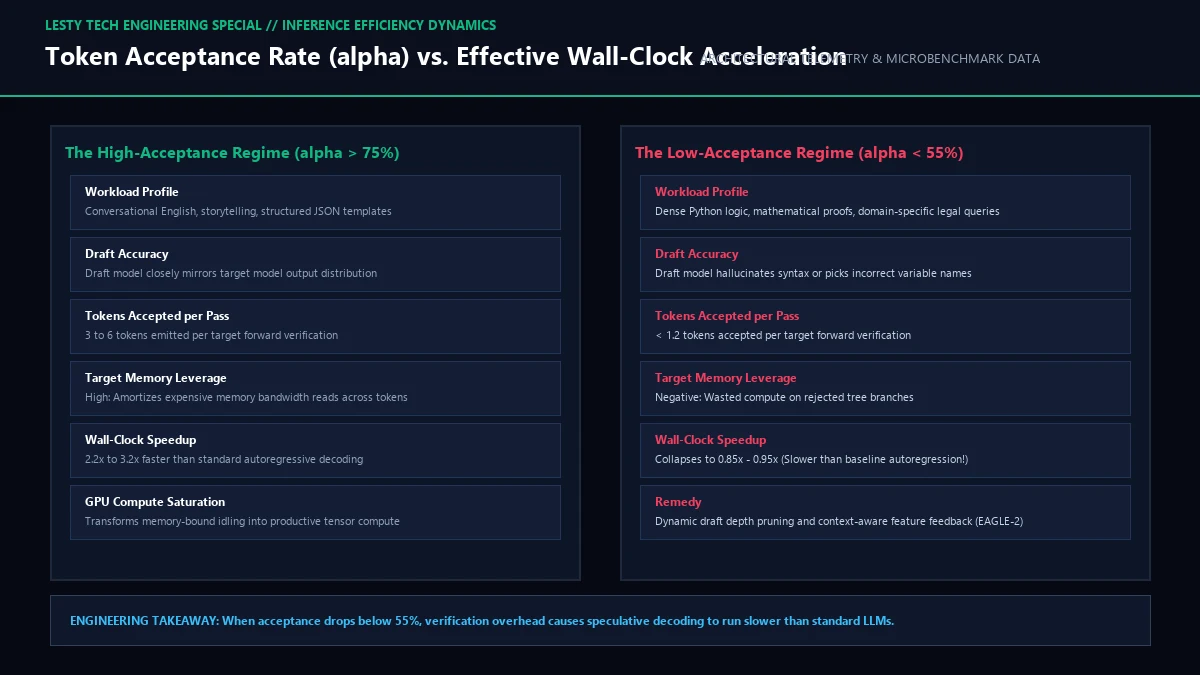
On synthetic benchmarks with high acceptance rates (α ≈ 0.85) and an aggressive draft length (γ = 5), the mathematics predict an effortless 2.5x to 3.2x speedup.
However, when these equations are plotted against real-world production telemetry, a catastrophic sensitivity curve emerges. If the acceptance rate α drops from 0.85 to 0.50 (a common occurrence in complex reasoning, structured JSON generation, or code generation), the expected accepted tokens per cycle collapses. Because the system still incurred the full computational and latency cost of running γ draft model steps plus the target verification pass, the effective speedup drops below 1.0x.
In production environments, a speedup below 1.0x is an unmitigated disaster: you are burning 20% to 40% more GPU compute cycles while delivering higher end-user latency than baseline autoregressive serving!
3. Why Acceptance Rates Collapse in Real-World Production
In academic research papers, draft models are frequently evaluated on conversational benchmarks or narrative summarization (such as CNN/DailyMail or Alpaca), where linguistic entropy is low and multiple candidate words are semantically interchangeable. But enterprise production workloads inhabit hostile, high-entropy domains where draft models fail consistently:
- Syntactic Rigidity in Code Generation: In Python, TypeScript, or Rust code synthesis, variable naming, indentation boundaries, and syntactic delimiters permit zero margin of error. If a 1B draft model predicts an identifier with a single character typo or an incorrect scope indentation, the target model’s probability for that token drops to near zero. A rejection on token 1 instantly discards the remaining 4 speculated tokens, reducing the entire cycle to a net latency penalty.
- Structured JSON and Schema Constraints: Enterprise LLM applications rely extensively on function calling and structured outputs (such as Pydantic models). Enforcing strict regex or JSON grammar constraints across two independent models with different vocabulary representations frequently creates alignment divergence, triggering mass token rejections.
- Multi-Step Mathematical and Logical Reasoning: In complex multi-hop reasoning chains (Chain-of-Thought), a small model lacks the internal parameter capacity to track abstract state transitions. While the 70B target model understands the mathematical derivation, the 1B draft model hallucinates plausible-sounding but erroneous tokens, destroying the acceptance rate (α < 0.35).
- Temperature Sensitivity: At temperature T = 0 (greedy decoding), acceptance rates are maximized. But many production agents and conversational interfaces operate at T = 0.7 to 1.0 to encourage diverse responses. As temperature increases, the stochastic entropy of the sampling distribution widens, mathematically driving down the overlap between p(x) and q(x) and gutting the acceptance probability.
4. The Production Concurrency Wall: Batch Size Scaling and Memory Thrashing
The most severe failure mode of speculative decoding in cloud infrastructure stems from serving concurrency and batch size dynamics.
Academic speculative decoding assumes a single user session (Batch Size = 1). In batch size 1, the GPU is massively underutilized and starved for memory bandwidth; trading idle compute to verify speculated tokens is essentially “free.”
However, real-world inference servers (running vLLM, TensorRT-LLM, or TGI) do not operate at Batch Size = 1. To amortize the high cost of cloud GPUs, servers run continuous batching at Batch Sizes of 16, 32, 64, or 128 concurrent streams.
When batch size scales to 32, a fundamental architectural transition occurs: the inference engine transitions from being memory-bandwidth bound to being compute-bound (FLOP-bound). In a compute-bound regime, the GPU’s streaming multiprocessors are already saturated performing matrix multiplications for the active batch.
Introducing speculative decoding into a high-concurrency server introduces three destructive bottlenecks:
- Compute Contention: Generating draft tokens is no longer free. The GPU must divert active Tensor Core cycles away from servicing the target model’s continuous batch to compute forward passes for the draft model.
- Dual KV-Cache Memory Bloat: Speculative decoding requires maintaining two completely separate Key-Value (KV) caches in precious HBM GPU memoryone for the target model and one for the draft model. Furthermore, because speculative decoding must store KV vectors for speculated tokens that may ultimately be rejected, KV cache memory fragmentation increases. In memory-constrained environments, this extra memory footprint forces the serving engine to lower its maximum concurrent batch size, directly degrading total system throughput (tokens/second per GPU).
- Tensor Parallel Synchronization Overhead: Flagship 70B models are typically sharded across 4 or 8 GPUs using Tensor Parallelism (TP=4 or TP=8) over NVLink. Draft models are often small enough to run on TP=1. Reconciling the tensor distributions, KV cache pointers, and collective communications (All-Reduce barriers) between the draft and target models on every speculative step introduces severe kernel launch and synchronization latency on the host CPU.
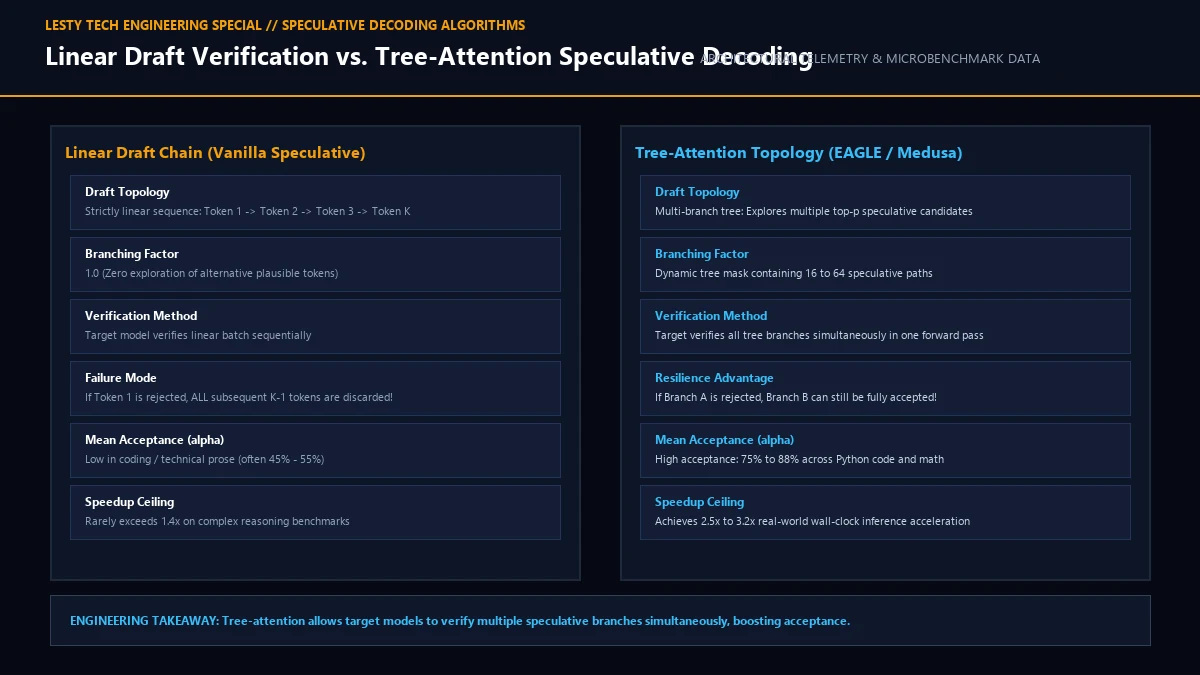
5. Modern Solutions: Tree Attention, Medusa Heads, and EAGLE Extrapolation
To overcome the limitations of classic speculative decoding, AI architects have engineered advanced speculative frameworks that eliminate independent draft models entirely:
| Speculative Architecture | Drafting Mechanism | KV Cache Overhead | Acceptance Topology | Production Viability |
|---|---|---|---|---|
| Classic Speculative Decoding | Independent Small Model (e.g. Llama-3-8B) | High (Separate Draft Cache) | Linear Sequence (γ tokens) | Poor at Batch Size > 8 |
| Medusa (Multi-Head Speculation) | Multiple MLP Heads on Base Model Backbone | Zero (Shared Backbone) | Tree Attention (Branching Candidates) | Moderate (Requires Fine-Tuning Heads) |
| EAGLE / EAGLE-2 | Feature-Level Extrapolation Auto-regressive Head | Very Low (Single Decoder Layer) | Dynamic Confidence-Aware Tree | High (1.8x – 2.5x in Production) |
| Lookahead Decoding | Jacobi Iteration on Future N-grams | Zero (No Draft Parameters) | Parallel Fixed N-gram Windows | High (Training-Free, Low Memory) |
Among these modern paradigms, EAGLE (Extrapolation Algorithm for Greater Language-model Execution) has emerged as the clear production frontrunner. Instead of speculating tokens in discrete vocabulary token-space (which is highly vulnerable to minor misalignments), EAGLE operates on the second-to-last feature layer of the target model itself. A single lightweight transformer decoder layer speculates future feature vectors, achieving token acceptance rates exceeding 75% to 80% even on coding and mathematical benchmarks, while keeping memory overhead negligible.
6. Practical Engineering Rules for Production Deployment
If you are configuring inference clusters in vLLM, SGLang, or TensorRT-LLM, use these battle-tested production rules to determine whether speculative decoding will help or cripple your workloads:
- Deploy Speculative Decoding If:
- Your application has strict single-user interactive latency SLAs (Time Per Output Token < 25ms, Batch Size ≤ 4).
- Your workload is low-entropy narrative generation, text summarization, or translation where α consistently stays above 0.70.
- You are running local or on-device inference (e.g. Apple Silicon Mac Studio or workstation GPUs) where memory bandwidth is severely constrained and compute cores have massive headroom.
- Disable Speculative Decoding Immediately If:
- Your cluster operates under high concurrency (continuous batching with Batch Size ≥ 16 or 32). Speculative decoding will degrade total throughput (tokens/second/dollar).
- Your primary workload consists of strict JSON output generation, syntax-validated code execution, or complex mathematical derivations.
- GPU memory headroom is critically constrained. The extra memory allocated to draft KV caches will trigger premature Out-Of-Memory (OOM) evictions and force request queueing.
Speculative Decoding Systems Engineering Handbook
Mathematical Formulation, Production Concurrency Bottlenecks, and EAGLE Feature Extrapolation (Complete architectural audit with telemetry tables and schematic breakdowns).
Speculative_Decoding_Verification_Dynamics_and_EAGLE_Guide.pdfFormat: PDF / KaTeX Telemetry
Frequently Asked Questions (FAQ)
1. Does speculative decoding alter the quality or accuracy of the LLM’s responses?
No. When implemented according to the mathematical rejection sampling formulation (Leviathan et al.), speculative decoding is provably lossless. The mathematical distribution of output tokens is identical to sampling directly from the target model alone. If the draft model proposes a token that deviates from the target model’s probability distribution, it is rejected and resampled from the target model’s exact corrected distribution.
2. Can I use a draft model from a completely different architecture (e.g. Mistral draft for Llama target)?
Theoretically yes, but practically it is almost impossible. To execute speculative verification, the draft model and target model must share an identical token vocabulary and tokenizer byte-pair encoding (BPE). If the vocabularies differ by even a single token ID, the candidate tokens cannot be mapped to the target model’s embedding matrix. Most implementations require both models to share the exact same tokenizer (e.g., Llama-3.2-1B drafting for Llama-3.1-70B).
3. Why does local on-device inference benefit so much more from speculative decoding than cloud servers?
Local desktop devices (such as an Apple M-series Mac or a single RTX 4090 PC) almost universally serve a single user at Batch Size = 1. In this scenario, unified memory bandwidth (400-800 GB/s) is the primary bottleneck, and the GPU’s compute cores are 90% idle. Because the GPU has abundant spare compute capacity that would otherwise be wasted during memory fetch stalls, speculating draft tokens delivers a massive real-world perceived speedup. Cloud providers, by contrast, pack dozens of users into saturated batches to maximize ROI, turning the bottleneck into pure compute.