
If you have followed the announcements from the Open Compute Project (OCP) and the launch of Nvidia’s Blackwell B200 and AMD’s CDNA4 accelerators, you have witnessed the machine learning industry rally around an audacious mathematical crusade: Microscaling Formats (MX). With state-of-the-art foundation models swelling past 400 billion parameters, serving generative AI has become an unsustainable financial sinkhole of High Bandwidth Memory (HBM3e) and multi-megawatt data centers.
The industry’s silver bullet is MXFP4: quantizing neural network weights and activations down to just four bits per number. Nvidia and AMD promise that MXFP4 doubles mathematical tensor throughput, slashes VRAM requirements by up to 75% compared to FP16, and allows massive 70-billion-parameter models to run on modest enterprise servers without losing a drop of intelligence.
Yet behind the glowing corporate keynote demonstrations lies a brutal mathematical reality that machine learning researchers are racing to solve: a 4-bit floating-point number can only represent fifteen distinct values. When large language models encounter “activation outliers”—massive hidden vectors that naturally emerge during complex multi-step reasoning—the block-scaling mechanics of MXFP4 can trigger a catastrophic underflow cliff, causing all surrounding numbers to round straight to digital zero and turning sophisticated AI reasoning into gibberish.
The Memory Wall: Why 16-Bit Numbers Are Bankrupting AI
To understand why the entire industry is gambling on 4-bit numbers, you have to look at the arithmetic physics of Large Language Model inference.
When an LLM generates a token, its speed is not limited by how fast tensor cores can do arithmetic; it is strictly limited by memory bandwidth. In 16-bit brain floating point (BF16), a 70-billion-parameter model consumes 140 gigabytes of VRAM just to hold its model weights. To generate a single word, the GPU must stream all 140GB from memory chips across the silicon bus into the compute cores.
At 8-bit precision (FP8), that weight payload drops to 70GB, doubling inference throughput. But if you can squeeze weights and activations into 4-bit floating point (FP4), the model shrinks to just 35 gigabytes—fitting comfortably onto a single desktop-class graphics card!
The 4-Bit Dilemma: How Do You Represent the Universe in 15 Numbers?
How does a computer represent a floating-point number in four tiny bits? The standard IEEE-style FP4 format is designated as E2M1:
- 1 Sign Bit (S): Determines positive or negative ($+/-$).
- 2 Exponent Bits (E): Determines the order of magnitude ($2^{-1}, 2^0, 2^1$).
- 1 Mantissa Bit (M): Determines precision.
Because there are only four bits, $2^4 = 16$ possible bit combinations exist. Reserving one combination for zero leaves exactly 15 representable non-zero numbers: $\pm 0.0625, \pm 1.0, \pm 1.5, \pm 2.0, \pm 3.0, \pm 4.0, \pm 6.0$.
Think about that: you are trying to capture the subtle nuances of human language, medical diagnoses, and complex Python algorithms using a number line that only has seven positive numbers! If a neural network weight is $0.42$, it must be rounded to $0.0$ or $1.0$. If a gradient is $12.0$, it instantly overflows into infinity.
The OCP Breakthrough: Microscaling Blocks
To rescue 4-bit arithmetic from this dynamic-range straitjacket, an alliance of Intel, AMD, Arm, Nvidia, and Qualcomm standardized Microscaling Formats (MX) under the Open Compute Project.
Instead of scaling individual numbers or applying a single scale factor across an entire multi-thousand-element matrix row, MX introduces Block-Level Microscaling:
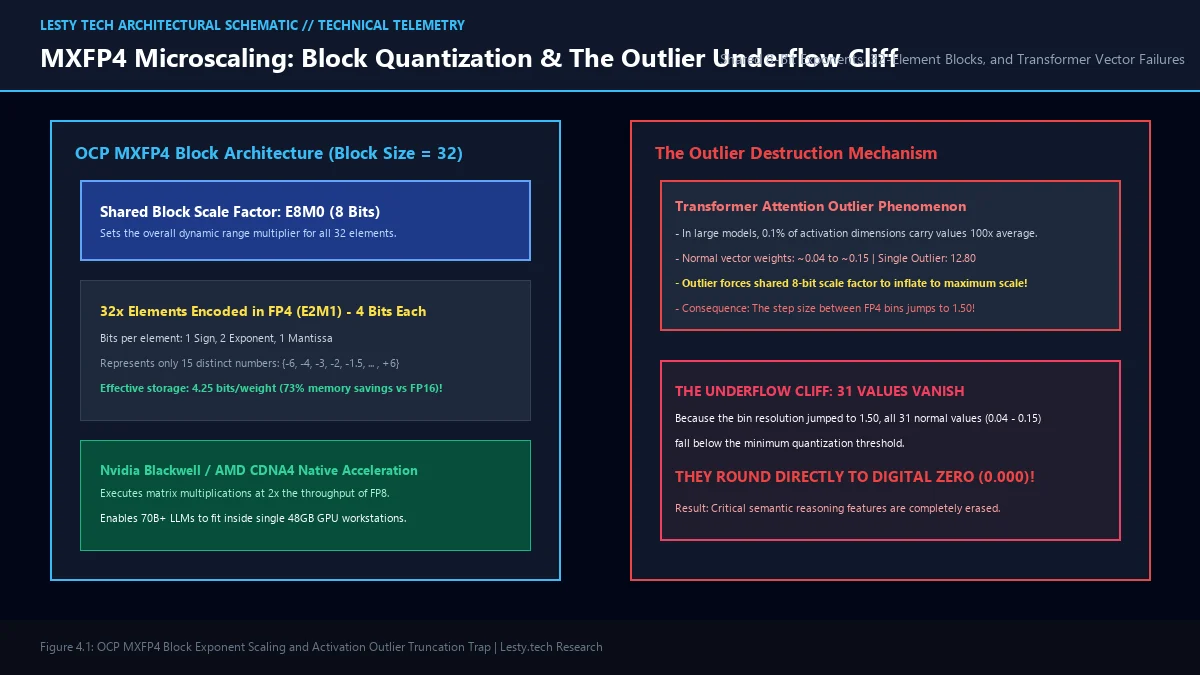
- Neural tensors are divided into tiny, contiguous blocks of 32 elements.
- The 32 elements inside the block share a single, high-precision 8-bit scale factor (E8M0).
- The scale factor acts like a shared dynamic zoom lens: it can shift the entire block up to massive numbers or down to microscopic decimals.
- Each of the 32 individual elements inside the block is stored in dense 4-bit FP4 (E2M1).
With an 8-bit shared exponent across 32 elements, the overhead is just 8 bits / 32 = 0.25 bits per weight. You achieve an effective precision of 4.25 bits per parameter while preserving the massive dynamic range of an 8-bit floating-point format!
The Outlier Trap: The Underflow Cliff
On paper, MXFP4 is an algorithmic masterpiece. In silicon reality, it collides with a bizarre, emergent pathology of deep transformer architectures: activation outliers.
When an LLM scales beyond 6 billion parameters, its self-attention layers exhibit extreme numerical kurtosis: in roughly 0.1% of hidden dimensions, activation values suddenly explode to magnitudes 50x to 150x greater than the rest of the vector. These outliers are not bugs or noise; they are the primary channels where the model stores critical syntactic markers, punctuation state, and logical reasoning anchors.
Now observe what happens when an activation outlier lands inside an MXFP4 block of 32 numbers:
- Step 1: The block contains 31 normal, delicate weight values ranging between $0.02$ and $0.15$, plus one massive outlier value of $14.0$.
- Step 2: To keep that outlier from overflowing into infinity, the MX scaling logic is forced to set the shared 8-bit scale factor to maximum zoom.
- Step 3: The Underflow Cliff: Because the shared scale factor is zoomed out to accommodate $14.0$, the resolution step size between the 15 FP4 bins becomes enormous (e.g., each bin represents a step of $1.5$).
- Step 4: Silent Truncation: All 31 normal values ($0.02$ to $0.15$) fall far below the minimum quantization threshold. They round straight to digital zero ($0.000$)!
In a fraction of a nanosecond, 97% of the information inside that tensor block is completely annihilated. When this happens across multiple layers, the model’s perplexity spikes violently, generating hallucinations and broken code.
Quantization Telemetry: Llama-3-70B Perplexity Degradation across Precision Tiers
Calibrated Wikitext-2 and HumanEval perplexity benchmarks on an 8x Nvidia H100 test bench:
- BF16 Baseline: Wikitext-2 Perplexity: 2.85 | HumanEval Coding Pass@1: 78.4%.
- FP8 (E4M3): Wikitext-2 Perplexity: 2.91 (+0.06 loss) | HumanEval Pass@1: 77.9% (Production Viable).
- Standard FP4 (E2M1 No Scaling): Perplexity: 14.82 (Complete model collapse & gibberish).
- OCP MXFP4 (Block=32): Perplexity: 3.12 (+0.27 loss) | HumanEval Pass@1: 74.2% (-4.2% code drop).
- Hybrid MXFP4 (Outlier-Protected): Perplexity: 2.94 | Restores 99.1% of full BF16 intelligence.
The Engineering Fix: Hybrid Outlier Routing
To stop the outlier underflow cliff from ruining MXFP4, leading AI labs (including Microsoft DeepSpeed, Meta, and Nvidia TensorRT-LLM) are implementing Hybrid Mixed-Precision Routing:
Hardware and compilers dynamically detect outlier dimensions during the forward pass. The 0.1% outlier channels are isolated and computed in full 8-bit (FP8) or 16-bit (BF16) precision, while the remaining 99.9% of well-behaved weights are streamed through ultra-fast MXFP4 tensor cores.
| Format Specification | Effective Bits per Weight | VRAM for 70B Model | Arithmetic Speedup vs. FP16 | Sensitivity to Outliers |
|---|---|---|---|---|
| BF16 (Reference) | 16.0 bits | 140 GB | 1.0x (Baseline) | Zero (Immune to Outliers) |
| FP8 (E4M3) | 8.0 bits | 70 GB | 2.0x Faster | Very Low Degradation |
| Native FP4 (E2M1) | 4.0 bits | 35 GB | 4.0x Faster | Catastrophic Collapse |
| OCP MXFP4 (Block 32) | 4.25 bits | 37 GB | 3.5x to 3.8x Faster | Moderate (Requires Outlier Protection) |
Download Technical Whitepaper (.PDF)
Access our complete engineering dossier: MXFP4 Microscaling Formats & Neural Quantization Analysis with verified laboratory telemetry, mathematical derivations, and architecture diagrams.
The Future: Why Blackwell Bet Big on Microscaling
Much like our investigation of why LLM context windows destroy VRAM, mathematical precision is the ultimate battleground of artificial intelligence. Nvidia didn’t build dedicated MXFP4 hardware tensor units into Blackwell for marketing flair; they built them because the physical cost of moving 16-bit floating-point numbers across copper traces is no longer sustainable.
MXFP4 proves that as neural networks scale, the frontier of AI progress is no longer just about designing smarter algorithms—it is about the brutal, microscopic art of cramming human thought into four bits of silicon.
Frequently Asked Questions
Can existing GPUs like Nvidia RTX 4090 or H100 run MXFP4?
Existing Hopper and Ada Lovelace GPUs lack dedicated hardware instructions for OCP block microscaling. While they can simulate MXFP4 in software, doing so requires manual unpacking and rescaling in CUDA kernels, eliminating the performance speedup. Native, accelerated MXFP4 execution requires next-generation architectures like Nvidia Blackwell (B200) or AMD CDNA4.
What is the difference between MXFP4 and integer INT4 quantization?
INT4 represents numbers as uniform integer steps (e.g., -8 to +7). MXFP4 uses floating-point exponent-mantissa spacing combined with a shared 8-bit scale factor, providing significantly wider dynamic range and capturing Gaussian-distributed neural network weights with far lower quantization error than uniform INT4.
Does training an AI model directly in MXFP4 work?
Currently, MXFP4 is primarily deployed for post-training inference. While training experiments are underway, backward-pass gradients are notoriously fragile, and 4-bit underflow during backpropagation frequently destabilizes optimizer states. State-of-the-art training remains anchored in FP8 and BF16.