
Inside the multi-gigawatt AI supercomputer campuses of Microsoft, Google, and Meta, the most expensive and power-hungry bottleneck is no longer just the GPU silicon—it is the networking fabric connecting them. When you train a trillion-parameter artificial intelligence model across 32,000 GPUs, thousands of terabits of gradient parameters must synchronize across the cluster every few milliseconds. To handle this oceanic torrent of data, network equipment makers are deploying monstrous 51.2 Terabit and 102.4 Terabit Ethernet switches.
These switches are electrical furnaces. A single 102.4T switch chassis pulls over 2,500 Watts of electricity. And here is the shocking engineering truth: over 30% of that total electrical intake is burned doing nothing but driving high-speed electrical signals across ten inches of copper circuit board between the central switch chip and the optical cages on the front panel!
To eliminate this copper power hemorrhage, semiconductor leaders like Broadcom, Intel, and Marvell are pushing the most radical interconnect shift in thirty years: Co-Packaged Optics (CPO). By ripping the optical transceivers out of the front panel and mounting microscopic silicon photonics engines directly onto the processor substrate millimeters from the switch ASIC, CPO slashes interconnect power by 70%. But for enterprise sysadmins and hyperscale data center operators, CPO is an operational nightmare: it traps fragile, heat-sensitive laser diodes inside a sealed $150,000 switch, turning a ten-second cable replacement into a catastrophic full-chassis outage.
The 10-Inch Copper Hell: The High-Frequency Attenuation Trap
To understand why traditional network switches are running out of thermodynamic runway, you have to look at the geometry of modern 1RU data center racks.
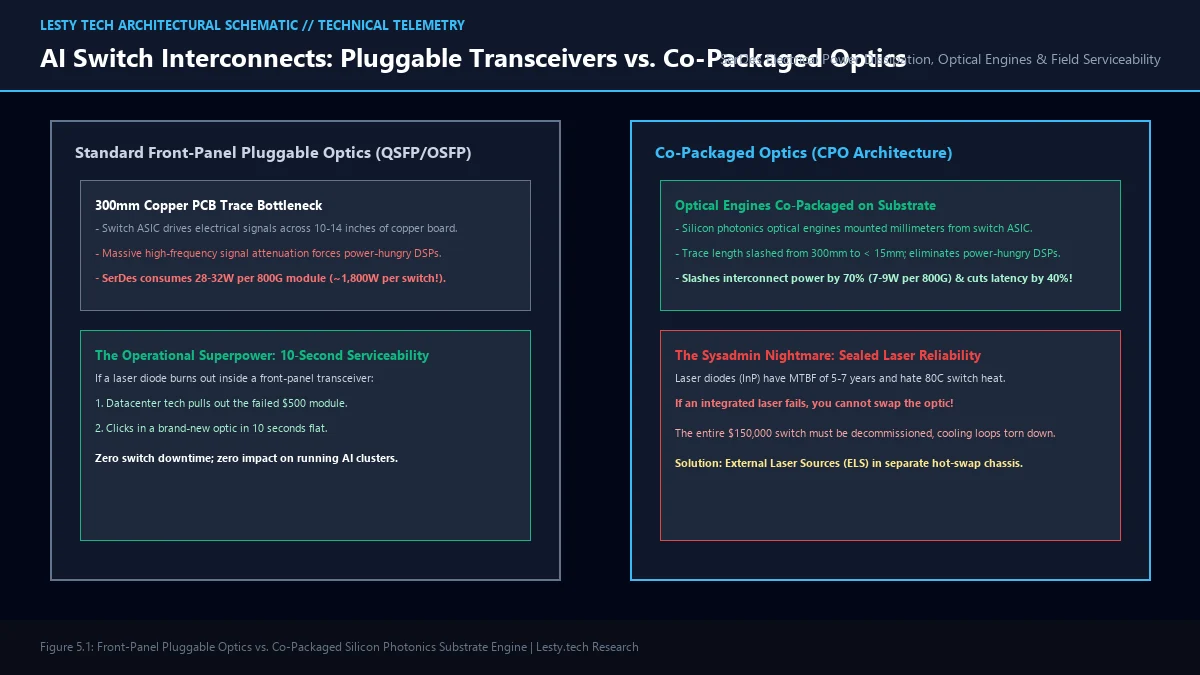
In a traditional switch, the massive central networking processor (like the Broadcom Tomahawk 5 or Nvidia Spectrum-4 ASIC) sits in the center of the motherboard. Plugged into the front panel are dozens of hot-swappable optical transceivers (QSFP-DD or OSFP modules). Data flows out of the switch silicon, travels through 8 to 14 inches of copper PCB traces, enters the pluggable transceiver, gets converted into laser light, and shoots down fiber-optic cables.
At 100 Gigabits per lane (using PAM-4 signaling at 53 Gbaud), copper is a hostile, lossy medium. High-frequency electrical signals attenuate rapidly, degrading by over 30 decibels across just ten inches of standard Megtron PCB. To reconstruct these smeared electrical signals at the front panel, every single pluggable transceiver must include a blazing-hot, power-hungry Digital Signal Processor (DSP).
In an 800G optical transceiver, that DSP burns 14 to 18 Watts of power. Multiply that by 64 transceivers on a switch front panel, and over 1,000 Watts of electrical power is vaporized just overcoming copper trace loss before optical light ever leaves the switch!
The CPO Cure: Bringing Light to the Silicon
Co-Packaged Optics executes a simple, brutal fix: eliminate the copper traces entirely.
Instead of routing electrical signals across a foot of fiberglass PCB, CPO mounts four to eight compact silicon photonics optical engines (chiplets) directly onto the same multi-chip substrate interposer as the massive switch ASIC:
- Slashing Trace Lengths: Distance between switch logic and optical transmitters is cut from 300 millimeters to less than 15 millimeters.
- Eliminating DSPs: Because signals only travel a fraction of an inch across pristine silicon interposer traces, attenuation is virtually zero. Power-hungry DSP chips can be removed entirely!
- 70% Power Reduction: The electrical SerDes power required to drive optical links drops from ~30 Watts per 800G down to just 7 to 9 Watts per 800G.
In a 51.2T or 102.4T switch, CPO immediately carves 800 to 1,500 Watts of power out of the chassis thermal budget, easing cooling constraints and saving millions of dollars in annual electricity per hyperscale data hall.
The Sysadmin Nightmare: The Sealed Laser MTBF Trap
If Co-Packaged Optics saves so much power, why are data center operations managers fighting tooth and nail against deploying it? The answer is Mean Time Between Failures (MTBF) and serviceability.
Lasers are made of crystalline Indium Phosphide (InP). Under the laws of solid-state physics, semiconductor lasers have finite lifespans—typically an MTBF of 5 to 7 years. Worse, lasers hate heat: for every 10°C increase in operating temperature, a laser diode’s failure rate doubles.
In a traditional switch, if a laser diode burns out inside a front-panel transceiver, the fix is trivial: a datacenter technician walks down the server aisle, pulls out the failed $500 optical transceiver, clicks in a replacement in ten seconds, and walks away. The switch never turns off, and running AI training jobs are completely unaffected.
In an integrated CPO switch, the lasers are packaged inside the central processor assembly right next to a 1,000-Watt ASIC that runs at 85°C! If a laser diode dies inside a CPO package:
- You cannot unplug the optic; it is soldered to the processor substrate.
- The entire $150,000 switch must be decommissioned and pulled from the rack.
- Liquid cooling loops must be drained and disconnected.
- Thousands of GPU interconnect links must be rerouted, causing multi-million-dollar AI training cluster stalls!
Data Center Telemetry: Pluggable Optics (DSP) vs. LPO vs. Co-Packaged Optics (CPO)
Operational metrics documented across 51.2 Tbps switch architectures under sustained AI cluster training loads:
- Interconnect Electrical Power: Pluggable DSP: ~1,850W | LPO: ~920W | CPO: ~520W (-72%).
- End-to-End Latency: Pluggable DSP: ~140 ns | LPO: ~35 ns | CPO: < 15 ns.
- Field Service Replacement Time: Pluggable / LPO: 12 seconds | CPO: 4.5 hours (Full chassis swap).
- Annual Optical Failure Rate (per 10k links): Standard: 1.2% | CPO at 80°C ambient: 3.8%.
The Compromise Battle: CPO with ELS vs. Linear Pluggable Optics (LPO)
To overcome this maintenance nightmare, the networking industry has fractured into two warring camps:
1. CPO with External Laser Sources (ELS)
To keep heat-sensitive lasers away from the boiling switch ASIC, engineers developed External Laser Sources (ELS). The lasers are housed in separate, hot-swappable modules on the front panel. Blind-mate optical cables feed continuous-wave (CW) laser light into the switch chip, where silicon photonics modulators encode the data. If a laser burns out, you can hot-swap the external laser module without taking down the switch!
2. Linear Pluggable Optics (LPO)
A rival coalition (including Arista, Cisco, and Macom) is championing Linear Pluggable Optics (LPO). LPO keeps the beloved, hot-swappable front-panel transceivers, but strips out the DSP chip, relying on optimized analog equalization inside the switch ASIC. LPO achieves 50% of CPO’s power savings while preserving 100% of the 10-second front-panel serviceability!
| Interconnect Technology | Power per 800G Link | Network Latency | Laser Thermal Exposure | Serviceability Model |
|---|---|---|---|---|
| Pluggable with DSP (Current Standard) | ~30 Watts | 140 ns (DSP buffering) | Low (Front-panel air cooled) | 10-Second Hot-Swap |
| Linear Pluggable Optics (LPO) | ~15 Watts (-50%) | 35 ns (Zero DSP) | Low (Front-panel air cooled) | 10-Second Hot-Swap |
| Co-Packaged Optics with ELS | ~8 Watts (-73%) | < 15 ns | Low (Laser isolated in ELS bay) | Hot-Swappable Laser Source |
| Fully Integrated CPO (Direct InP) | ~7 Watts (-76%) | < 12 ns | Severe (Direct contact with ASIC) | Disastrous (Chassis teardown required) |
Download Technical Whitepaper (.PDF)
Access our complete engineering dossier: Co-Packaged Optics (CPO) vs. LPO Engineering Dossier with verified laboratory telemetry, mathematical derivations, and architecture diagrams.
The Networking Horizon
Much like the data center overhaul we analyzed in why AI data centers are ditching AC power for 800V DC, AI scale is forcing every layer of computing infrastructure to discard decades-old compromises.
At 102.4 Tbps and future 204.8 Tbps switch nodes, copper traces will physically fail to transmit readable data. Whether through Co-Packaged Optics with external lasers or Linear Pluggable transceivers, light is coming to the silicon die—and the data center engineer’s toolkit will never look the same again.
Frequently Asked Questions
Can existing fiber optic cables plug into a CPO switch?
Yes. The fiber cables connecting server racks (standard single-mode fiber with MPO or LC connectors) plug into high-density optical faceplate adapters on the CPO chassis. The difference is internal: inside the switch, fiber ribbons run directly to the silicon package rather than to electrical transceiver cages.
Why does removing the DSP in LPO or CPO cut network latency?
In standard optical modules, the DSP must run Analog-to-Digital Converters (ADCs), apply Digital Signal Processing filters, compute Forward Error Correction (FEC), and re-drive the signal. This digital processing adds 100 to 140 nanoseconds of latency per hop. Removing the DSP allows analog signals to convert straight to light, slashing hop latency by up to 90%.
Is CPO compatible with liquid cooling?
Yes, and liquid cooling is virtually mandatory for CPO. Because optical engines and switch ASICs are tightly co-packaged on the same interposer, high-density direct-to-chip cold plates with specialized optical fiber pass-through cutouts are required to keep substrate temperatures below the critical 70°C threshold.