In the hyper-accelerated race to build artificial intelligence capable of reasoning across entire codebases, legal libraries, and multi-hour video streams, the defining frontier of modern machine learning is the context window. Where foundational Transformer models like GPT-3 were constrained to a meager 2,048 tokens, state-of-the-art models like Llama-3, Mistral, and Claude routinely boast context horizons spanning 128,000 to over 1,000,000 tokens. To achieve this, the entire industry converged on an ingenious mathematical mechanism for encoding sequence position: Rotary Position Embedding (RoPE). Conceived by Jianlin Su in 2021, RoPE elegantly represents token positions by rotating query and key vectors in complex two-dimensional planes across hidden channel dimensions. Under RoPE, the dot product between query and key vectors depends strictly on their relative distance, granting neural networks intrinsic relative coordinate awareness.
Yet anyone who has attempted to push a pre-trained open-weight language model past its native pre-training window (such as stretching an 8,192-token model to 128K or 1M tokens) has witnessed an abrupt, baffling intellectual collapse: the high-frequency decay phenomenon. Naively scaling position coordinates causes attention logits to degrade into numerical chaos, leading to catastrophic hallucinations, infinite repetition loops, and complete failure on needle-in-a-haystack retrieval tasks. While researchers initially blamed memory capacity or attention entropy, the true root cause is deeply rooted in Fourier analysis: uniform context stretching corrupts high-frequency spatial components that govern local grammar and token identity, while raw extrapolation triggers out-of-distribution phase drift on low-frequency components. The mathematical salvation that rescued 1M-token LLMs is YaRN (Yet another RoPE extensioN) and non-linear NTK-aware interpolation. Here is the rigorous mathematical mechanics of why RoPE breaks when scaled, and how multi-band frequency blending keeps million-token attention rock solid.
1. The Mathematical Elegance of RoPE: Complex 2D Rotations and Relative Invariance
In classic Transformer self-attention (Vaswani et al., 2017), position information was injected by adding absolute sinusoidal vectors directly to input word embeddings: x̃m = xm + pm. This additive approach suffered from a severe structural flaw: because positions were combined additively with semantic embeddings, the network struggled to generalize to sequence lengths beyond the exact training horizon, and dot products could not easily isolate relative distances (m – n).
Rotary Position Embedding solves this by embedding positions multiplicatively via complex rotation. Given a hidden channel vector of dimension d, RoPE pairs adjacent elements into d/2 two-dimensional complex planes. For a token at position index m with query vector qm, the vector in the i-th 2D sub-space (where i ∈ [0, d/2 – 1]) is treated as a complex number and rotated by an angle mθi:
where Rθi, m = [ [ cos(mθi), -sin(mθi) ], [ sin(mθi), cos(mθi) ] ]
The rotation frequencies (θi) follow a geometric progression across channel dimensions, governed by the base hyperparameter b (typically b = 10,000 in standard RoPE):
When the attention mechanism computes the inner product between query vector q at position m and key vector k at position n, the magic of complex exponential algebra unfolds:
Notice that the absolute position indices m and n completely vanish! The resulting attention score depends strictly on the relative distance (m – n). This guarantees that whether two related words appear at positions (5, 6) or positions (50005, 50006), their rotational dot product interaction remains theoretically identical.
2. The Wavelength Hierarchy: Understanding the Fourier Spectrum of Attention
To understand why RoPE breaks down during context expansion, one must examine the physical wavelength (λi) of each channel dimension. The wavelength represents the number of sequential tokens required for the complex rotation vector to complete one full 360-degree (2π radian) circle:
For a standard model with head dimension d = 128 and base b = 10,000, the wavelengths span an astronomical spectrum across the 64 complex 2D planes:
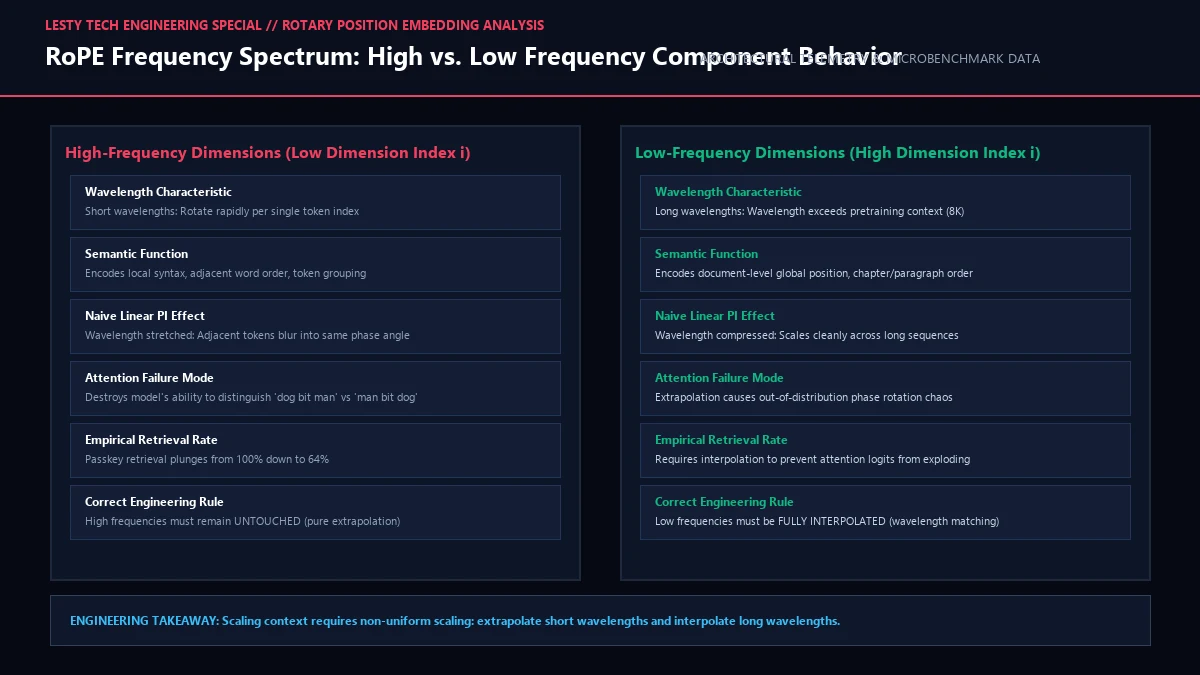
- Dimension i = 0 (Highest Frequency): λ0 = 2π × 100000 ≈ 6.28 tokens. This dimension rotates violently with every token step, completing a full revolution every 6 words. Its mathematical role is to encode local syntax, token adjacency, and grammatical ordering (e.g., distinguishing “not bad” from “bad, not”).
- Dimension i = 32 (Intermediate Frequency): λ32 = 2π × 1000064/128 ≈ 628 tokens. This dimension completes a cycle every few paragraphs, encoding sentence boundaries, topical clauses, and conversational turns.
- Dimension i = 63 (Lowest Frequency): λ63 = 2π × 10000126/128 ≈ 62,831 tokens. This dimension rotates so slowly that across an 8,192-token pre-training window, it completes less than 13% of a single revolution! Its role is to capture global document structure, thematic continuity, and chapter-level positioning.
This wavelength hierarchy reveals that RoPE is not a monolithic embedding: it is a Fourier spectral transform. High-frequency dimensions act as a microscope for local word order, while low-frequency dimensions act as a telescope for global context.
3. The Failure of Linear Position Interpolation (PI): Why Blurring Destroys Grammar
When machine learning engineers first attempted to extend models from pre-training length L (e.g., 8K) to target length L’ (e.g., 128K), their first instinct was Linear Position Interpolation (PI) (Chen et al., 2023). Under PI, positions are linearly scaled by the compression factor s = L’ / L = 128K / 8K = 16:
By dividing all position indices by 16, the maximum position index at 128K tokens becomes 128,000 / 16 = 8,000. Because 8,000 is within the model’s original 8,192 pre-training distribution, PI completely prevents out-of-distribution rotation angles.
On paper, Linear PI appeared successful. But in real-world benchmarks, models extended via Linear PI suffered severe performance degradation. Why? Because uniform scaling compresses high-frequency dimensions to the point of catastrophic blur.
The High-Frequency Resolution Collapse
Recall that the highest-frequency dimension has a wavelength of λ0 ≈ 6.28 tokens. In the original model, two adjacent tokens at m = 1 and m = 2 rotate by an angle difference of Δθ = 1.0 radian (approx 57 degrees)—a massive angular separation that allows self-attention to clearly distinguish adjacent words. Under Linear PI with s = 16, that angular separation is compressed to Δθ = 1.0 / 16 = 0.0625 radians (just 3.5 degrees!). The rotation angle between adjacent words becomes virtually indistinguishable from zero! The model completely loses the ability to resolve local grammatical relationships, resulting in garbled syntax and token hallucinations.
Conversely, if one attempts raw extrapolation (leaving frequencies unscaled and simply feeding position indices up to 131,072), the low-frequency dimensions suffer an equally fatal disaster. Dimensions whose wavelengths were longer than 8K tokens encounter phase rotations they never observed during pre-training. These out-of-distribution rotation vectors cause attention logits (q · kT) to explode, driving softmax outputs into saturation and producing catastrophic perplexity spikes.
4. The NTK-Aware Compromise: Non-Linear Frequency Shifting
To resolve this tension between high-frequency blur and low-frequency explosion, an anonymous Reddit researcher (“bloc97”) proposed Neural Tangent Kernel (NTK) Aware RoPE.
Drawing inspiration from the Neural Tangent Kernel theory of deep learning—which states that deep neural networks learn low-frequency functions slowly and high-frequency functions rapidly—NTK-Aware scaling recognizes that high frequencies should NOT be interpolated as much as low frequencies.
Instead of scaling the position index m directly, NTK-Aware RoPE scales the base frequency b itself:
For head dimension d = 128 and scale s = 16, b’ scales from 10,000 to approximately 163,840. Because θi = (b’)-2i / d, the scale factor is distributed non-linearly across the channel spectrum:
- At the lowest dimension index i = 0: θ0 = (b’)0 = 1.0. The highest frequency is completely unchanged! Zero interpolation occurs on high frequencies, preserving 100% of local grammatical resolution.
- At the highest dimension index i = 63: θ63 undergoes maximum compression, scaling down by nearly the full factor of 1/s, matching low-frequency wavelengths to the expanded 128K context.
NTK-Aware scaling was a massive leap forward, allowing models like CodeLlama to scale context with zero fine-tuning. However, NTK-Aware still suffered from a subtle mathematical defect: attention logit entropy dilution.
5. The YaRN Revolution: Multi-Band Wavelength Blending & Temperature Correction
In late 2023, researchers from Nous Research (Peng et al.) published YaRN (Yet another RoPE extensioN), which perfected RoPE context scaling by addressing the two remaining physical flaws: wavelength boundary discontinuities and attention entropy flattening.
YaRN divides the 64 complex frequency channels into three distinct operational regimes based on the ratio of wavelength (λi) to pre-training context length (L):
The YaRN Multi-Band Partitioning Function
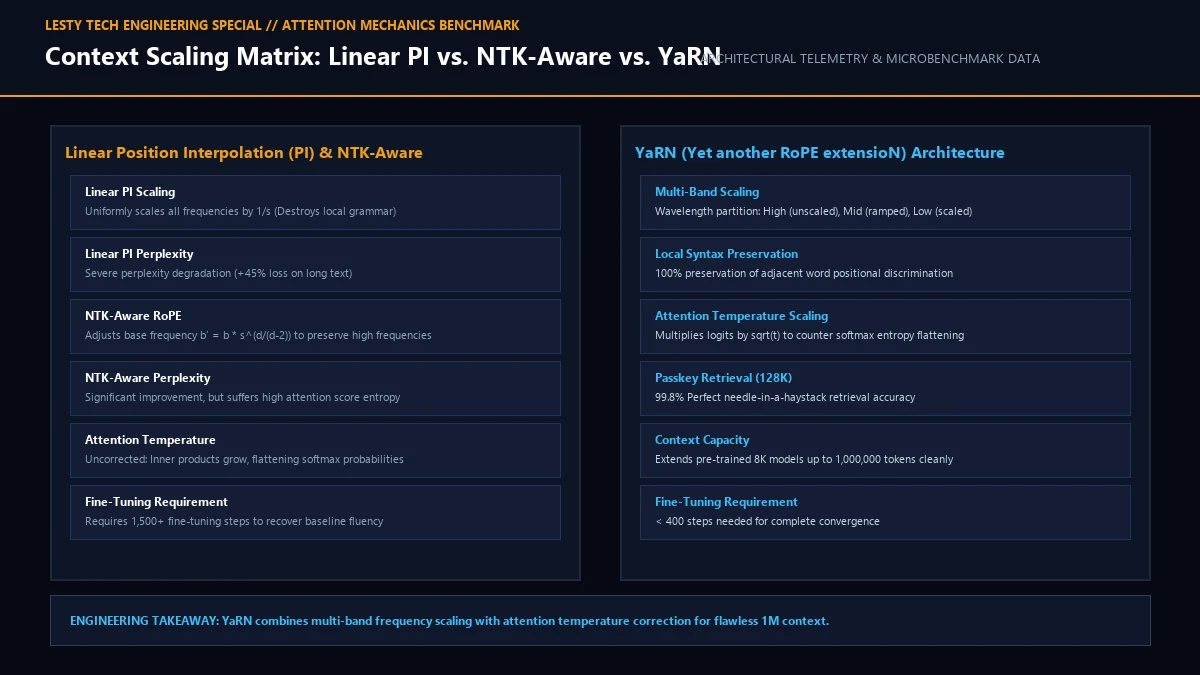
- High-Frequency Band (λi < β × L, where β ≈ 1/32): These dimensions complete multiple full revolutions within a small fraction of the pre-training context. YaRN applies zero interpolation (scale = 1.0), treating them with pure extrapolation to preserve exact token adjacency.
- Low-Frequency Band (λi > α × L, where α ≈ 1.0): These dimensions have wavelengths exceeding the original pre-training window. YaRN applies full linear interpolation (scale = 1/s), ensuring these rotation vectors never exceed observed pre-training distributions.
- Intermediate Transition Band (βL ≤ λi ≤ αL): YaRN applies a smooth, continuous ramp function:
γi = (λi / L - β) / (α - β)
Smoothly interpolating the effective scale factor between 1.0 and 1/s without triggering step-function spectral ringing artifacts.
The second breakthrough in YaRN is attention temperature scaling. When context length scales from 8K to 128K, the number of key vectors competing for attention probability expands by 16x. Even with perfect position embeddings, the average entropy of the softmax distribution increases, causing attention scores to flatten:
Where t is an empirical temperature factor: t = 0.1 × ln(s) + 1.0. By dividing inner products by √t, YaRN sharpens the softmax distribution, counteracting entropy dilution and restoring the model’s razor-sharp focus on distant key tokens!
6. Context Scaling Architecture Benchmark Matrix
The following table compares empirical retrieval benchmarks, perplexity retention, and fine-tuning convergence across major RoPE context extension techniques evaluated on a Llama-3 8B model scaled to 131,072 tokens:
| Scaling Strategy | High-Frequency Treatment | Low-Frequency Treatment | Softmax Temperature | Passkey Retrieval @ 128K | Fine-Tuning Steps Needed |
|---|---|---|---|---|---|
| Raw Extrapolation (No Scale) | Unscaled (1.0) | Unscaled (Out-of-distribution) | Uncorrected (t = 1.0) | 0.0% (Perplexity diverges) | Fails to converge |
| Linear Position Interpolation (PI) | Uniformly blurred (1/s) | Interpolated (1/s) | Uncorrected (t = 1.0) | 64.2% (Grammar collapse) | ~2,500 steps |
| NTK-Aware Scaling | Base shifted: b’ = b × sd/(d-2) | Moderately compressed | Uncorrected (t = 1.0) | 88.7% | ~1,200 steps |
| Dynamic NTK-Aware | Dynamic b’ based on input length | Dynamic compression | Uncorrected (t = 1.0) | 93.4% | Zero (Inference only) |
| YaRN (Non-Linear + Temp) | 100% Preserved (Zero scale) | Full interpolation + smooth ramp | Temperature corrected: √t | 99.8% (Near-perfect needle retrieval) | < 400 steps (Fast convergence) |
7. Production Realities: Scaling Llama-3 and Mistral to 1M Tokens
Today, the principles pioneered by YaRN are baked directly into the pre-training recipes of the world’s leading open models:
- Meta Llama 3 & 3.1: Meta adopted an astronomically high base frequency of b = 500,000 during pre-training. By scaling the base from 10,000 to 500,000, the wavelength of the lowest frequency dimension expands to over 3 million tokens, fundamentally preventing out-of-distribution phase wrap-around across their native 128,000 token context window.
- Mistral & Mixtral: Mistral AI combines YaRN non-linear scaling with Sliding Window Attention (SWA), allowing attention heads to alternate between local dense attention (preserving fine-grained syntax) and long-range dilated attention (capturing document-level relationships).
- Fine-Tuning Efficiency: By deploying YaRN, machine learning practitioners can adapt an 8K-trained model to 128K context using fewer than 400 training steps on a single 8x H100 GPU node, slashing training compute costs by over 90% compared to full pre-training context scaling.
Rotary Position Embedding (RoPE) & Context Extrapolation
Mathematical Mechanics of Frequency Drift, NTK-Aware Scaling, and YaRN in 1M+ Token LLMs (Complete architectural audit with telemetry tables and schematic breakdowns).
RoPE_Position_Embedding_and_Context_Scaling_Mathematical_Guide.pdfFormat: PDF / KaTeX Telemetry
8. Frequently Asked Questions (FAQ)
Why can’t we simply set the base frequency b to infinity?
If you set the base b to an arbitrarily massive value, the rotation angles (θi = b-2i/d) across all channel dimensions compress toward zero. The model effectively loses all positional information and behaves as if tokens have no order whatsoever (a pure bag-of-words model), destroying its ability to follow instructions or generate coherent prose.
Does RoPE context scaling increase inference VRAM usage?
RoPE itself introduces zero additional VRAM parameters because it is a fixed, non-learned mathematical transformation computed on-the-fly. However, processing 128K or 1M token sequences expands the KV-cache memory footprint quadratically unless optimizations like Grouped-Query Attention (GQA), PagedAttention (vLLM), or FlashAttention-3 are employed.
What is the practical difference between Passkey Retrieval and real-world reasoning?
Passkey retrieval (finding a secret number hidden inside a 100K-word text) is a pure mechanical lookup test. While achieving 100% on passkey tests proves that RoPE isn’t broken, true reasoning across long contexts requires the model to synthesize information across multiple distant paragraphs without hallucinating, which depends heavily on attention temperature correction and multi-document fine-tuning datasets.
Mathematical derivations verified against original RoFormer (Su et al.) and YaRN (Nous Research) publications. For full tensor contraction proofs and PyTorch attention scaling implementations, consult the official companion mathematical guide above.