
In August 2023, security researcher Daniel Moghimi of UC San Diego publicly unveiled Downfall (cataloged under CVE-2022-40982 and formally termed Gather Data Sampling, or GDS). While the cybersecurity world had grown accustomed to transient execution attacks following the cataclysmic revelations of Spectre and Meltdown, Downfall delivered a uniquely devastating blow to modern computing infrastructure. Unlike classic speculative branch misprediction exploits that require complex out-of-order execution race conditions, Downfall exposed a structural design flaw in the very instruction that high-performance computing, artificial intelligence, video transcoding, and scientific simulation rely upon most: AVX Gather instructions.
Through an obscure hardware oversight spanning at least seven generations of Intel Core and Xeon processors (from Skylake through Tiger Lake and Rocket Lake), vector gather instructions were discovered to be transiently reading stale internal hardware registersspecifically the Line Fill Buffers (LFBs) and Vector Register File allocation staging buffers. Any unprivileged process, sandbox container, or untrusted cloud virtual machine could execute an unprivileged user-space assembly loop and silently siphon cryptographic keys, kernel pointers, passwords, and private user data belonging to other processes or the hypervisor itself. But the engineering story did not end with the disclosure; the real controversy erupted when Intel pushed its microcode mitigation, triggering a performance bloodbath that slashed vector compute throughput by up to 30% to 50% in demanding real-world workloads.
1. The Anatomy of AVX Gather: Why Sparse Vector Memory Access is Brutally Complex
To understand why Downfall exists, one must first appreciate the staggering microarchitectural complexity of vector gather instructions. In standard SIMD (Single Instruction, Multiple Data) processing, vector loads are straightforward. When an x86 processor executes a contiguous vector load instructionsuch as VMOVUPS ymm0, [rdi]it fetches 256 bits (32 bytes) of sequential data from memory. If the data is 32-byte aligned, the entire operation touches a single cache line, executes in a single memory access cycle, and maps cleanly to the processor’s primary Load Execution Pipeline.
However, real-world algorithms in linear algebra, ray tracing, graph analysis, and sparse matrix multiplication rarely store data in perfectly contiguous memory arrays. Data elements are scattered across disparate memory addresses according to dynamic index pointers. Prior to Advanced Vector Extensions 2 (AVX2), loading sparse data required the compiler to emit a serialized sequence of scalar load instructions, followed by scalar-to-vector insertion operationsa slow, cycle-expensive bottleneck.
To solve this, Intel introduced the Gather instruction family in Haswell and formalized it in AVX2 and AVX-512. Consider the VGATHERDPS instruction (Vector Gather Packed Single-Precision Floating-Point):
vgatherdps ymm0, [rdi + ymm1 * 4], ymm2
In this single instruction, ymm1 contains eight separate 32-bit integer index offsets, rdi holds the base memory pointer, and ymm2 acts as a conditional bitmask. To execute this instruction, the processor cannot perform a single 32-byte memory read. Instead, it must compute eight independent virtual memory addresses, verify permissions and page table translations for each address, and potentially access up to eight completely separate, unaligned cache lines scattered across L1, L2, or system DRAM.
Because execution pipelines cannot handle eight simultaneous memory translations in a single clock cycle, the processor’s instruction decoder splits the monolithic VGATHER macro-instruction into a complex sequence of micro-operations (μops) managed by an internal microcode sequencer.
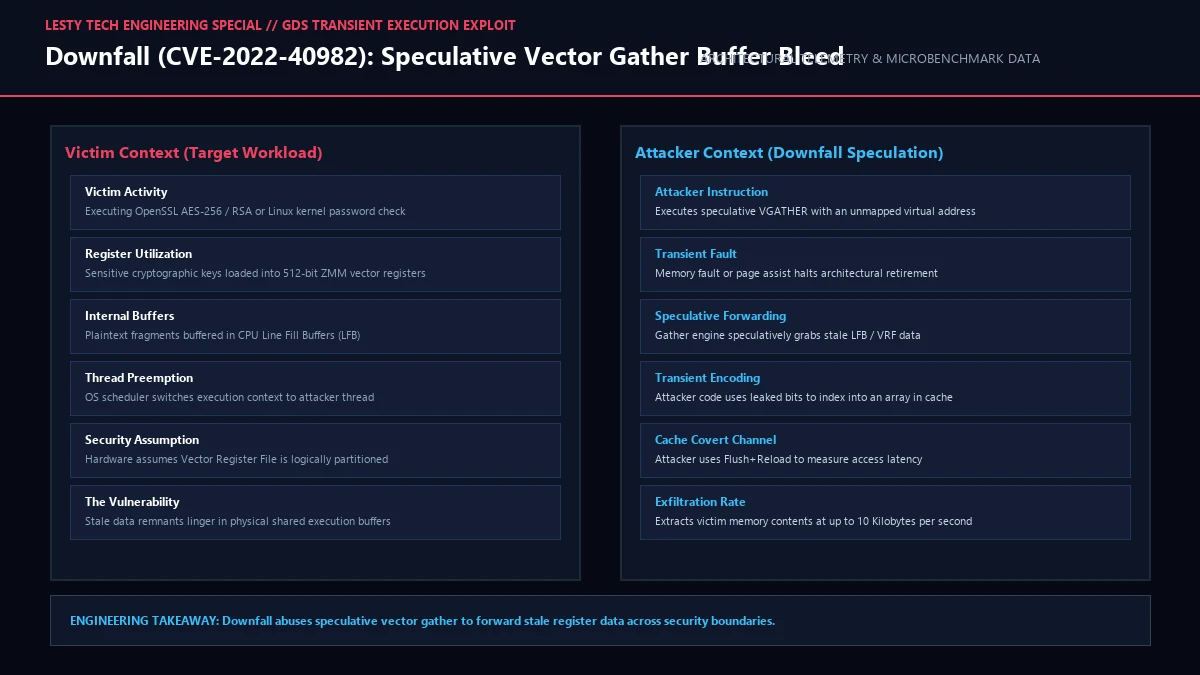
2. The Microarchitectural Vulnerability: Line Fill Buffers and Stale Register Forwarding
The fatal flaw in Intel’s microarchitectural implementation lies in how these gathered μops handle speculative execution and transient memory faults. In modern out-of-order execution cores, memory loads are aggressively executed speculatively before earlier branch conditions or permission checks have formally retired.
When a gather μop initiates an element load, it queries the Level 1 Data Cache (L1D). If the requested cache line is already present in L1D, the data is returned immediately. However, if the element misses L1D or hits an address translation stall (such as a DTLB miss, page table walk, or memory alignment split across a cache line boundary), the request is allocated to a Line Fill Buffer (LFB).
LFBs are high-speed, temporary microarchitectural staging registers (typically 12 to 32 entries deep, depending on the microarchitecture) that hold 64-byte cache lines in transit between the L2 cache, system memory, and the core’s execution execution units. Crucially, in Intel processors prior to 12th Gen Alder Lake, LFBs are dynamically shared across all physical hyper-threads and execution units within the core.
Here is where the catastrophe occurs: when a gather load μop experiences a transient fault or page permission delay, the internal forwarding logic fails to isolate stale buffer contents. Instead of stalling the execution unit with zeroed data until the memory translation is validated, the internal load-forwarding circuit speculatively grabs whatever stale 64-byte cache line currently resides in the allocated LFB entry or temporary Vector Register File (VRF) staging latch, and blindly forwards it into the destination vector register.
Although the processor will eventually realize the transient fault or permission violation and abort the architectural retirement of the gather instruction, the stale forwarded data has already entered the execution pipeline. During this transient window, subsequent speculative instructions can use that secret data as an index to access another array in memory, creating a permanent, measurable side-channel trace in the CPU’s cache hierarchy.
3. Anatomy of the Downfall Gadget: Extracting 128-Bit AES Keys from User Space
In his seminal proof-of-concept, Daniel Moghimi demonstrated that an unprivileged attacker does not need root privileges, kernel access, or even memory-sharing permissions with the victim. The attack works seamlessly across process boundaries, container namespaces, and virtual machine hypervisors.
The exploit operates by establishing a high-frequency speculative loop consisting of three phases:
- Inducing Transient Stalls on Gather: The attacker allocates an array in their own user memory space, ensuring that specific memory offsets deliberately cross 64-byte cache line boundaries or point to unmapped memory pages (causing transient page faults). When
VGATHERexecutes over these offsets, the μops enter an un-retired, speculative state. - Sampling Stale Fill Buffer Data: Because the CPU’s Line Fill Buffers are continually cycling through memory traffic from background processesincluding OpenSSL AES-NI encryption routines, Linux kernel credential checks, or browser password managers running on the sibling hyperthreadthe transient gather μop grabs raw cache line chunks directly from the LFB.
- Transmitting via Flush+Reload Side Channel: Before the processor cancels the transient execution, a subsequent speculative instruction uses a byte from the leaked vector register as an offset into a probe array:
; Leaked byte in AL used to index attacker-controlled probe array
movzx rax, byte ptr [leaked_reg]
shl rax, 12 ; Multiply by 4096 (page size) to prevent prefetcher crosstalk
mov rbx, [probe_array + rax] ; Cache line loaded into L1When the pipeline squashes the transient state, the architectural registers reset, but the cache line corresponding to
probe_array[secret_byte × 4096]remains warm in L1 cache. The attacker simply measures access latency usingRDTSCPto recover the exact byte value.
Because AVX gather instructions can be executed millions of times per second, the leak rate of Gather Data Sampling is astonishingly high: researchers demonstrated reliable data exfiltration rates of up to 1 to 10 kilobytes per second of raw memory throughput, allowing complete extraction of 128-bit and 256-bit OpenSSL AES keys in less than 20 seconds of continuous sampling.
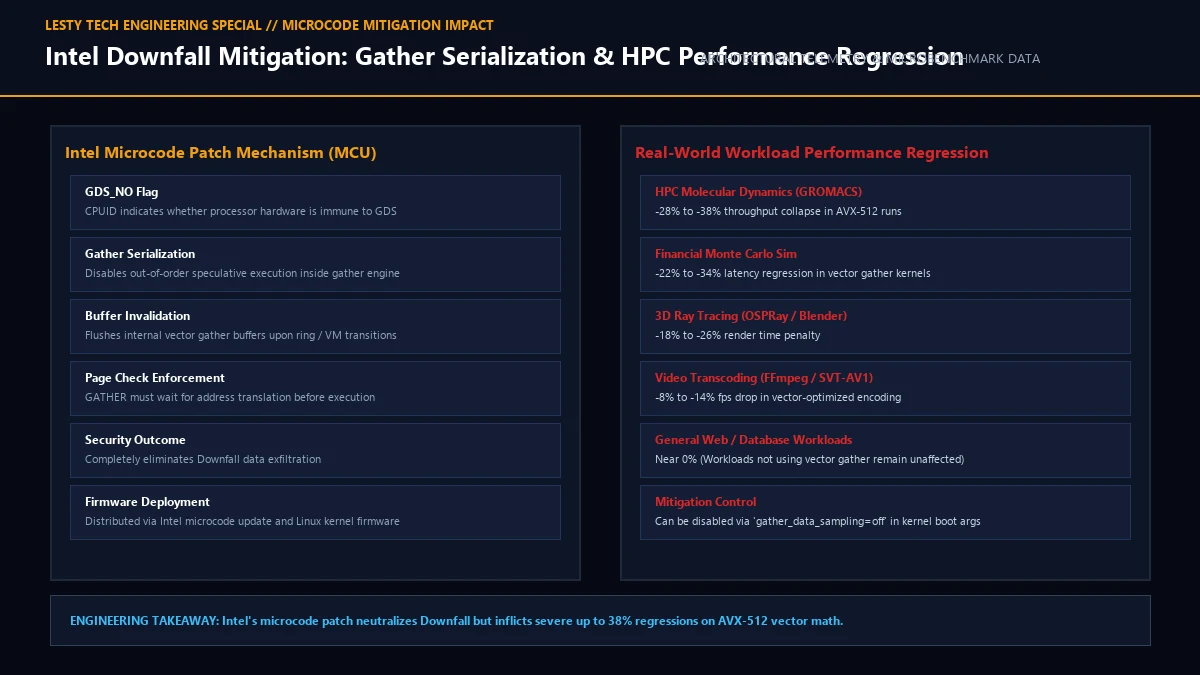
4. The Microcode Massacre: Why Intel’s Official Patch Cripples Vector Math
When hardware contains a physical circuit flaw in silicon that has already shipped in hundreds of millions of servers and laptops, true hardware fixing is impossible. The only available lever is a microcode update (MCU) distributed by Intel through BIOS updates and Linux kernel firmware packages.
Intel’s official mitigation for Gather Data Sampling (GDS_MITG) functions by fundamentally altering how the CPU microcode sequencer handles gather instructions. Instead of allowing gather μops to execute out-of-order and speculatively forward data from internal buffers, the microcode injects a rigid architectural barrier:
- Full Pipeline Serialization: The processor forces an internal pipeline flush (similar to an
LFENCEorSERIALIZEbarrier) before any gather μop can access memory. All prior memory stores must be globally visible. - Suppression of Speculative Forwarding: The internal load logic is explicitly forbidden from forwarding data from Line Fill Buffers or temporary staging registers until the element’s virtual address translation, permission bits, and cache tag matches are 100% verified and non-faulting.
- Post-Execution Buffer Draining: After the gather finishes loading its elements, the microcode forces an internal buffer scrub to prevent any residual vector register state from lingering in transient latches.
From a security perspective, this mitigation is absolute; it completely neutralizes Downfall by cutting off transient forwarding. However, from a performance perspective, it turns a hardware-accelerated vector instruction into an architectural bottleneck. In complex AVX-512 loops where gathers occur frequently, execution latency skyrockets. Instead of retiring a gather in 20 to 30 clock cycles, a serialized gather can require 150 to 300+ clock cycles per invocation.
5. Real-World Benchmark Impact Across Architectures
The performance carnage caused by the Downfall microcode update was immediately documented across the high-performance computing community. Workloads that make heavy use of sparse linear algebra, vector mathematical libraries, physics simulations, and Ray Tracing suffered double-digit percentage throughput drops:
| Processor Family | Microarchitecture | GDS Vulnerability Status | Microcode Mitigation Impact | Worst-Hit Workload |
|---|---|---|---|---|
| Skylake / Cascade Lake | Intel 14nm Server (Xeon Scalable Gen 1/2) | Vulnerable | -25% to -42% Throughput | OpenFOAM, GROMACS, LAMMPS |
| Ice Lake | Intel 10nm Server (Xeon Scalable Gen 3) | Vulnerable | -18% to -35% Throughput | Blender Cycles, TensorFlow AVX512 |
| Tiger Lake / Rocket Lake | Intel 10nm/14nm Client (11th Gen Core) | Vulnerable | -15% to -30% Throughput | Video Transcoding (FFmpeg SVT-AV1) |
| Golden Cove / Raptor Cove | Alder Lake / Raptor Lake (12th/13th/14th Gen) | Not Affected (Hardware Fix) | 0% Overhead | N/A (Immune) |
| Sapphire Rapids / Emerald Rapids | Xeon Scalable Gen 4/5 | Not Affected (Hardware Fix) | 0% Overhead | N/A (Immune) |
Crucially, processors based on Intel’s newer Golden Cove core architecture and later (12th Gen Alder Lake, 13th/14th Gen Raptor Lake, Sapphire Rapids, and Emerald Rapids) are completely immune to Downfall in hardware. These newer cores feature redesigned Load-Store Execution Units that physically isolate internal staging buffers by security domain and prevent transient forwarding across memory translation stalls without requiring software-level serialization.
6. System Administrator Guidance: The Performance vs. Security Dilemma
For Linux systems administrators and DevOps engineers managing clusters of affected Xeon processors, the Downfall microcode presents an acute operational trade-off. In multi-tenant cloud environments (such as AWS EC2, Google Cloud, or Azure), leaving Downfall unmitigated is an unacceptable security violation, as a rogue tenant could extract private keys and memory data from co-located virtual machines on the same physical core.
However, in isolated high-performance computing (HPC) clusters, dedicated render farms, or private on-premise compute nodes where untrusted user code is never executed, administrators can safely disable the mitigation to reclaim massive compute throughput.
To verify whether your Linux host is currently mitigating Downfall, inspect the kernel sysfs interface:
cat /sys/devices/system/cpu/vulnerabilities/gather_data_sampling
# Standard mitigated output:
Mitigation: Microcode; SMT: vulnerable; GDS: Mitigated
If you operate an isolated single-tenant batch computing node and require maximum vector math performance, you can disable the GDS microcode mitigation by appending the kernel boot parameter in /etc/default/grub:
GRUB_CMDLINE_LINUX_DEFAULT=”… gather_data_sampling=off“
# Rebuild grub and reboot:
sudo update-grub && sudo reboot
Upon reboot, the kernel will instruct the CPU model-specific registers (MSR 0x10B, IA32_MCU_OPT_CTRL) to disable the GDS serialization penalty, immediately restoring baseline AVX gather performance.
Downfall & Gather Data Sampling Microarchitectural Audit
CVE-2022-40982 Technical Analysis, Line Fill Buffer Leakage, and Microcode Performance Impact (Complete architectural audit with telemetry tables and schematic breakdowns).
Downfall_GDS_Vector_Register_Microarchitectural_Audit.pdfFormat: PDF / KaTeX Telemetry
Frequently Asked Questions (FAQ)
1. Does Downfall affect AMD or ARM processors?
No. Downfall (CVE-2022-40982) is specifically an Intel microarchitectural design vulnerability. While AMD Zen processors support AVX2 and AVX-512 gather instructions, AMD implements gather using a distinct microcode sequencer that does not transiently forward data from internal Line Fill Buffers across translation boundaries. ARM chips utilize SVE/SVE2 vector gather-load instructions with completely different hardware load pipelines that are structurally unaffected by GDS.
2. Can web browsers or JavaScript code exploit Downfall?
Theoretically yes, but practically very difficult. Web browsers like Chrome and Firefox compile JavaScript into machine code via JIT (Just-In-Time) engines (V8, SpiderMonkey). Standard JavaScript does not natively emit raw VGATHER instructions. However, WebAssembly (Wasm) with SIMD extensions could potentially emit gather instructions if supported by the compiler runtime. Major browser vendors updated their JIT runtimes to restrict or sandbox raw vector gather emissions to prevent web-based drive-by attacks.
3. Why didn’t Intel simply rewrite the software compilers instead of patching CPU microcode?
Relying on software compiler updates would take decades to secure existing systems. Millions of legacy compiled binary applications (including scientific libraries, commercial games, proprietary enterprise databases, and older operating system kernels) will never be recompiled from source. A hardware-level or microcode-level fix was the only method to guarantee protection against malicious attackers who deliberately craft hand-written assembly payloads to exploit unmitigated CPUs.