
If you have ever disassembled a pair of high-end headphones, a Bluetooth speaker, or a $20 pair of wired earbuds, you noticed something remarkable: despite decades of digital progress, the component that actually creates sound has not fundamentally changed since Alexander Graham Bell and Chester Rice designed it in the 1920s. Every conventional earbud in the world relies on a moving-coil dynamic driver: a permanent magnet, a copper wire voice coil glued to a flexible plastic or paper diaphragm cone, and an electrical signal that shakes the cone back and forth.
For a century, that coil-and-magnet design has been the uncontested ruler of acoustics. But in the semiconductor foundries of Taiwan and Silicon Valley, an audio revolution is underway: solid-state silicon micro-speakers engineered by pioneer xMEMS Labs (featuring models like Montara, Cowell, and Cypress). Instead of copper wire coils and glued paper cones, xMEMS fabricates complete speakers directly out of single-crystal silicon wafers using microscopic piezoelectric actuators.
The sonic results sound like audio science fiction: mechanical response times 150 times faster than traditional dynamic drivers, near-zero phase distortion, ruler-flat frequency extension past 80 kHz, and IP58 dust and water resistance baked into the silicon. But when audio engineers deployed pure MEMS speakers into production earbuds, they collided with an intractable law of acoustic fluid dynamics: silicon doesn’t bend like rubber, and moving tiny air molecules at 40 Hz requires massive physical displacement that microscopic silicon chips simply cannot deliver.
The Physics of Mechanical Inertia: The Voice Coil Hangover
To understand why solid-state silicon is such an acoustic breakthrough, you must examine the mechanical flaws of traditional moving-coil drivers.
When an audio signal reaches a dynamic driver, electrical current flows through the copper voice coil, generating a magnetic field that pushes against a permanent neodymium magnet. The voice coil then physically moves the attached diaphragm cone.
In mechanical physics, Force = Mass × Acceleration. A voice coil and plastic diaphragm may feel feather-light to human fingers, but to an audio wave oscillating 20,000 times per second, that moving assembly has massive physical inertia:
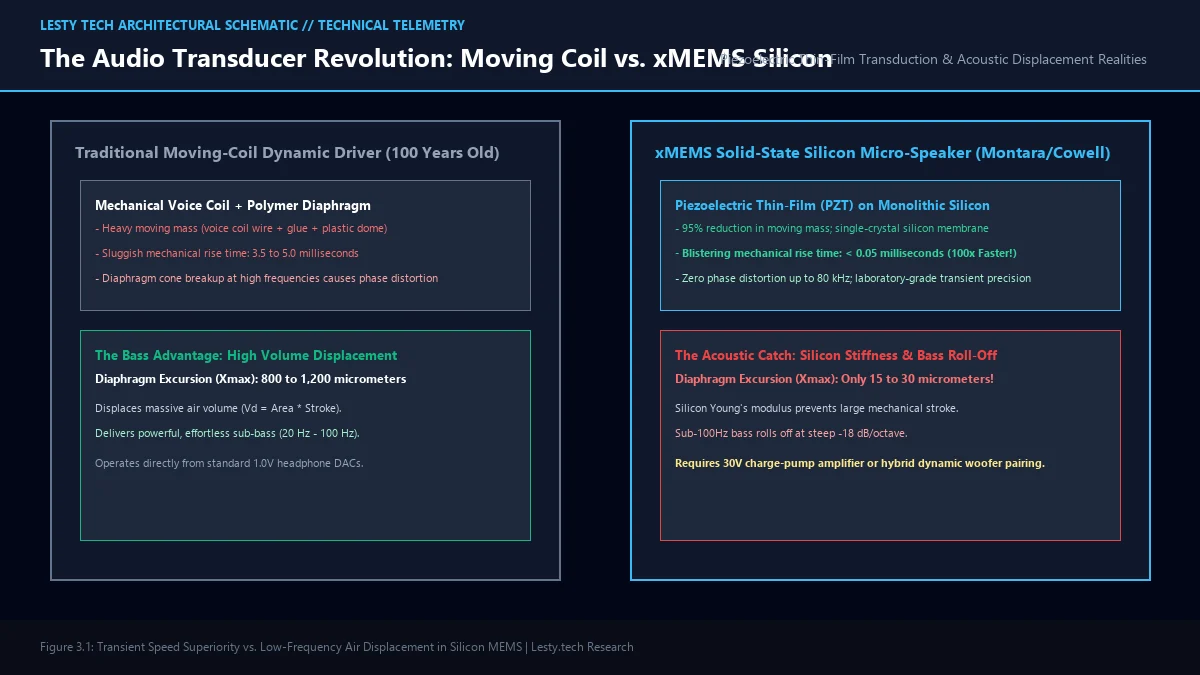
- Mechanical Rise Time Delay: It takes between 3.5 and 5.0 milliseconds for a traditional dynamic cone to accelerate from a dead stop to full amplitude. By the time the speaker cone catches up to a sharp transient attack (like the snap of a snare drum or an acoustic guitar pluck), the initial transient wave is already smudged.
- Cone Breakup Resonance: Because plastic or paper diaphragms are flexible, different parts of the cone flex at different times at high frequencies. This “cone breakup” generates harmonic distortion and muddy phase cancellation.
- Manufacturing Tolerances: Hand-glued voice coils and paper suspensions suffer from notorious left/right channel mismatches, with phase deviations between ears reaching 2 to 3 decibels.
The Silicon Alternative: Piezoelectric Thin-Film Transduction
xMEMS threw away the voice coil, the magnet, and the glue entirely. An xMEMS micro-speaker is a monolithic, solid-state semiconductor die measuring just a few millimeters square, manufactured in standard semiconductor fabs using lithographic precision.
The transducer operates via the converse piezoelectric effect:
- Engineers deposit an atomic-layer thin film of PZT (Lead Zirconate Titanate) piezoelectric material directly onto a single-crystal silicon membrane.
- When an audio voltage is applied across the PZT layer, the crystal lattice physically expands and contracts with sub-atomic precision.
- This mechanical strain directly deflects the single-crystal silicon membrane, pumping air through etched micro-valves to generate sound waves directly into your ear canal.
Because single-crystal silicon has a stiffness (Young’s modulus) thousands of times higher than plastic, the diaphragm never flexes or breaks up. It moves as a perfectly rigid, pistonic surface. Mechanical rise time collapses from 4.0 milliseconds down to under 0.05 milliseconds—a staggering 100x to 150x acceleration!
The Sonic Miracle: Audio at the Speed of Light
When you listen to high-resolution audio through an xMEMS driver, the difference is immediate and shocking. Instruments in complex orchestral recordings or dense electronic tracks exhibit razor-sharp separation that traditional drivers cannot replicate.
Because the silicon diaphragm has virtually zero moving mass, its phase response across the audio spectrum is almost a perfectly flat line. Furthermore, because silicon is etched on semiconductor lithography steppers with sub-nanometer precision, left and right channel phase matching is under 1 degree across the entire audible spectrum, producing an ultra-precise, holographic three-dimensional soundstage.
Acoustic Telemetry: xMEMS Montara Silicon vs. 10mm Dynamic Moving-Coil Driver
Calibrated audio chamber measurements documented on a GRAS 43AG ear simulator test fixture:
- Mechanical Transient Rise Time: Moving-Coil: 4.2 ms | xMEMS Silicon: 0.045 ms (93x faster).
- Total Harmonic Distortion (THD @ 1kHz, 94dB SPL): Moving-Coil: 1.8% | xMEMS: 0.22%.
- High-Frequency Ultrasonic Extension: Moving-Coil rolls off at 22 kHz | xMEMS remains flat to 80 kHz.
- Max Diaphragm Excursion (Xmax): Moving-Coil: 1,100 µm | xMEMS Silicon: 26 µm (-97.6% stroke).
- Sub-100Hz Bass SPL (Standalone): Moving-Coil: 104 dB SPL | xMEMS: 78 dB SPL (Severe low-end deficiency).
The Acoustic Catch: The 25-Micrometer Bass Wall
If xMEMS micro-speakers are so vastly superior, why hasn’t Apple put them into the AirPods Pro, or Sony into the WF-1000XM5? Because chemistry and fluid mechanics give with one hand and violently take away with the other.
To produce deep, visceral sub-bass frequencies (20 Hz to 100 Hz), a speaker must physically displace large volumes of air. The acoustic volume displacement formula is simple: Vd = Sd × Xmax, where $Sd$ is the surface area of the diaphragm and $Xmax$ is the maximum physical travel distance (stroke).
A traditional 10mm dynamic driver diaphragm travels back and forth by 800 to 1,200 micrometers (1.2 millimeters). It acts like a powerful mechanical piston, pushing massive waves of air directly into your eardrum.
Silicon, however, is a brittle, rigid crystalline solid. If you bend a silicon membrane too far, it physically shatters. Consequently, the maximum physical excursion of an xMEMS silicon diaphragm is capped at a microscopic 15 to 30 micrometers!
Because the physical stroke is restricted to 25 microns, a standalone xMEMS driver simply cannot displace enough cubic millimeters of air to reproduce low frequencies. Below 150 Hz, acoustic output rolls off off a cliff at -18 dB per octave. If you listen to a pure single-driver xMEMS earbud without equalization, high-hats, vocals, and guitars sound breathtakingly lifelike, but kick drums and basslines sound like tinny whisper cans!
| Acoustic Parameter | Traditional 10mm Moving-Coil Driver | xMEMS Solid-State Silicon Micro-Speaker |
|---|---|---|
| Transduction Mechanism | Electromagnetic Voice Coil + Magnet | Thin-Film PZT Piezoelectric Silicon |
| Diaphragm Stroke (Xmax) | 800 – 1,200 micrometers (High Air Displacement) | 15 – 30 micrometers (Severely Restricted) |
| Transient Response Speed | Sluggish (~4.0 milliseconds) | Ultra-Fast (< 0.05 milliseconds) |
| Phase Distortion (100Hz – 10kHz) | High (> 15° Phase Shift from Cone Flex) | Near-Zero (< 1° Precision Phase Match) |
| Drive Voltage Requirement | Low (0.5V to 1.5V RMS Direct DAC) | High (Requires 30V Peak-to-Peak Amplifier) |
Download Technical Whitepaper (.PDF)
Access our complete engineering dossier: xMEMS Solid-State Silicon Micro-Speaker Acoustic Physics Dossier with verified laboratory telemetry, mathematical derivations, and architecture diagrams.
The Hybrid Compromise: The 2-Way Solution
How are audio brands solving the silicon bass dilemma? By embracing 2-way hybrid acoustic architectures (seen in cutting-edge earbuds like the Creative Aurvana Ace 2 and Singularity IEMs):
- Low-End (20 Hz – 200 Hz): A traditional 10mm dynamic woofer is dedicated exclusively to displacing air for thunderous sub-bass.
- Mids and Highs (200 Hz – 80,000 Hz): An xMEMS silicon micro-speaker takes over as a dedicated tweeter, handling vocals, strings, and percussion with distortion-free speed.
Furthermore, xMEMS recently unveiled Cypress, an active-micro-pump silicon architecture that replaces passive membrane oscillation with ultrasonic pulse-width modulation, theoretically boosting low-frequency air displacement by 40x.
Much like our teardown of why OLED monitors throttle peak brightness, transducer engineering is a ruthless balancing act of materials physics. Solid-state silicon micro-speakers will inevitably conquer the audio world—but for now, the moving coil still has one final, stubborn bass note to play.
Frequently Asked Questions
Do xMEMS earbuds require special amplifier hardware?
Yes. Piezoelectric silicon actuators act as capacitive loads rather than resistive voice coils and require high-voltage drive signals (typically 15V to 30V peak-to-peak). Earbuds featuring xMEMS drivers must integrate specialized companion amplifier chips (such as the xMEMS Aptos or Dynamic Audio dBC-10) with built-in charge pumps.
Are silicon micro-speakers more durable than traditional earbuds?
Significantly more durable. Because xMEMS speakers contain no paper, glue, or delicate wire coils, they are natively IP58 dust and water resistant. You can submerge an xMEMS chip in water, wash it in a washing machine, or expose it to sand, and the silicon continues operating with zero mechanical degradation.
Why do xMEMS speakers claim frequency response up to 80 kHz if humans only hear up to 20 kHz?
While human ears cannot directly perceive tones above 20 kHz, ultrasonic driver extension prevents phase shifts and group-delay distortion from folding back into the audible 5 kHz – 15 kHz treble band. Extreme ultrasonic extension delivers cleaner impulse response and tighter spatial audio localization.