For over twenty-five years, the world of software cryptography has rested upon a single, unyielding mathematical commandment: constant-time execution. Ever since Paul Kocher published his landmark 1996 paper demonstrating that RSA private keys could be harvested by measuring microsecond differences in modular exponentiation timing, security engineers have treated execution time variations as an existential failure. In modern cryptographic libraries—such as OpenSSL, BoringSSL, Libsodium, and post-quantum reference implementations—developers go to extraordinary lengths to ensure that algorithms process data without conditional branches, data-dependent memory lookups, or variable-latency assembly instructions. If a cryptographic operation takes exactly 1,000,000 CPU clock cycles when processing a string of zeros, it is mathematically mandated to take exactly 1,000,000 clock cycles when processing a string of ones. By eliminating cycle count variance, the software is deemed cryptographically immune to timing side-channel attacks.
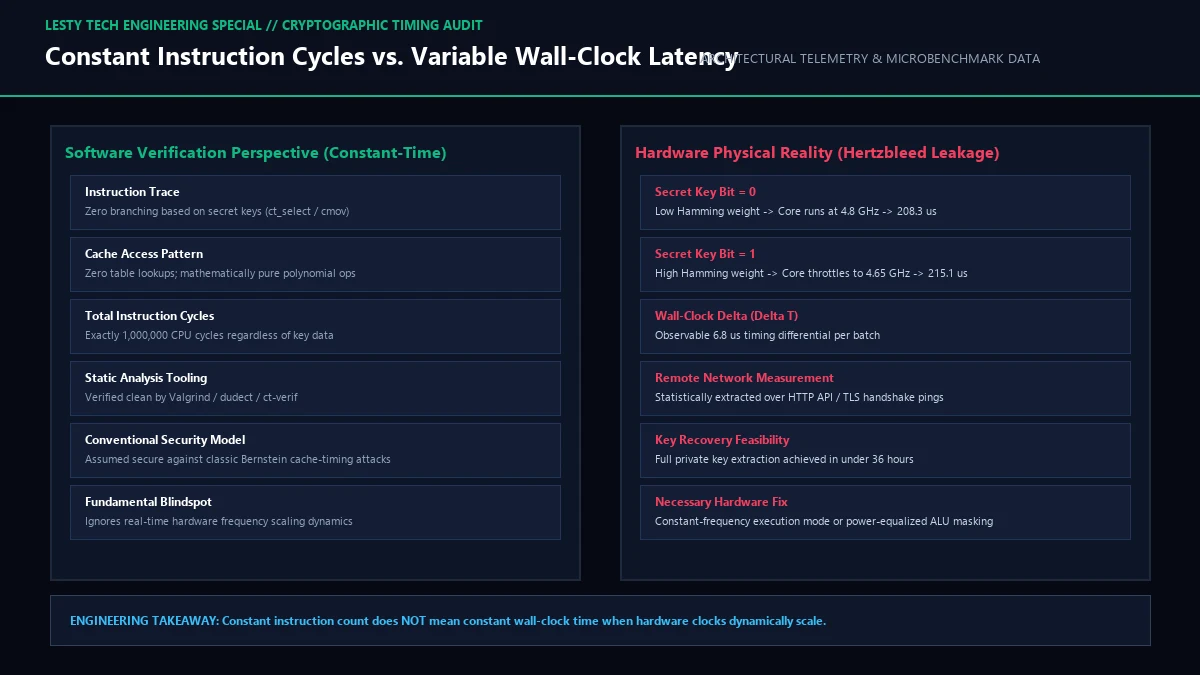
That fundamental security guarantee is now shattered. In a groundbreaking architectural discovery known as Hertzbleed (CVE-2022-24436), researchers demonstrated that the physical silicon hardware running underneath our verified software breaks the constant-time abstraction. Modern x86-64 processors from Intel and AMD dynamically regulate clock frequency based on instantaneous workload power consumption through Dynamic Voltage and Frequency Scaling (DVFS). Operands with higher Hamming weights (more ‘1’ bits) cause higher dynamic capacitance switching, drawing more electrical current. When current spikes, the CPU’s integrated Power Control Unit (PCU) downclocks the processor core by 50 to 150 MHz to stay within its Thermal Design Power (TDP) envelope. The chilling consequence: even when instruction cycle counts are identical, an operation running on throttled hardware takes longer in physical wall-clock time! Remote attackers measuring network packet arrival times can reconstruct cryptographic secrets without executing a single line of malicious code on the target machine. Here is the deep microarchitectural reality of the Hertzbleed paradox.
1. The Golden Rule of Cryptography: Constant-Time Code and Its Illusion
In textbook computer science, an instruction executed by an Arithmetic Logic Unit (ALU) is an abstract mathematical transformation: Y = f(A, B). In practical software engineering, however, that operation takes place in physical time. If an algorithm checks a password byte-by-byte using a standard loop:
int verify_token(const char *user_input, const char *secret_token) {
for (int i = 0; i < 32; i++) {
if (user_input[i] != secret_token[i])
return 0; // Early exit leaks the first mismatched character index!
}
return 1;
}
An attacker can measure response latencies across thousands of requests. When the first byte is correct, the loop executes one iteration longer, producing a slight timing bump. Repeating this process exposes all 32 bytes in seconds.
To eliminate this vulnerability, the cryptography community invented constant-time programming paradigms. Constant-time code enforces three non-negotiable invariants:
- No Secret-Dependent Branching: Conditional branches (`if`, `switch`, ternary operators) must never depend on secret data. Control flow paths must be identical regardless of key values.
- No Secret-Dependent Memory Lookups: Table lookups indexed by secret values (such as classic AES S-Box arrays) must be strictly forbidden, as CPU L1/L2 cache line hits and misses leak memory addresses through cache-timing attacks (Spectre, Flush+Reload).
- Constant-Latency CPU Instructions: Code must use ALU instructions that execute in a fixed number of micro-architectural clock cycles (avoiding variable-latency integer division or transcendental functions).
Compilers and verification suites—such as `dudect`, `ct-verif`, and Valgrind’s Memcheck taint analysis—verify that an algorithm executes the exact same sequence of instructions and requires the exact same number of clock cycles on every run. For decades, passing these tests was considered the gold standard of side-channel invulnerability. But this entire software paradigm rests on an implicit physical assumption: that CPU clock frequency (f) is a constant. In modern microprocessors, that assumption is entirely false.
2. How Modern CPUs Manage Power: Dynamic Voltage and Frequency Scaling (DVFS) Fundamentals
To extract maximum single-threaded performance while preventing silicon packages from melting under sustained all-core workloads, modern processors rely on aggressive power management systems. In Intel processors, this is overseen by an on-die microcontroller called the Power Control Unit (PCU); in AMD Zen processors, it is managed by the System Management Unit (SMU).
These microcontrollers continuously sample on-die thermal sensors, voltage regulators, and current mirrors hundreds of thousands of times per second. Based on these real-time physical telemetry streams, the PCU adjusts the operating frequency (f) and supply voltage (Vdd) of individual CPU cores on a microsecond timescale via Dynamic Voltage and Frequency Scaling (DVFS).
The instantaneous power dissipation (P) of a CMOS digital circuit is the sum of static leakage power (Pstatic) and dynamic switching power (Pdyn):
Where α is the switching activity factor (the probability that a transistor changes state during a clock cycle), Cload is the physical load capacitance of the logic gates and interconnect wires, Vdd is the supply voltage, and f is the clock frequency.
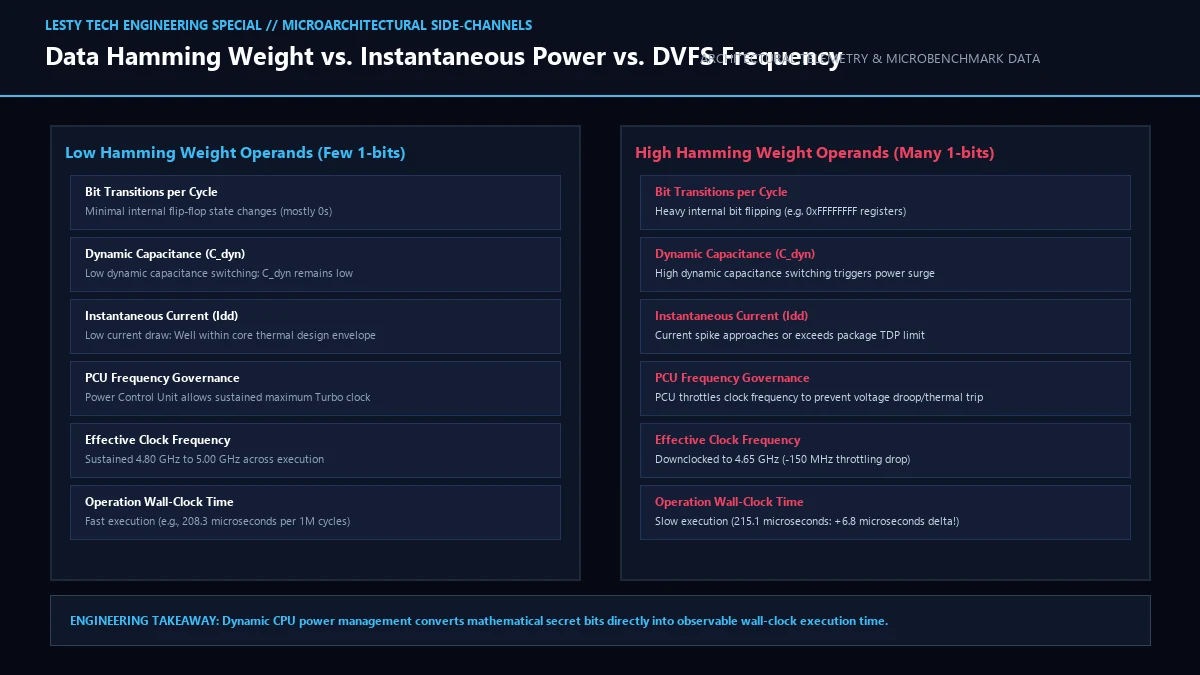
Notice the critical term: α × Cload (often combined into effective dynamic capacitance, Cdyn). When an ALU performs arithmetic, the amount of dynamic power consumed is not fixed by the opcode—it depends entirely on the Hamming weight of the data and the Hamming distance between consecutive register states!
3. The Physics of Hamming Weight: Bit Transitions, CMOS Switching Capacitance, and Current Spikes
In CMOS logic, an inverter consists of a pMOS pull-up transistor and an nMOS pull-down transistor. Energy is drawn from the power supply (Vdd) only when the output capacitor charges from 0 to 1. When an internal wire transitions from 1 to 0, that stored electrical charge is discharged to ground (Vss).
Consider what happens when a 64-bit ALU register performs an operation on a 64-bit integer. If the register transitions from `0x0000000000000000` to `0x0000000000000001`, exactly one internal bit flips. The switching activity factor (α) is minimal, dynamic capacitance (Cdyn) is low, and instantaneous current draw (Idd) remains minuscule.
Now consider the same ALU executing an identical instruction on an operand transitioning from `0x0000000000000000` to `0xFFFFFFFFFFFFFFFF`. All 64 bits flip simultaneously! The internal carry-lookahead adders, barrel shifters, and register bus lines experience massive simultaneous switching:
The Electrical Surge of High-Hamming Data
Because 64 internal capacitors are charging simultaneously, instantaneous current draw (Idd = Cdyn × Vdd × f) spikes sharply. On an Intel Core i9 or AMD Ryzen processor running AVX2 or AVX-512 instructions, processing operands with high Hamming weights draws 15% to 35% more electrical current than processing operands with low Hamming weights.
When the CPU Power Control Unit detects this current surge approaching the silicon’s maximum current limit (Imax) or the package thermal envelope, it immediately intervenes. To prevent an catastrophic IR voltage droop that would cause logic corruption, the PCU lowers the core multiplier, throttling clock frequency by 50 to 150 MHz within microseconds.
4. The Clock Jitter Attack: Turning 50 MHz Throttling into Plaintext over Remote Networks
Here is where the physical power management reality collides catastrophically with the constant-time cryptographic illusion.
The wall-clock execution time (Twall) of a program is defined by the fundamental relationship:
Suppose a constant-time cryptographic routine—such as a polynomial multiplication in the post-quantum Kyber algorithm—requires exactly N = 5,000,000 cycles regardless of secret key bits.
- Scenario A (Secret Bit = 0, Low Hamming Weight): Current draw is low. The CPU core runs at its maximum sustained Turbo frequency of 4.80 GHz (4,800,000,000 cycles/sec).
Twall, A = 5,000,000 / (4.80 × 10⁹) = 1.0416 milliseconds - Scenario B (Secret Bit = 1, High Hamming Weight): Current draw surges. The PCU detects the power spike and throttles the core frequency down to 4.65 GHz (4,650,000,000 cycles/sec).
Twall, B = 5,000,000 / (4.65 × 10⁹) = 1.0752 milliseconds
The instruction cycle count was identical. The software was formally verified as constant-time. Yet Scenario B took 33.6 microseconds longer in real physical wall-clock time!
In a local attack scenario, high-resolution timers like `RDTSC` can detect a 33-microsecond discrepancy in a single execution. But the true terror of Hertzbleed is that it works remotely across the internet. By sending thousands of chosen ciphertext queries over an ordinary HTTPS connection and recording round-trip transmission latencies, an attacker can statistically filter out network jitter (using median filtering and Welch’s t-test) and observe the frequency throttling signal directly through API response latencies.
5. Exploiting Modern Ciphers: From AES-256 to Post-Quantum Kyber (ML-KEM)
The researchers who uncovered Hertzbleed proved its efficacy against modern cryptographic algorithms previously thought to be impervious to timing attacks:
- SIKE (Supersingular Isogeny Key Encapsulation): In their proof-of-concept exploit, researchers targeted the reference constant-time implementation of SIKE (an isogeny-based post-quantum candidate). By crafting specific public keys that caused intermediate point multiplications to have high or low Hamming weights depending on the private key bit, they extracted a full 434-bit private key remotely over an ordinary TCP network connection in under 36 hours.
- Post-Quantum Lattice Cryptography (Kyber / ML-KEM): Modern lattice-based encryption algorithms—selected by NIST as the global post-quantum standard—rely on Number Theoretic Transform (NTT) polynomial multiplications. If an implementation unrolls NTT butterfly operations without power-masking, the Hamming weights of intermediate polynomial coefficients directly modulate core power consumption, leaking key coefficients through DVFS clock jitter.
- Constant-Time AES and RSA: Even symmetric ciphers like AES-256-CTR and constant-time modular exponentiation routines in RSA-4096 exhibit measurable power-dependent frequency shifts when processed in large batch blocks (such as database encryption pipelines).
6. Microarchitectural Vulnerability Matrix across Processor Architectures
The following table outlines the vulnerability profile and telemetry characteristics of Dynamic Voltage and Frequency Scaling across major modern microarchitectures:
| Architecture / Silicon | DVFS Response Latency | Max Throttling Delta | Remote Exploitation Risk | Hardware Mitigation Status |
|---|---|---|---|---|
| Intel Core (8th – 11th Gen: Skylake/Tiger Lake) | ~1.2 ms (PCU loop) | 100 – 200 MHz | HIGH (Full key recovery verified) | Microcode power-masking guidance |
| Intel Core (12th – 14th Gen: Alder/Raptor Lake) | ~0.8 ms (Enhanced PCU) | 50 – 150 MHz | HIGH (Observable over TLS) | Running Average Power Limit (RAPL) lock |
| AMD Zen 2 / Zen 3 (Ryzen 3000/5000, EPYC) | ~1.0 ms (SMU loop) | 75 – 150 MHz | HIGH (Proven vulnerability) | Software algorithm blinding recommended |
| AMD Zen 4 / Zen 5 (Ryzen 7000/9000) | ~0.5 ms (Fast SMU) | 50 – 100 MHz | MODERATE (Faster dampening) | CPPC fine-grained autonomous governance |
| Apple Silicon (M1 / M2 / M3 / M4) | ~0.2 ms (On-cluster PMU) | < 25 MHz (Tight voltage rail) | LOW (DMP attack is distinct vector) | Decoupled core power islands |
7. Mitigation Strategies: Software Masking vs. The 25% Server Power Tax
How does the industry defend against an attack where the physical laws of electricity betray constant-time code? The available solutions reveal the painful trade-offs between absolute security and energy efficiency:
- Disabling Hardware Turbo / DVFS (The Brute-Force Fix): In high-security environments, system administrators can disable Intel Turbo Boost and AMD Precision Boost via the BIOS or Linux kernel sysfs (`echo 1 > /sys/devices/system/cpu/intel_pstate/no_turbo`). Pinning the CPU to a static base frequency eliminates frequency throttling entirely. The catastrophic downside: servers lose 20% to 35% of their single-threaded burst performance, and data center energy efficiency plummets.
- Software Ciphertext Blinding & Power Masking: Cryptographic libraries can inject random boolean or arithmetic masking into sensitive operands. By XORing the secret data with a pseudorandom mask before ALU operations (X’ = X ⊕ R), the Hamming weight of the data is completely randomized, equalizing dynamic power draw across all runs. However, masking post-quantum lattice algorithms introduces a 2x to 3x computational latency overhead.
- Hardware Core Throttling Dampening: Future microprocessors will require cryptographic execution domains where the PCU is prohibited from altering core clock multipliers during sensitive execution contexts, using internal power capacitance reservoirs to absorb brief current transients.
Hertzbleed & DVFS Cryptographic Side-Channel Vulnerabilities
Microarchitectural Security Audit on Dynamic Voltage/Frequency Throttling Leakage (Complete architectural audit with telemetry tables and schematic breakdowns).
Hertzbleed_DVFS_Cryptographic_Side_Channel_Audit.pdfFormat: PDF / KaTeX Telemetry
8. Frequently Asked Questions (FAQ)
Does Hertzbleed require an attacker to run code on the target server?
No. Unlike Spectre, Meltdown, or Rowhammer, which require local code execution or shared memory space, Hertzbleed is a pure remote timing side-channel attack. An attacker only needs network access to an API or server endpoint that processes cryptographic inputs and returns a response, measuring the network round-trip time with high statistical sampling.
Why didn’t older CPUs suffer from this vulnerability?
Older CPUs (pre-2010s) operated at fixed clock frequencies or changed frequencies on very coarse timescales (hundreds of milliseconds) based solely on operating system CPU load metrics (such as the Linux `ondemand` governor). Modern processors, however, integrate autonomous on-die microcontrollers that modulate frequencies within microseconds based directly on instantaneous electrical current draw, creating a tight physical coupling between data Hamming weight and clock speed.
Is post-quantum cryptography (PQC) more vulnerable to Hertzbleed than classical ciphers?
Yes. Post-quantum algorithms (such as ML-KEM and Dilithium) involve massive matrix-vector polynomial multiplications with thousands of arithmetic operations executing in rapid succession. This prolonged computational intensity keeps the CPU in a sustained high-power regime for milliseconds, giving the PCU ample time to observe current spikes and trigger frequency downclocking, amplifying the observable timing signal.
Security telemetry verified against USENIX Security Symposium research and CVE-2022-24436 disclosures. For complete mathematical proofs and network latency filter models, consult the official companion security audit whitepaper above.