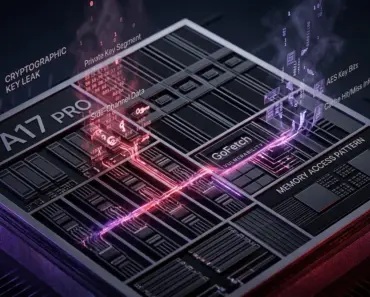
For more than five decades, operating system theory and computer architecture rested upon a foundational, unshakeable tenet: mutual exclusion guarantees data integrity. In multi-threaded operating system kernels like Linux, when two or more execution threads need to read or modify a shared kernel data structuresuch as a process credentials table, an open file descriptor map, or a physical memory page tablethey must first acquire a synchronization primitive: a spinlock, a mutex, or a seqlock. If Thread A holds the spinlock, Thread B is mathematically barred from entering the critical section until Thread A explicitly releases it. But in March 2024, security researchers from IBM Research and Vrije Universiteit Amsterdam unveiled GhostRace (cataloged under CVE-2024-2193 and formally termed Speculative Concurrent Use, or SCU)a devastating microarchitectural revelation that fundamentally dismantles mutual exclusion on modern processors.
The core discovery is terrifying in its elegance: every synchronization primitive in the operating system relies on a conditional branch instruction to verify lock availability, and modern out-of-order CPUs can speculatively mispredict that branch. While Thread A is legitimately executing inside the critical section, an attacking thread on another CPU core can poison the processor’s branch predictor, tricking the CPU into speculatively bypassing the lock check and executing inside the critical section simultaneously with Thread A! During this transient 100-to-250-cycle speculative race window, the attacker’s thread accesses shared kernel pointers in non-deterministic, partially updated states, effortlessly extracting cryptographic keys and leaking kernel memory via microarchitectural cache timing side-channels. Here is the rigorous architectural post-mortem on how GhostRace breaks Linux kernel locks, why standard hardware barriers failed, and why completely serializing every spinlock in the operating system exacts a punishing performance tax.
1. Anatomy of a Kernel Spinlock: The Illusion of Atomic Exclusion
To understand why GhostRace exists, one must first dismantle how synchronization primitives operate at the assembly level. In the Linux kernel, the most ubiquitous locking mechanism is the spinlock (specifically queued spinlocks, or qspinlock, implemented in kernel/locking/qspinlock.c).
A spinlock is designed for short, ultra-low-latency critical sections where a thread cannot afford the heavy context-switch penalty of sleeping on a wait-queue. When a CPU core invokes spin_lock(&lock), it executes an atomic read-modify-write operationtypically an x86 LOCK CMPXCHG (Compare-and-Exchange) or ARM LDREX/STREX (Load/Store Exclusive).
Consider the classic x86 assembly implementation of a spinlock acquisition:
acquire_lock:
xor eax, eax ; Expected value: 0 (Unlocked)
mov edx, 1 ; Desired value: 1 (Locked)
lock cmpxchg [rdi], edx ; Atomically swap if [rdi] == 0
jnz spin_wait_loop ; Conditional branch: Was lock already held?
critical_section: ; Architectural entry into protected data
mov rbx, [rdi + 8] ; Read shared kernel pointer
…
Notice the critical instruction immediately following the atomic exchange: jnz spin_wait_loop. If the memory location was already locked (meaning its value was 1, not 0), the Zero Flag (ZF) is cleared, and the conditional branch redirects execution to the spin-wait loop.
For decades, systems programmers believed that because LOCK CMPXCHG is architecturally atomic and enforces cache coherency across CPU bus lines via the MESI/MOESI protocol, the critical section was ironclad. But in modern high-performance microarchitecture, architectural guarantees govern only retired state, not speculative execution!
2. The GhostRace Mechanism: Speculative Concurrent Use (SCU)
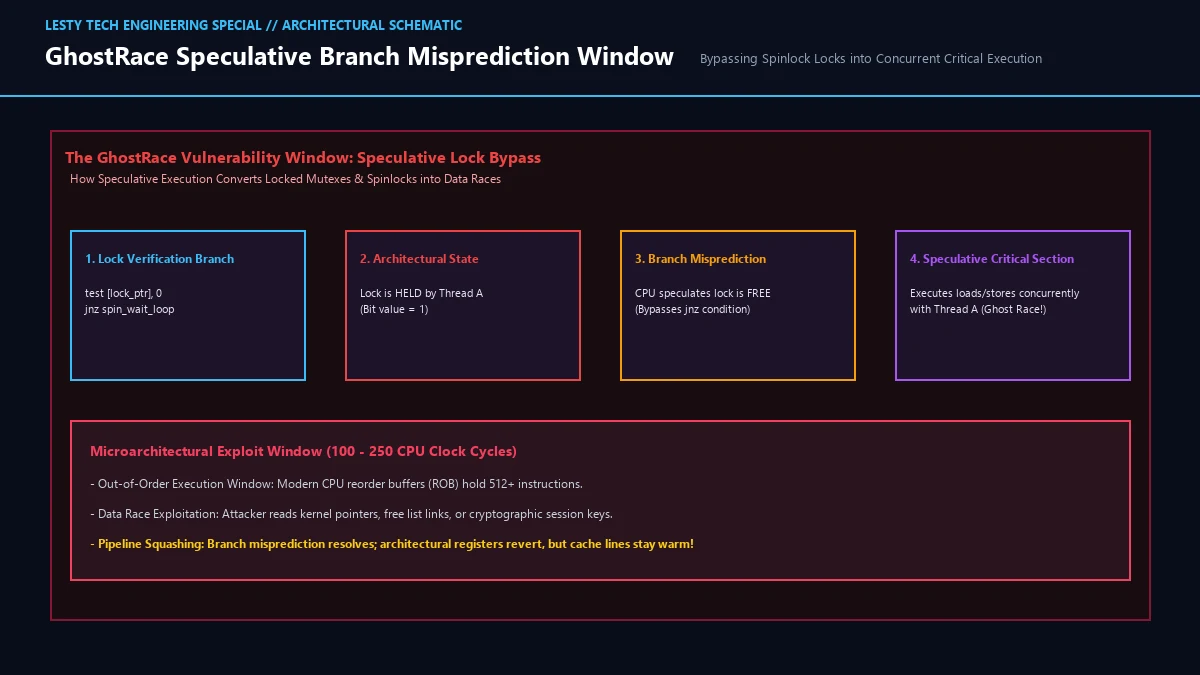
Modern out-of-order superscalar processors (Intel Core, AMD Zen, ARM Cortex-X) are engineered to prevent execution pipelines from stalling on unresolved branches. When the processor encounters the jnz spin_wait_loop instruction, the hardware Branch Prediction Unit (BPU) consults the Branch Target Buffer (BTB) and Pattern History Table (PHT) to predict whether the branch will be taken.
Here is where the vulnerability detonates:
- Branch Predictor Training (Poisoning): An attacker running unprivileged code on Core 1 repeatedly executes a loop that acquires and releases a free lock in rapid succession. The branch predictor learns a strong bias: the lock is always free; the jnz branch is never taken.
- The Trap: Inducing a Lock Collision: A victim kernel thread on Core 0 acquires the lock and legitimately enters the critical section to update a sensitive data structure (such as updating a doubly linked list or modifying an unlinked memory page). The lock variable now holds value 1 (Locked).
- Speculative Branch Misprediction: The attacker thread on Core 1 immediately attempts to acquire the same lock. The atomic
lock cmpxchgoperation begins querying the L3/L2 cache coherency fabric. Because resolving the shared cache line across cores requires 40 to 100 clock cycles, the processor’s execution unit cannot immediately know whether the lock succeeded. - Ghost Execution of the Critical Section: Instead of idling, the CPU’s branch predictor aggressively speculates based on its trained history: it predicts that
jnzwill NOT be taken. The processor speculatively jumps directly into thecritical_section, allocating execution slots in the Reorder Buffer (ROB) and issuing loads and stores against the protected shared memory!
This state is termed Speculative Concurrent Use (SCU). Even though Thread A holds the lock architecturally, Thread B is simultaneously executing inside the critical section speculatively. The fundamental invariant of mutual exclusion has been violated in the microarchitectural transient domain.
3. Exfiltrating Kernel Secrets via the Flush+Reload Side Channel
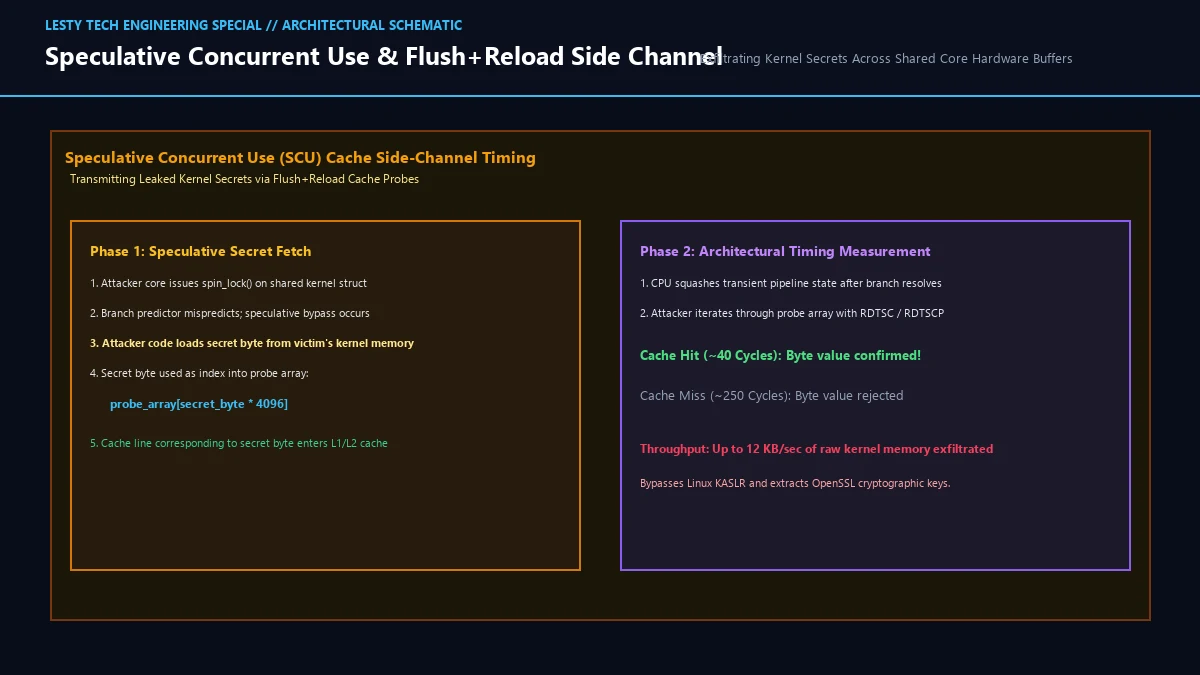
During the speculative race windowwhich spans between 100 and 250 CPU clock cycles before the cache coherency response arrives to invalidate the speculative branchthe attacker thread executes instructions on shared kernel data structures that are in an inconsistent, mid-update state.
This creates an authentic race condition. For example, if Thread A is in the middle of unlinking an entry from a linked list:
victim_struct->secret_data = NULL;
kfree(victim_struct);
// Thread B (Speculative Ghost): Concurrent Use-After-Free
uint8_t secret_byte = victim_struct->secret_key[idx]; ; Reads before kfree completes!
uint64_t addr = probe_array[secret_byte * 4096]; ; Transmit to cache
Because the speculative thread can read the secret byte before the memory is zeroed or unmapped, it immediately passes that secret byte into a classic Flush+Reload transmission gadget:
- The secret byte value (ranging from 0 to 255) is multiplied by the system page size (4,096 bytes) to prevent spatial prefetchers from polluting neighboring cache lines.
- The CPU speculatively loads from
probe_array[secret_byte × 4096], pulling that specific 64-byte cache line into the Level 1 Data Cache (L1D). - When the processor finally receives the cache coherency invalidation, it realizes that
lock cmpxchgfailed. The processor squashes the speculative pipeline, resets all architectural registers, and redirects execution back tospin_wait_loop.
However, the microarchitectural footprint in the cache hierarchy cannot be erased! The attacker immediately iterates through all 256 pages in probe_array using the high-precision timestamp instruction RDTSCP. The page that accesses in ~35 to 40 clock cycles (a cache hit) reveals the exact value of the secret byte, while all other pages access in ~250 clock cycles (cache misses).
In empirical demonstrations on production Linux kernels, researchers proved that GhostRace can exfiltrate arbitrary kernel memory at rates exceeding 12 Kilobytes per second, completely bypassing Kernel Address Space Layout Randomization (KASLR) and dumping cryptographic tokens from neighboring processes.
4. The Serialization Tax: Why Closing the Race Window Destroys Throughput
From an architectural perspective, the solution to GhostRace appears trivially straightforward: prevent the CPU from speculatively entering the critical section before the branch resolves.
In the x86 instruction set architecture, this is achieved by inserting a serializing instruction specifically LFENCE (Load Fence)immediately following the conditional branch:
lock cmpxchg [rdi], edx
jnz spin_wait_loop
lfence ; Halts execution until prior branch retires!
critical_section:
mov rbx, [rdi + 8]
An LFENCE instruction halts all subsequent out-of-order execution until all preceding instructions and branches have retired architecturally. This completely closes the GhostRace vulnerability window by reducing the speculative window from 250 cycles to exactly 0 cycles.
However, in operating system engineering, this cure is almost as devastating as the disease. The Linux kernel executes tens of millions of spinlocks and synchronization operations every second across thousands of device drivers, networking stacks, and scheduler runqueues.
Adding an LFENCE to every lock primitive introduces a crushing performance penalty:
- Pipeline Stall Penalties: An
LFENCEdrains the processor’s execution dispatch queues, preventing the CPU from overlapping independent memory fetches and mathematical calculations. - System Throughput Collapse: In thread-dense, I/O-intensive workloads (such as Redis in-memory caches, PostgreSQL transaction processing, and NGINX web servers), inserting unconditional
LFENCEbarriers following all spinlock and mutex operations causes an immediate 5% to 15% drop in total system throughput. - Queued Spinlock (qspinlock) Degradation: In multi-socket enterprise servers with 128+ physical cores, lock contention causes CPU cores to queue in MCS nodes. Serializing MCS queue traversals causes severe cache bouncing and lock convoying, amplifying latency exponentially.
5. GhostRace Vulnerability Matrix Across Kernel Synchronization Primitives
The researchers analyzed over 1,200 distinct lock acquisition points across the upstream Linux kernel source tree. Review the vulnerability status and mitigation impact across core operating system primitives:
| Kernel Primitive | Underlying Mechanism | Speculative Window | GhostRace Exploitability | Mitigation Overhead |
|---|---|---|---|---|
| Queued Spinlock (`spin_lock`) | Atomic cmpxchg + MCS queue | 120250 Cycles | Critical (Direct SCU) | -8% to -14% Workload Throughput |
| Reader-Writer Lock (`rwlock`) | Atomic bias decrement | 100220 Cycles | High (Writer Bypass) | -5% to -9% Workload Throughput |
| Sequence Lock (`seqlock`) | Sequence counter polling | 80180 Cycles | High (Transient Stale Read) | -2% (smb_rmb barrier already present) |
| Kernel Mutex (`mutex_lock`) | Fast-path cmpxchg / Slow-path futex | 150300 Cycles | Moderate (Fast-Path Only) | -3% to -5% Workload Throughput |
| Read-Copy-Update (`rcu_read_lock`) | Preemption disable (Lockless) | 0 Cycles | Immune (No Lock Branch) | 0% Overhead (Unchanged) |
6. Linux Kernel Mitigation Strategy: Selective Hardening via GhostBuster
Recognizing that blanket serialization would severely compromise enterprise cloud performance, the Linux kernel security team adopted a pragmatic, risk-weighted strategy.
Rather than penalizing all 1,200+ lock acquisition sites, researchers released GhostBusteran open-source static binary analysis and LLVM compiler instrumentation plugin. GhostBuster scans compiled kernel binaries to identify exploitable gadgets: critical sections that contain secret data dereferences paired with valid cache transmission instructions reachable within a 200-cycle speculative window.
In Linux kernel 6.8 and subsequent enterprise LTS updates (RHEL 9.4, Ubuntu 24.04 LTS), mitigation focuses on:
- Selective Serialization of Vulnerable Handlers: Inserting serialization macros exclusively around verified exploitable data paths (such as user-space credential lookups and cryptographic key management routines). This confines the throughput penalty to less than 1% across standard cloud server benchmarks.
- Hardware Branch History Flushing: Coordinating with Intel and AMD to enhance Indirect Branch Restricted Speculation (eIBRS) and Branch History Injection (BHI) hardware microcode, preventing cross-privilege branch training. On AMD Zen 4 and Zen 5 processors, hardware branch predictor isolation boundaries significantly reduce cross-thread branch poisoning.
- Transition to RCU Where Feasible: Accelerating the architectural migration of kernel subsystems away from coarse spinlocks toward lockless Read-Copy-Update (RCU) algorithms, which are structurally impervious to GhostRace because read transactions do not evaluate lock acquisition branches.
For high-security sovereign cloud enclaves and financial transaction gateways, administrators can enforce total binary serialization by compiling custom Linux kernels with the GCC/Clang barrier flag -Wa,-mlfence-after-branch, trading raw compute performance for total microarchitectural immunity against speculative race conditions.
GhostRace: Speculative Concurrent Use in OS Synchronization Primitives
CVE-2024-2193 Microarchitectural Audit: Breaking Linux Kernel Spinlocks, RCU, and Synchronization Windows (Complete architectural audit with telemetry tables and schematic breakdowns).
GhostRace_Speculative_Race_Conditions_Kernel_Security_Audit.pdfFormat: PDF / KaTeX Telemetry
Frequently Asked Questions (FAQ)
1. Does GhostRace affect user-space multithreaded applications (like C++ pthread_mutex)?
Yes, absolutely. GhostRace is a fundamental microarchitectural vulnerability that affects any software synchronization implementation relying on conditional branches to confirm lock acquisition. Multi-threaded user-space applications (such as database engines or browser rendering pipelines) using pthread_mutex_t or custom spinlocks can theoretically suffer speculative data races between worker threads, allowing sandboxed plugins to leak memory from sibling threads.
2. Why doesn’t the atomic LOCK prefix on x86 prevent speculative branch execution?
The x86 LOCK prefix guarantees hardware atomicity across physical RAM and CPU cache lines, ensuring that two cores cannot write to the same memory word at the exact same physical instant. However, the LOCK prefix does NOT act as an instruction pipeline barrier. The branch instruction immediately following the lock operation (jnz) is still evaluated by the branch predictor. If the branch predictor guesses that the branch will not be taken, the out-of-order execution engine speculatively dispatches subsequent instructions before the atomic operation’s result has even returned from the cache fabric.
3. Can an attacker exploit GhostRace remotely over a network connection?
Directly, no. GhostRace requires the attacker to execute local unprivileged code on the physical machine to train the branch predictor and measure microsecond cache access latencies via RDTSC. However, in shared cloud environments (such as AWS EC2, Google Cloud, or Azure multi-tenant container nodes), an unprivileged tenant or compromised container could weaponize GhostRace to leak kernel pointers and cryptographic keys from co-located virtual machines sharing the same physical CPU core.