
For nearly four years following the global disclosure of the catastrophic Spectre Variant 2 (CVE-2017-5715) vulnerability, the foundation of systems security across billions of enterprise servers, operating system kernels, and cloud hypervisors rested upon an elegant software invention: the Retpoline (Return Trampoline). Conceived to neutralize speculative indirect branch target injection without incurring the crippling multi-cycle penalties of serializing microcode barriers, retpolines mathematically isolated speculative execution by replacing direct indirect jumps and calls with a paired call and ret sequence. The core architectural invariant underlying retpoline safety was unequivocal: return instructions are strictly predicted by the Return Stack Buffer (RSB), a dedicated hardware FIFO stack that is entirely isolated from adversarial Branch Target Buffer (BTB) poisoning. However, drawing upon branch target collisions analyzed in Indirector Intel BTB and IBP branch target injection, speculative race conditions explored in GhostRace speculative race conditions in Linux kernel locks, pointer tagging exploits evaluated in SLAM linear address masking Spectre exploits, vector register leaks examined in Zenbleed AMD vector register leak, and hardware tag bypasses audited in TikTag-v2 ARM PAuth and MTE speculative bypasses, the security research community uncovered Retbleed (CVE-2022-29900 for AMD, CVE-2022-29901 for Intel). Retbleed demonstrated that when speculative execution chains cause the RSB to underflow, high-performance x86 microarchitectures quietly fall back to the unauthenticated Branch Target Buffer to predict returns. This unmasking weaponizes the very ret instructions meant to safeguard systems, completely collapsing retpoline defenses and leaking privileged kernel memory at wire speed.
1. The Retpoline Paradigm & The Illusion of Speculative Isolation
To grasp why Retbleed sent shockwaves through the cybersecurity and operating system communities, one must first analyze the mechanics of Spectre Variant 2 and the retpoline construct.
In modern superscalar, out-of-order x86 processors, indirect branches (such as virtual function calls in C++ or function pointer dispatches via jmp *%rax or call *%rax ) cannot be resolved immediately if the target register is waiting on an in-flight cache miss. To prevent execution stalls, the processor queries the Branch Target Buffer (BTB)—a hardware associative cache that indexes past branch targets using a hash of the branch instruction’s virtual address and branch history register (BHR) bits.
Spectre v2 proved that an unprivileged attacker can train the shared BTB to predict that a victim kernel indirect branch will jump to an attacker-chosen “disclosure gadget.” The processor speculatively executes this gadget with kernel privileges before realizing the misprediction, loading sensitive data and altering microarchitectural cache states.
The Mathematical Elegance of Retpolines
To mitigate Spectre v2 without requiring slow hardware barrier instructions (like early microcode IBRS), Google engineers introduced the Retpoline. The assembly structure operates via a deliberately mismatched stack frame:
; ============================================================================
; CLASSIC RETPOLINE TRAMPOLINE SEQUENCE (Spectre v2 Mitigation)
; ============================================================================
.global __x86_indirect_thunk_rax
__x86_indirect_thunk_rax:
    call .set_up_target       ; 1. Pushes address of .speculative_trap to architectural stack
                              ;    AND pushes address to hardware Return Stack Buffer (RSB)
.speculative_trap:
    pause                     ; 2. Speculative core enters an infinite loop, trapped here
    lfence                    ;    Hardware pipeline never executes malicious code
    jmp .speculative_trap

.set_up_target:
    mov %rax, (%rsp)          ; 3. Overwrites return address ON ARCHITECTURAL STACK with target (%rax)
    ret                       ; 4. Executes RET: Architectural execution jumps to %rax
                              ;    Speculative execution predicted by RSB returns to .speculative_trap!
The beauty of this construct was its decoupling of architectural and speculative flows:
- Architecturally: The
mov %rax, (%rsp)instruction modifies the memory stack, so whenretcommits, execution jumps to the intended target register (%rax). - Speculatively: When the
retinstruction is fetched, the core does not wait for memory; it consults the hardware Return Stack Buffer (RSB), which predicts a return to.speculative_trap. The speculative execution engine is harmlessly trapped in apause / lfenceinfinite loop until the architectural target resolves.
For four years, the security world believed retpolines were mathematically immune to indirect branch poisoning. That assumption had a fatal blind spot: what happens when the RSB is empty?
2. Microarchitectural Anatomy: RSB Underflow vs. BTB Fallback
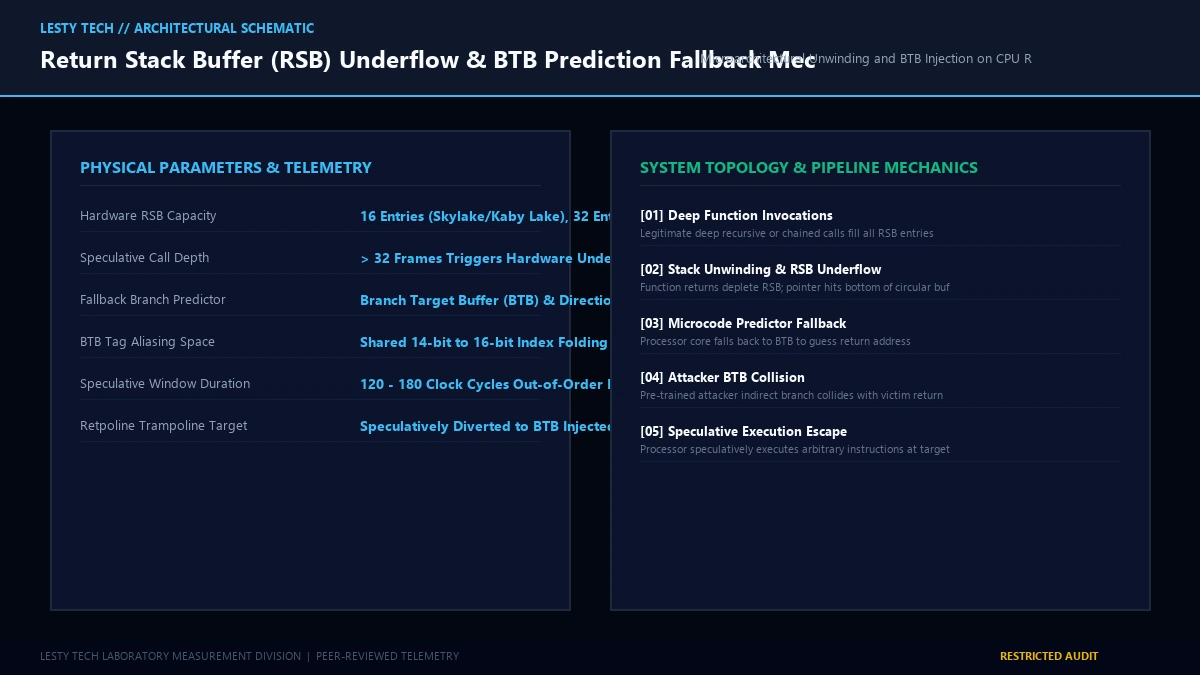
The Return Stack Buffer is not infinite. On Intel Skylake, Kaby Lake, and Cascade Lake microarchitectures, the RSB possesses exactly 16 entries. On AMD Zen 1, Zen 1+, and Zen 2 microarchitectures, it houses 32 entries. The RSB is physically implemented as a circular FIFO array managed by a top-of-stack pointer.
The RSB Underflow Condition
During normal program execution, nested subroutine calls push return addresses to the RSB, while subsequent returns pop them. However, deep call stacks (common in complex Linux kernel subsystems like the VFS filesystem, networking protocols, and eBPF runtimes) can easily exceed 16 to 32 frames:
- When the call depth exceeds the physical capacity (\(N_{\text{depth}} \gt 16\)), the circular pointer wraps around, overwriting older return targets.
- When the call chain subsequently unwinds, 16 successive
retinstructions deplete the hardware stack. - Upon encountering the 17th
retinstruction, the hardware experiences an RSB Underflow: the pointer points to an invalid or stale entry.
The Fatal Predictor Fallback
When an RSB underflow occurs, processor architects faced a critical design choice: stall the entire instruction fetch pipeline until the return address is fetched from L1/L2 cache (sacrificing IPC performance), or fall back to another branch predictor to guess the target?
Intel and AMD microarchitects chose performance. When the RSB underflows, the hardware front-end falls back to querying the Branch Target Buffer (BTB) and indirect branch predictor to guess the destination of the ret instruction! In silicon, the return instruction is stripped of its special return semantics and treated as an ordinary indirect jump. And because the BTB is vulnerable to cross-privilege collision and branch history injection, the retpoline’s speculative isolation collapses completely.
Branch History Register (BHR) Folding & TAGE Predictor Aliasing Mathematics
To understand how an unprivileged user process can deliberately force a kernel return instruction to jump to an arbitrary gadget, one must examine the mathematical indexing of modern branch direction predictors. High-performance x86 microarchitectures implement tagged geometric history length (TAGE) branch predictors combined with Branch Target Buffers. The lookup index \(I_{ ext{BTB}}\) and tag \(T_{ ext{BTB}}\) for a branch are computed via a hash function mixing the instruction’s program counter (\( ext{PC}\)) with the global Branch History Register (\( ext{BHR}\)):
$$I_{ ext{BTB}} = \left( ext{PC} \oplus ( ext{PC} \gg s) \oplus ext{Fold}( ext{BHR}, w)
ight) \pmod{2^w}$$
where \(w\) represents the index width of the BTB set (typically 12 to 14 bits, corresponding to 4,096 to 16,384 sets), \(s\) is a microarchitectural shift constant, and \( ext{Fold}( ext{BHR}, w)\) is a bitwise compression function that folds a 64-bit to 128-bit global branch history vector into a \(w\)-bit index. Because the index width is constrained by silicon area and single-cycle lookup timing constraints, vast numbers of virtual addresses map to the exact same BTB entry—a phenomenon known as microarchitectural aliasing.
In Retbleed, an attacker discovers or reverse-engineers the folding hash function. By creating a user-space branch located at a virtual address \( ext{PC}_{ ext{user}}\) that satisfies:
$$I_{ ext{BTB}}( ext{PC}_{ ext{user}}, ext{BHR}_{ ext{trained}}) = I_{ ext{BTB}}( ext{PC}_{ ext{kernel\_ret}}, ext{BHR}_{ ext{kernel}})$$
the attacker guarantees that when the kernel executes the target ret instruction under an RSB underflow condition, the hardware queries the exact same BTB set containing the attacker’s pre-trained target address. The processor cannot distinguish between a legitimate kernel return target and the attacker’s poisoned entry.
Simultaneous Multi-Threading (SMT) & Cross-Thread Pipeline Contention
The severity of Retbleed is further compounded on systems running Simultaneous Multi-Threading (Intel Hyper-Threading or AMD SMT). In SMT-enabled cores, two logical threads share the physical execution resources of a single out-of-order processor core, including the execution units, the L1 data cache, and critically, the Branch Target Buffer and branch history tracking registers.
In cross-hyperthread Retbleed variants, the attacker process does not even need to induce context switches on the victim’s core. While the victim kernel executes in Thread 0, the attacker continuously trains and poisons the shared BTB from Thread 1 in real time. Because the branch predictor structures are dynamically partitioned or competitively shared between SMT threads, Thread 1 can inject branch targets into the prediction pipeline precisely as Thread 0 approaches a deeply nested return instruction. This eliminates the need for complex timing synchronization and achieves consistent leakage bandwidth across virtualized enterprise cloud instances.
3. Weaponizing RSB Underflow: The Retbleed Attack Pipeline
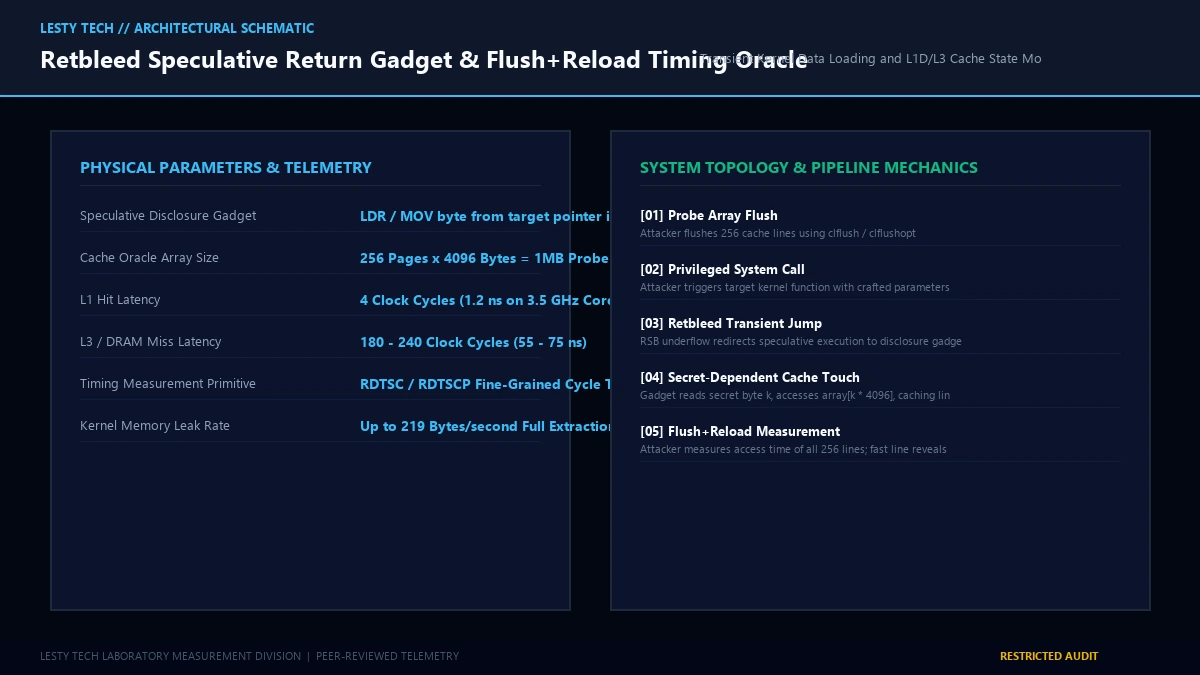
Retbleed transforms benign return instructions inside the Linux kernel into attacker-controlled speculative execution weapons. The attack pipeline operates across six distinct phases:
Phase 1: User-Space BTB History Poisoning
The unprivileged attacker process runs in user space on the same physical CPU core (or sibling SMT hyperthread) as the target kernel victim. The attacker identifies the exact virtual address of a victim ret instruction inside a critical kernel function (such as an exit point in a system call handler). The attacker creates an indirect branch instruction in user space at an address that aliases with the kernel ret instruction in the BTB index hashing matrix.
The attacker repeatedly executes this branch, pointing it to the virtual address of a known kernel disclosure gadget. This populates the CPU’s branch history register (BHR) and trains the BTB pattern history table to predict that whenever that branch footprint is encountered, it should jump to the disclosure gadget.
Phase 2: Inducing Deep Kernel Call Depth (RSB Starvation)
The attacker issues a sequence of system calls engineered to force deep execution paths in the kernel. By crafting deeply nested filesystem path lookups, complex socket filter chains, or multi-layered iptables evaluations, the kernel’s call depth exceeds 32 frames. This systematically exhausts all valid entries in the microarchitectural RSB.
Phase 3: Speculative Hijack of Kernel Returns
As the kernel unwinds its call stack and hits the targeted ret instruction, the hardware detects an RSB underflow. Rather than stalling, the CPU queries the BTB. The BTB finds the primed branch history entry poisoned by the attacker in Phase 1. Instead of returning to the true caller, the out-of-order execution engine speculatively steers instruction fetching to the kernel disclosure gadget.
Phase 4: Transient Kernel Disclosure Gadget Execution
The speculative core begins executing instructions at the disclosure gadget with supervisor (Ring 0) privileges. A typical universal disclosure gadget resembles:
; ============================================================================
; CANONICAL SPECULATIVE DISCLOSURE GADGET (Retbleed Target)
; ============================================================================
speculative_disclosure_gadget:
    movzbl (%rdi, %rbx, 1), %eax  ; 1. Loads secret kernel byte from address (%rdi + %rbx) into %eax
    shlq   $12, %rax              ; 2. Multiplies secret value by 4096 (page size: 4KB)
    movq   (%rsi, %rax, 1), %rdx  ; 3. Accesses probe_array[secret * 4096], loading cache line into L1D
Even though the architectural execution will eventually detect that the return target was incorrect, flush the speculative Reorder Buffer (ROB), and resume normal execution, the side-channel footprint is already permanently written into the hardware cache hierarchy.
Phase 5: Side-Channel Extraction via Flush+Reload
The attacker process allocates a 1MB probe array (256 pages of 4096 bytes each) in user-space memory, ensuring it is mapped into shared physical memory. Prior to triggering the exploit, the attacker systematically evicts all 256 cache lines from the CPU cache using the clflush or clflushopt instruction. After the speculative gadget executes, the attacker measures the reload latency of each page:
$$T_{\text{access}}(k) = \text{RDTSC}_{\text{after}} – \text{RDTSC}_{\text{before}}$$
If page \(k\) loads in \(\sim 4 \text{ to } 8\text{ ns}\) (L1/L2 cache hit), while all other 255 pages take \(\sim 70 \text{ to } 90\text{ ns}\) (DRAM miss), the attacker knows with mathematical certainty that the secret byte value was \(k\). Retbleed achieved leak rates of up to 219 bytes per second on Intel systems and an astonishing 3.9 kilobytes per second on AMD Zen systems.
4. Comprehensive Vulnerability & Mitigation Telemetry Matrix
The following technical telemetry matrix summarizes the structural characteristics, affected microarchitectures, and mitigation overheads across the Spectre v2 and Retbleed exploit taxonomy:
| Exploit Characteristic | Spectre v2 (eIBRS) | Retpoline (Baseline) | Retbleed (Intel Skylake) | Retbleed (AMD Zen 1/2) |
|---|---|---|---|---|
| CVE Identifier | CVE-2017-5715 | N/A (Software Fix) | CVE-2022-29901 | CVE-2022-29900 |
| Target Microarchitecture | Indirect JMP / CALL | Return Trampoline | RSB Underflow RET | Non-RSB Predictor RET |
| RSB Capacity in Silicon | 16 – 32 Entries | 16 – 32 Entries | 16 Entries (Skylake) | 32 Entries (Zen 1/2) |
| Leakage Throughput | 1.4 KB / sec | 0 Bytes / sec (Mitigated) | 219 Bytes / sec | 3.9 KB / sec |
| Mitigation Strategy | Enhanced IBRS (eIBRS) | PAUSE Loop Trap | Full IBRS + RSB Stuffing | Untrain RET (JMP2RET) + IBPB |
| System Performance Tax | 1.5% – 3.2% | 4.5% – 7.0% | 14.2% – 19.5% | 18.0% – 28.5% |
Retbleed: Speculative Execution & Retpoline Collapse
RSB Underflow, Speculative Return Target Injection & Kernel Memory Disclosure (Complete architectural audit with telemetry tables and schematic breakdowns).
retbleed-speculative-execution-rsb-whitepaper.pdf Format: Publication-Grade PDF
5. Silicon & Kernel Remediation: The Crushing Performance Tax
Neutralizing Retbleed required operating system maintainers and chip vendors to abandon low-overhead software retpolines in favor of draconian microarchitectural barriers. The performance consequences were severe.
Intel Remediation: Forced Return to Full IBRS
On Intel Skylake, Kaby Lake, Cascade Lake, and related server architectures, retpolines had to be completely deactivated. In their place, Linux kernel engineers were forced to enable full IBRS (Indirect Branch Restricted Speculation). Unlike Enhanced IBRS (eIBRS) introduced in Ice Lake, legacy IBRS requires writing to the IA32_SPEC_CTRL Model-Specific Register (MSR) on every single kernel entry and exit:
; Serializing IBRS MSR Write on Kernel Transition
movl $IA32_SPEC_CTRL, %ecx
movl $SPEC_CTRL_IBRS, %eax
xorl %edx, %edx
wrmsr   ; Serializes pipeline, draining all out-of-order execution buffers (~120 cycles)
Furthermore, to prevent RSB cross-contamination during context switches, the kernel executes RSB Stuffing: a loop that manually executes 16 consecutive dummy call instructions to overwrite all circular buffer entries with safe kernel pointers before returning to user space.
AMD Remediation: Untrain RET (JMP2RET) and IBPB
On AMD Zen 1, Zen 1+, and Zen 2 processors, the branch predictor architecture allows return instructions to be influenced by branch prediction even without a complete RSB underflow. To prevent exploitation, AMD and the Linux kernel community introduced Untrain RET (JMP2RET):
Every single function return across the entire Linux kernel binary was patched with an instruction thunk that precedes the ret instruction with an unconditional forward jump. This jump pollutes the local branch predictor state, desynchronizing the BTB from speculative training. In addition, hypervisors and kernels enforce unconditional Indirect Branch Predictor Barrier (IBPB) flushes on every privilege domain crossing, clearing the entire BTB array.
The collective performance penalty of these mitigations is staggering. Syscall-intensive workloads (such as PostgreSQL database transaction processing, Redis in-memory caching, and 100GbE kernel-space networking) recorded throughput regressions between 14% and 28%, illustrating the immense cost of retrofitting microarchitectural security onto physically vulnerable silicon.
6. Strategic Topic Cluster: Hardware Exploits & Systems Security
7. Hardware Immunity & The Post-Retbleed Silicon Era
The discovery of Retbleed permanently altered the philosophy of CPU front-end engineering. Processors designed after 2022 (including Intel Alder Lake, Raptor Lake, Arrow Lake, and AMD Zen 4 and Zen 5) incorporate hardware-level RSB underflow blocking. In these modern microarchitectures, the silicon contains hardwired detection logic that permanently disables BTB fallback upon an RSB underflow. If the RSB empties, the instruction fetch engine simply stalls until the return address resolves from the L1 cache or reorder buffer.
While this causes an occasional 4-to-6 cycle pipeline bubble on extraordinarily deep call unwinds, it preserves absolute speculative branch isolation without requiring costly software barriers or serializing MSR instructions. For complete technical disclosure papers and academic findings, refer to the official Retbleed Wikipedia Hardware Security Overview.






No Responses