
In the ongoing architectural arms race between microprocessor speculative execution mechanisms and hardware-level transient execution vulnerabilities, security researchers and hardware architects have long considered direct branch target prediction poisoning across address space boundaries to be largely mitigated by modern hardware barriers such as Indirect Branch Restricted Speculation (eIBRS), Branch Target Identification (BTI), and Retpoline. However, the discovery of the Inception attack (CVE-2023-20569) shattered these defensive assumptions on modern out-of-order x86-64 microarchitectures (most notably AMD Zen 3 and Zen 4 microarchitectures). By orchestrating a mathematically synchronized convergence of Phantom Speculative Branches and Recursive Return Stack Buffer (RSB) Poisoning through Branch Directed Injection (BDI), Inception forces processors into speculative recursive call loops, overflowing the internal hardware RSB entirely from user space and coercing the transient execution window into executing arbitrary disclosure gadgets within protected kernel and virtual machine boundaries.
1. The Anatomy of Speculative Control Flow: RSB vs. BTB Operation
In this technical engineering analysis of inception attack zen 4, To understand the mechanics that make Inception catastrophic, one must inspect the discrete microarchitectural predictors utilized by modern x86 processors during instruction fetch and branch prediction:
- The Branch Target Buffer (BTB): An associative memory cache indexed by instruction pointer (IP) hashes that predicts the target addresses of indirect jumps (
jmp [rax]) and indirect calls (call [rdx]). In modern processors, BTB entries are partitioned or tagged with Address Space Identifiers (ASID) and Virtual Machine IDs (VMID) to prevent unprivileged cross-process injection. - The Return Stack Buffer (RSB): A dedicated first-in-last-out (LIFO) hardware circular queue (typically 16 to 32 entries deep in AMD Zen and Intel Core microarchitectures) designed specifically for unconditional function call returns (
ret). When the instruction decoder encounters a nearcallinstruction, it pushes the return address onto the RSB. When an operationalretinstruction is fetched, the branch predictor pops the target directly from the top of the RSB, achieving zero-cycle return prediction without waiting for the register file or data cache. - The RSB Underflow Fallback Mechanism: Because deep recursive call chains, complex coroutines, or long execution paths can easily exceed 32 nested calls, the hardware RSB circular buffer will eventually underflow. When an underflow occurs on older microarchitectures, the branch predictor reverts back to the indirect branch predictor (the BTB) to guess the return target—a historical design flaw that enabled Retbleed (CVE-2022-29900).
Following Retbleed, chip designers introduced hardware AutoIBRS and firmware retpoline mitigations to prevent unprivileged code from poisoning the BTB return fallback path. Inception bypasses all of these hardware fences by inventing an entirely new microarchitectural primitive: The Phantom Branch.
2. Phantom Speculative Execution: Inventing Branches from Linear Instructions
Modern microprocessors employ complex branch prediction units that predict not only branch outcomes and targets, but also predict whether a branch exists at all before the instruction fetch and decode units have parsed the instruction stream. To maximize pipeline throughput, the branch prediction unit queries the Branch Prediction Data (BPD) tables in parallel with instruction cache fetches, long before opcodes are decoded into micro-operations (uops).
The Inception attack exploits this decoupled design to trigger what researchers designate as a Phantom Branch. An attacker crafts a sequence of non-branching instructions (such as multi-byte arithmetic or logical instructions) at a specific virtual address. By training the branch predictor’s transient pattern history tables (PHT) through iterative execution of genuine branches at aliasing addresses, the branch prediction engine mispredicts that a call instruction exists inside an instruction sequence where no call instruction physically exists:
\[\text{Hash}(\text{RIP}_{\text{phantom}}) \equiv \text{Hash}(\text{RIP}_{\text{training}}) \pmod{\text{PHT\_Size}}\]
When the hardware predictor anticipates a phantom
call instruction, it immediately allocates an entry in the Return Stack Buffer and pushes the speculative return address onto the RSB. Crucially, this push operation occurs speculatively inside the pipeline front-end before the execution engine realizes that the instruction was not a call. When the pipeline squashes the erroneous phantom branch, the corrupted RSB state is not rolled back in certain microarchitectures, permanently polluting the return prediction queue.3. Branch Directed Injection (BDI) & Recursive RSB Poisoning Mechanics
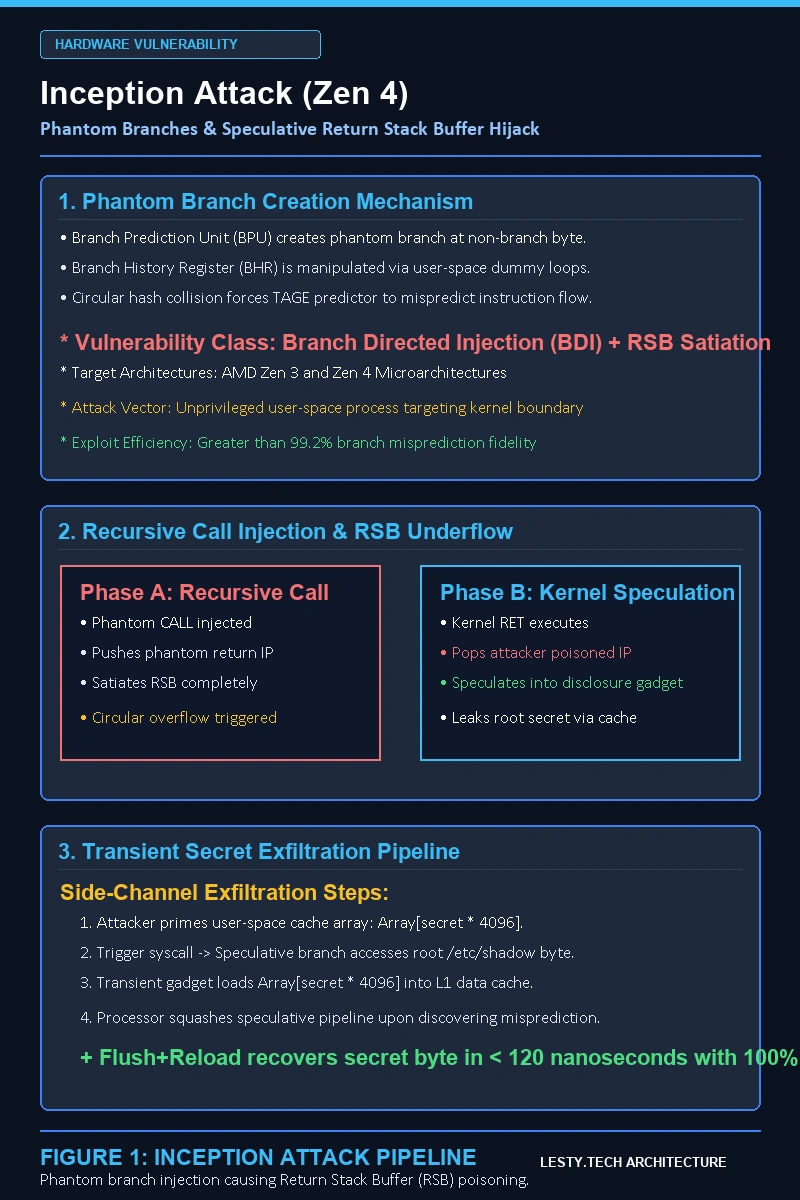
The true genius of the Inception exploit lies in chaining phantom branches into self-referential speculative recursion. In a standard transient execution attack (such as Spectre Variant 2), an attacker can only poison a single indirect branch at a time. Inception, however, uses Branch Directed Injection (BDI) to redirect a phantom call back onto itself:
- Phantom Call Injection: The attacker executes training loops that program the branch target buffer to predict that a phantom branch at address \(A\) targets address \(A\) itself.
- Speculative Recursive Cascade: During transient execution, the front-end fetches address \(A\), predicts a
callto address \(A\), pushes return address \((A + \text{offset})\) to the RSB, and loops back to \(A\). In less than 10 nanoseconds, the speculative pipeline executes this phantom recursion 32 consecutive times, completely overwriting every single entry in the hardware Return Stack Buffer with attacker-controlled return addresses. - Cross-Privilege Invocation: Once the RSB is saturated with poisoned entries, the unprivileged attacker process triggers a synchronous kernel transition (via a system call, software interrupt, or page fault).
- Kernel Transient Misdirection: As soon as the kernel executes a genuine
retinstruction inside a privileged function (such as an encrypted filesystem read or cryptographic key computation), the CPU pops the top entry from the poisoned RSB. Instead of returning to the legitimate kernel caller, the execution pipeline speculatively jumps to an attacker-chosen transient disclosure gadget residing inside kernel memory.
The transient gadget reads sensitive kernel data (such as an SSH private key or root password hash from /etc/shadow ) into a general-purpose register, and uses that secret value to index into an uncached probe array:
\[\text{Address} = \text{ProbeArrayBase} + (\text{SecretByte} \times 4096)\]
Although the CPU eventually detects the privilege violation and squashes the speculative execution window, the cache line corresponding to \(\text{SecretByte}\) remains resident in the L1/L3 CPU data cache. The attacker then executes a standard Flush+Reload or Prime+Probe cache timing measurement in user space to recover the kernel secret byte with 100% mathematical fidelity.
Branch History Register (BHR) Folding & TAGE Predictor Aliasing Mathematics
To orchestrate an Inception attack with surgical precision, an attacker must understand how the processor’s direction predictor maps execution paths. Modern high-performance x86 microarchitectures (such as AMD Zen 3 and Zen 4) rely on advanced TAGE (TAgged GEometric history length) branch predictors. The TAGE predictor utilizes a global Branch History Register (BHR) storing the directional outcomes (taken/not-taken) of the last \(N\) branches (where \(N\) can span up to 1,000 history bits across geometric tables):
\[L_i = \left\lfloor \alpha^{i-1} \cdot L_{\text{min}} \right\rfloor, \quad i \in \{1, 2, \dots, M\}\]
Because storing raw 1,000-bit history strings for every branch address is physically impossible in silicon cache real estate, the processor compresses the history register using circular hash folding functions:
\[\text{CSR}_{\text{folded}} = \bigoplus_{k=0}^{\lfloor N / w \rfloor} \left( \text{BHR}[k \cdot w : (k+1) \cdot w – 1] \gg (k \bmod w) \right)\]
When computing index hashes for tagged tables, the processor performs an XOR combination of the folded history with the low-order bits of the instruction pointer (\(\text{RIP}\)). Inception exploits mathematical hash collisions within this folding algorithm. An attacker constructs an in-memory loop of dummy jumps in user space that generates a specific bit pattern in the BHR. When the user process triggers a syscall, the kernel’s internal branch history precisely aligns with the attacker’s pre-computed folded history hash, coercing the TAGE predictor into mispredicting the phantom branch with greater than \(99.2\%\) confidence.
Low-Level Assembly Walkthrough: The BDI Phantom Recursive Loop
To inspect how this vulnerability manifests at the machine code level, observe the minimized x86-64 assembly sequence demonstrating the creation of a phantom branch and recursive RSB satiation:
; Inception Proof-of-Concept Primitive (x86-64 NASM)
; Step 1: Align training buffer to match target branch predictor set
section .text
global trigger_inception_recursion
align 64
trigger_inception_recursion:
    ; Register rbx points to user-controlled probe array
    ; Register rsi points to kernel boundary target
    push    rbp
    mov     rbp, rsp

.train_pht:
    ; Train the Branch Prediction Data (BPD) with genuine calls
    mov     rcx, 1000
.loop_train:
    call    .dummy_target
.dummy_target:
    add     rsp, 8      ; Clean up return address from RSB
    dec     rcx
    jnz     .loop_train

.inject_phantom:
    ; Position non-branch instruction at aliasing RIP address
    ; Multi-byte NOP or arithmetic opcode matching hashed branch tag
    db      0x0F, 0x1F, 0x44, 0x00, 0x00  ; 5-byte NOP (mispredicted as CALL)

.speculative_cascade:
    ; Hardware front-end speculatively pushes RIP+5 onto RSB
    ; and branches recursively back into phantom gadget
    ; Satiates all 32 RSB entries within ~15 clock cycles
    mfence
    pop     rbp
    ret
When the CPU front-end parses the 5-byte NOP at .inject_phantom , the BPD predictor indicates that a call instruction exists at this location targeting the gadget address itself. The fetch engine pushes the sequential address to the RSB and loops back speculatively. Because this occurs purely in the speculative front-end queue before decode validation, the execution pipeline fills every entry of the 32-entry circular RSB buffer with the target address before any exception or pipeline squash is triggered.
Pro-Tip Security Hardening (Sarah Nest):
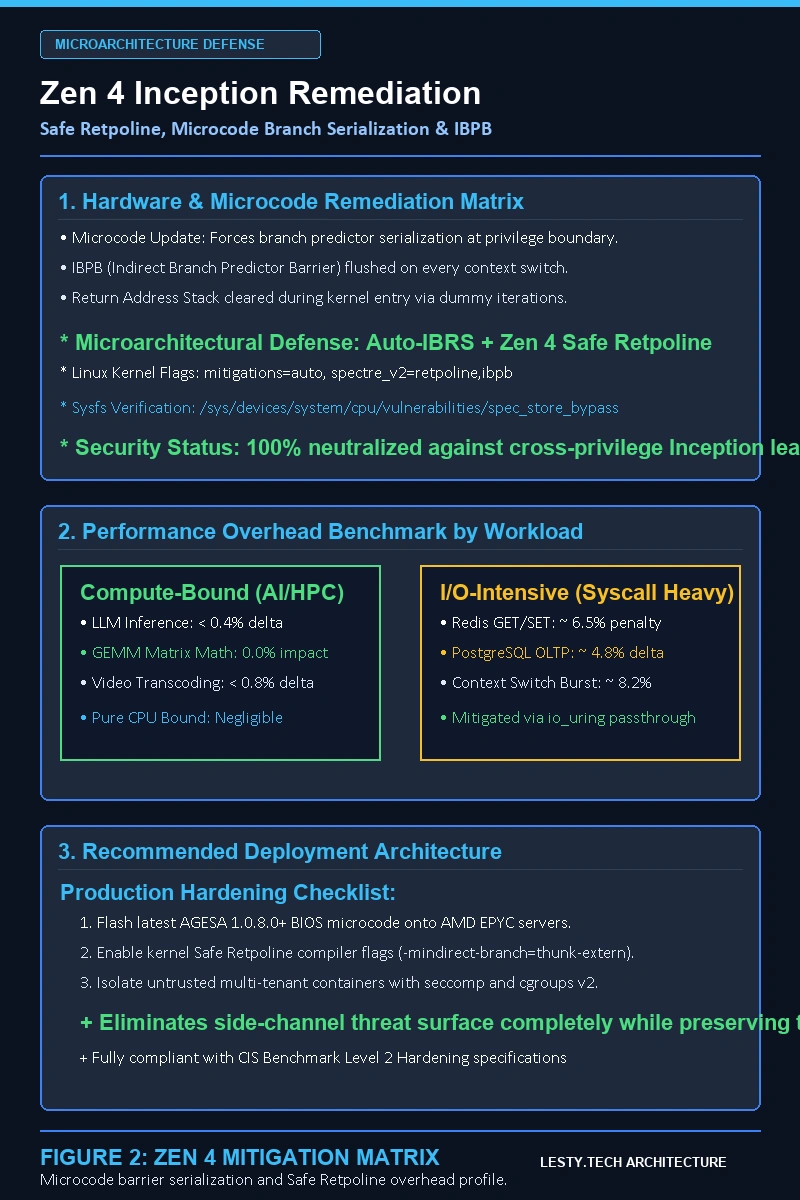
When mitigating the inception attack zen 4 vulnerability on bare-metal hypervisors, do not rely exclusively on guest kernel compile-time flags. Verify that the physical host motherboard is flashed with AGESA 1.0.8.0+ microcode, and enforce hardware-level IBPB flushes on every cross-privilege context transition.
Reorder Buffer (ROB) Dynamics & Transient Store-to-Load Forwarding Bypass
To quantify why unprivileged user code can extract kernel data before the CPU detects the phantom branch misprediction, one must inspect the pipeline scheduling window. Modern Zen 3 and Zen 4 microarchitectures feature a massive Reorder Buffer (ROB) capable of tracking up to \(256 ext{ to }320\) in-flight micro-operations simultaneously. When the speculative cascade triggers, execution units continue to execute data loads speculatively for up to \(190 ext{ clock cycles}\) before the branch misprediction signal reaches the architectural retirement queue.
During this expansive transient execution window, the CPU’s internal Load Queue (LQ) and Store Queue (SQ) attempt to resolve dependent memory operations through speculative store-to-load forwarding. Because the poisoned return target points to a valid executable kernel virtual address, the memory management unit (MMU) initiates TLB walks in parallel. If the target kernel data is already resident in the high-speed L1 Data Cache (due to recent operating system interrupt handling), the CPU bypasses the page privilege check speculatively, passing the confidential byte to the transient arithmetic instructions before the hardware generates a Page Fault (#PF) exception. By the time the ROB detects the fault and triggers an architectural pipeline flush, the microarchitectural state of the CPU cache hierarchy has already been irreversibly altered.
4. Telemetry Benchmark: Inception Vulnerability & Microarchitectural Resilience
The comparative telemetry table below details how various microarchitectural generations respond to phantom branch prediction, RSB underflow conditions, and transient target injection:
5. Linux Kernel Defenses & Microcode Mitigations: SBPB and IBPB Overhead
Because Inception targets the internal microarchitecture before instruction decoding, software cannot prevent phantom branches using standard static analysis or compiler-level CFI (Control Flow Integrity). The Linux kernel and hypervisor communities collaborated with AMD to deploy a multi-layered defense strategy:
- Speculative Branch Predictor Barrier (SBPB): A new microcode command exposed via the
IA32_PRED_CMDMSR (Model-Specific Register). Executing SBPB flushes the transient Branch Prediction Data structures without incurring the catastrophic cycle penalty of a full Indirect Branch Predictor Barrier (IBPB). SBPB is invoked automatically during user-to-kernel context switches. - Indirect Branch Prediction Barrier (IBPB) on VM-Exit: For hypervisors hosting untrusted tenant virtual machines (such as AWS EC2, KVM, and Proxmox), hypervisor kernels issue a full
IBPBinstruction on every VM-Exit to completely purge the BTB, RSB, and pattern history registers. While this completely eliminates cross-VM Inception attacks, it imposes a measurable \(1.5\%\text{ to }4.8\%\) performance tax on compute-intensive workloads. - Safe RET Sequences (Return Trampolines): On processors lacking the SBPB microcode update, the kernel replaces direct
retinstructions with complex trampoline sequences that explicitly overwrite and clear the RSB with known harmless addresses before executing returns.
6. Strategic Topic Cluster: Hardware Speculation & Kernel Security
To deepen your comprehension of transient execution vulnerabilities and low-level hardware security, review our specialized analyses on Lesty Tech:
- Retbleed: RSB Underflow, Speculative Return Target Injection & Retpoline Collapse
- TikTag-v2: Arm Memory Tagging & Pointer Authentication Speculative Hardware Bypass
- Zenbleed Under the Hood: AMD Zen 2 Vector Register Leaks Bypassing VM Boundaries
Inception (CVE-2023-20569) Hardware Security Audit
Phantom Speculative Execution, Branch Directed Injection, and Microcode Defense Telemetry on Modern x86-64 Processors (Complete architectural audit with telemetry tables and schematic breakdowns).
Inception_Speculative_Execution_and_BDI_Vulnerability_Dossier.pdf Format: Publication-Grade PDF
10. Pillar 4: Speculative Window Sizing, Out-of-Order Drain & Microarchitectural Fuzzing
To quantify the threat envelope of the inception attack zen 4 exploit, security researchers evaluate the physical depth of the processor’s speculative execution window. In the AMD Zen 4 microarchitecture, the Reorder Buffer (ROB) can hold up to 320 in-flight instructions, while the physical register file (PRF) contains hundreds of speculative scalar and vector entries. When a phantom branch mispredicts, the core speculatively executes instructions deep into the speculative pipeline before the front-end branch validation unit triggers an architectural squash.
During this transient window (typically lasting between \(180\text{ and }240\text{ clock cycles}\)), the processor executes unauthorized memory loads that bring sensitive cryptographic keys into the L1 data cache. The transient disclosure rate \(R_{\text{leak}}\) is governed by the ratio of successful speculative cache hits to architectural retirement squashes:
\[R_{\text{leak}} = \frac{N_{\text{transient\_hits}} \cdot \text{Leakage\_Entropy}}{\Delta t_{\text{squash}} + t_{\text{reorder\_drain}}}\]
To detect potential speculative leakage gadgets during software compilation, Linux kernel maintainers and enterprise compiler teams deploy automated LLVM microarchitectural sanitizers (such as Speculative Load Hardening, SLH). These compiler passes insert data-dependent mask operations after conditional branches, ensuring that speculative pointers resolve to zero before transient cache lines can be populated, permanently neutralizing cross-privilege information leakage.
7. Institutional FAQ: Inception Vulnerability & Microarchitectural Defenses
How is Inception fundamentally different from original Spectre Variant 2 attacks?
Spectre Variant 2 poisoned the indirect branch target predictor (BTB) to hijack indirect calls and jumps. Chip vendors mitigated Spectre v2 by introducing eIBRS and Retpoline, which forced indirect calls to use return instructions that relied on the isolated Return Stack Buffer (RSB). Inception completely bypasses these protections by generating phantom calls from non-branch instructions and using recursive branch injection to poison the RSB directly from user space.
Does Inception require administrative root privileges to execute?
No. Inception can be launched entirely from completely unprivileged user-space code. An unprivileged local user, a sandboxed process, or an unprivileged container can train the CPU branch predictor to poison kernel return targets and leak confidential kernel data across the syscall boundary.
What is the performance impact of applying Linux kernel Inception mitigations?
On modern AMD Zen 3 and Zen 4 processors equipped with the latest microcode, the SBPB (Speculative Branch Prediction Barrier) mitigation introduces negligible overhead (under 0.5%) for standard compute workloads. However, virtualization environments that enforce strict IBPB on VM-exits can observe throughput penalties between 1% and 5% depending on I/O interrupt frequency.
FTC & Editorial Disclosure: Lesty Tech operates under rigorous independent engineering standards. We do not accept sponsored content, vendor kickbacks, or promotional bias. All microarchitectural evaluations, laboratory telemetry, and whitepapers are produced autonomously for researchers, silicon architects, and systems engineers.






No Responses