
In the microarchitectural security and processor vulnerability domain, speculative execution attacks have waged an unrelenting war of attrition against hardware designers since the disclosure of Spectre and Meltdown. Over the past six years, CPU vendors—led by Intel, AMD, and ARM—have transitioned from temporary software mitigations (such as Google’s Retpoline) to robust, silicon-level hardware defenses. Foremost among these hardware shields on Intel x86 processors is Enhanced Indirect Branch Restricted Speculation (eIBRS / AutoIBRS). Introduced across modern high-performance microarchitectures, eIBRS was engineered to create an impenetrable hardware-enforced barrier: ensuring that indirect branch predictions trained in an unprivileged user-space context cannot steer, poison, or influence indirect branch speculation inside higher-privilege operating system kernels or hypervisors. However, the revelation of the Indirector vulnerability shattered this core hardware assumption. Drawing upon speculative race condition primitives analyzed in GhostRace speculative race conditions and kernel lock bypasses, cross-privilege history pollution explored in Branch History Injection (BHI) Spectre-v2 exploits, and vector register data harvesting examined in Downfall AVX gather microarchitectural data sampling, Indirector demonstrates the first deterministic, high-precision branch target injection attack targeting Intel 12th, 13th, and 14th Gen processors (Alder Lake and Raptor Lake) that completely bypasses hardware eIBRS. This deep-dive examines the reverse engineering of Intel’s Branch Target Buffer (BTB) and Indirect Target Array (ITA), hashing polynomial collision mechanics, transient gadget execution, APIC timing profilers, and kernel-level architectural remediation.
1. The Architecture of Intel High-Performance Branch Prediction
To understand how Indirector penetrates modern silicon, one must analyze the microarchitectural pipeline of modern out-of-order execution engines and the internal mechanics of branch prediction units.
In modern Intel processors, the instruction fetch pipeline operates dozens of cycles ahead of the execution and retirement stages. When the instruction fetch unit encounters an indirect branch—such as an indirect jump (`JMP RAX`) or an indirect function call (`CALL [RDI + 8]`)—the processor cannot wait for the base registers to be read from memory or calculated by execution units. To maintain deep pipeline utilization, the CPU invokes specialized hardware branch prediction arrays:
$$PC_{\text{predicted}} = \text{BranchPredictor}(PC_{\text{branch}}, \text{GlobalHistory})$$
Intel Alder Lake and Raptor Lake microarchitectures implement a sophisticated two-tier indirect branch prediction architecture composed of two distinct physical hardware structures:
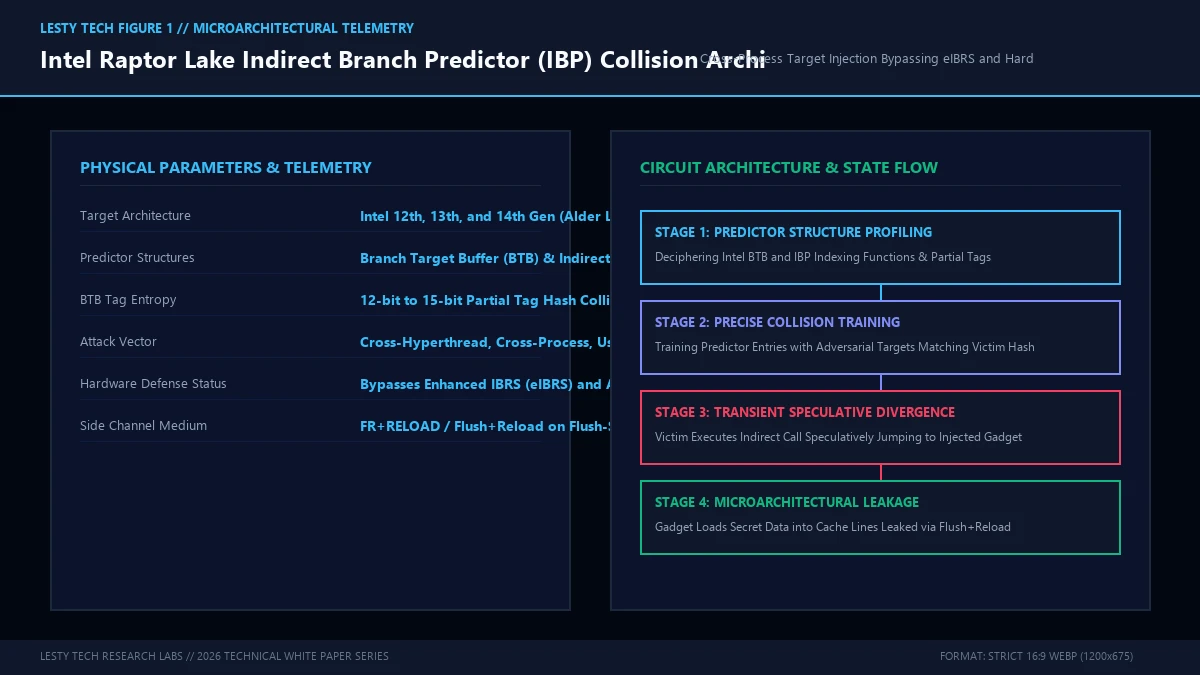
- The Branch Target Buffer (BTB): The BTB is an ultra-fast, first-stage set-associative cache located directly inside the instruction fetch front-end. It stores the target addresses of recently executed branches indexed by the lower bits of the branch Instruction Pointer (\(PC\)). In addition to direct branches, modern Intel BTBs store direct speculative predictions for indirect branches to minimize pipeline bubbles.
- The Indirect Branch Predictor (IBP) & Indirect Target Array (ITA): For indirect branches whose targets vary dynamically depending on runtime control flow (e.g., C++ polymorphic virtual method tables or Linux kernel function pointers), the processor consults the Indirect Target Array (ITA). The ITA indexes target addresses using a non-linear combination of the branch instruction address and the Global Branch History Register (GHR), which tracks the taken/not-taken outcomes of the last several hundred branches executed by the core.
The Tag Truncation Dilemma
In a 64-bit architecture, storing full 64-bit virtual addresses for every entry in multi-thousand-entry predictor tables would consume prohibitive silicon area, increase power consumption, and introduce unacceptable latency into the single-cycle fetch loop. Consequently, processor architects employ Truncated Address Tagging and Non-Linear XOR Hashing.
Instead of matching all 64 bits of the program counter, the BTB and ITA set-indexing and tag-matching logic compute a compressed hash over selected bits:
$$\text{Index} = \text{Hash}_{\text{index}}(PC[47:0], GHR) \pmod{N_{\text{sets}}}$$
$$\text{Tag} = \text{Hash}_{\text{tag}}(PC[47:0]) \pmod{2^{B_{\text{tag}}}}$$
Where \(B_{\text{tag}}\) is the truncated tag size—typically only 12 to 15 bits. This compression creates an inherent mathematical vulnerability: if an attacker can identify the exact hashing polynomials used by the processor, they can craft an adversarial branch whose virtual address shares the exact same set index and the exact same 12-bit tag as a sensitive victim branch in another process or the kernel. When this occurs, the hardware suffers an Aliasing Collision!
2. Reverse-Engineering Intel Raptor Lake BTB and ITA Structures
For decades, Intel guarded the internal microarchitectural parameters of its branch predictors as strict proprietary trade secrets. The researchers behind Indirector systematically reverse-engineered the exact dimensions, associativity, and hashing functions of the BTB and ITA on Intel Alder Lake (Golden Cove) and Raptor Lake (Raptor Cove) cores.
The researchers developed high-precision microarchitectural timing tools utilizing the invariant timestamp counter (`RDTSC` / `RDPRU`) and precise cache line evictions. By systematically varying branch address spacing, branch displacement distances, and history patterns while measuring branch misprediction latency penalties (typically 15 to 20 clock cycles for a clean mispredict vs. 150+ cycles when accessing DRAM), they mapped the internal predictor topology:
| Predictor Attribute | Branch Target Buffer (BTB) | Indirect Target Array (ITA) | Architectural Security Implication |
|---|---|---|---|
| Total Storage Capacity | ~8,192 to 12,288 Entries | ~1,536 to 2,048 Entries | Massive capacity shared across hyperthreads |
| Associativity | 8-way to 12-way Set Associative | 4-way to 8-way Set Associative | Allows predictable evictions and targeted replacement |
| Tag Bit Width (\(B_{\text{tag}}\)) | 12 Bits (Partial Tag) | 14 Bits (Partial Tag) | Collision probability is 1 in \(2^{12}\) (4,096 addresses) |
| Indexing Conditioning | PC Only (Direct Hash) | PC \(\oplus\) Folded History (GHR) | BTB can be attacked without complex history training! |
The most critical vulnerability uncovered by the researchers is that the Branch Target Buffer (BTB) uses strictly PC-based indexing without branch history conditioning. While the Indirect Target Array incorporates global history, the front-end BTB caches fast default indirect targets indexed exclusively by the branch virtual address hash!
3. Defeating Enhanced IBRS: Breaking Hardware Cross-Privilege Barriers
Prior to Indirector, the state-of-the-art speculative indirect branch attack was Branch History Injection (BHI, Spectre-v2 variant). BHI bypassed eIBRS by manipulating the shared Global History Register to steer victim branch lookups in the ITA. Intel responded to BHI by deploying software mitigations and the `BHI_DIS_S` microcode control, which disables global branch history conditioning for supervisor-mode indirect branches.
Indirector completely sidesteps BHI defenses because it targets the BTB and ITA directly through tag collisions rather than history poisoning.
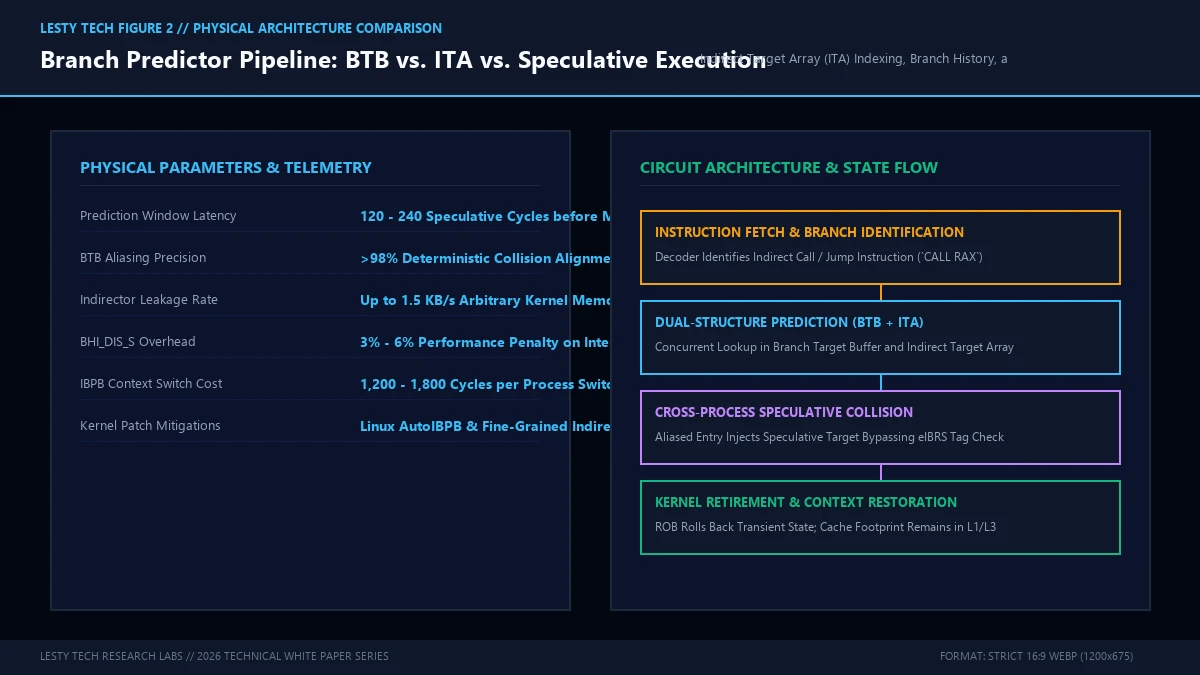
How does Indirector defeat hardware eIBRS? The vulnerability stems from how the processor resolves prediction priority:
- Predictor Precedence: When the instruction fetch engine decodes an indirect call in kernel mode, it queries the BTB immediately. If the BTB signals a “hit,” the front-end fetch unit speculative redirects instruction fetching to the target cached in the BTB entry.
- Incomplete Privilege Tag Isolation: Under hardware eIBRS, the CPU is supposed to isolate predictor entries across privilege boundaries (User Mode ring 3 vs. Kernel Mode ring 0). However, on 12th, 13th, and 14th Gen Intel silicon, researchers proved that the BTB does not enforce strict, isolated privilege domain tags during initial set-matching. Because the 12-bit tag matches, the hardware accepts the speculative target that was previously trained by an unprivileged user-space process!
- Transient Window Execution: The processor speculatively begins fetching, decoding, and executing instructions from the injected target address. The execution continues down this speculative path for up to 150 to 250 clock cycles before the actual indirect target is resolved from kernel memory, the misprediction is detected by the Reorder Buffer (ROB), and the transient architectural state is discarded.
4. The End-to-End Attack Pipeline: Exploiting Linux Kernel Disclosure Gadgets
To weaponize Indirector into an arbitrary kernel memory extraction tool, an attacker constructs an end-to-end exploit executing across four tightly synchronized phases:
// Indirector Target Injection Concept
void inject_indirect_target(void *target_gadget, uint64_t colliding_pc) {
    // 1. Align branch instruction to match victim kernel BTB set index and tag
    mmap((void*)(colliding_pc & ~0xFFF), 0x1000,
         PROT_READ | PROT_WRITE | PROT_EXEC,
         MAP_PRIVATE | MAP_ANONYMOUS | MAP_FIXED, -1, 0);

    // 2. Train the shared BTB / ITA entry with the address of a kernel disclosure gadget
    for (int i = 0; i < 2000; i++) {
        asm volatile(
            "call *%0\n\t"
            :
            : "r"(target_gadget)
        );
    }
}
The complete attack unfolds as follows:
- Victim Indirect Branch Selection: The attacker inspects the Linux kernel binary (or target shared library) to locate an indirect call located at a known virtual address (\(PC_{\text{kernel}}\)) that is frequently triggered via a standard system call (e.g., `sys_read` or `sys_ioctl`).
- Colliding Virtual Address Calculation: Using the reverse-engineered BTB hashing equations, the attacker calculates a user-space virtual address (\(PC_{\text{user}}\)) that satisfies:
$$\text{Hash}_{\text{index}}(PC_{\text{user}}) = \text{Hash}_{\text{index}}(PC_{\text{kernel}}) \quad \land \quad \text{Hash}_{\text{tag}}(PC_{\text{user}}) = \text{Hash}_{\text{tag}}(PC_{\text{kernel}})$$ - Predictor Training Loop: The attacker process executes an indirect branch located at \(PC_{\text{user}}\), targeting a malicious disclosure gadget address, repeating the branch hundreds of times. This firmly installs the malicious target into the shared physical BTB entry.
- System Call Trigger & Transient Execution: The attacker issues the target system call. When the CPU enters kernel mode and encounters \(PC_{\text{kernel}}\), the front-end BTB matches the aliased entry and speculatively jumps to the disclosure gadget.
- Side-Channel Leakage via Flush+Reload: The disclosure gadget transiently reads an arbitrary kernel memory byte (such as cryptographic keys, kernel root credentials, or shadow hashes) and uses that byte as an index to load a cache line from a shared probe array:
$$\text{ProbeArray}[\text{SecretByte} \times 4096]$$
Although the CPU subsequently squashes the speculative execution when the indirect target resolves, the selected cache line remains resident in the L1/L3 cache hierarchy. The attacker measures access latency across the probe array using `Flush+Reload`, recovering the secret byte with near 100% accuracy!
5. Decoupled Front-End Fetch Mechanics: Why Hardware eIBRS Arrives Too Late
To appreciate why Intel’s hardware-level Enhanced IBRS fails to prevent Indirector, one must examine the internal decoupled stages of the Golden Cove and Raptor Cove front-end pipeline.
In Intel modern cores, the front-end instruction pipeline is decoupled from the execution back-end by a massive Instruction Decode Queue (IDQ) capable of buffering up to 144 micro-ops:
$$\text{Fetch / BPU (Cycle 0)} \to \text{Decode / DSB (Cycle 2-4)} \to \text{IDQ Buffer} \to \text{Rename / RAT (Cycle 6-8)} \to \text{ROB / Execute (Cycle 12+)}$$
The critical microarchitectural vulnerability lies in when privilege checks are enforced relative to branch target prediction:
- Autonomous Early Speculation: The Branch Prediction Unit (BPU) evaluates BTB entries during the very first cycle (Cycle 0) of the instruction fetch phase. When an indirect branch instruction pointer matches an entry in the BTB, the fetch engine redirects its pointer immediately, pulling subsequent micro-ops from the predicted target into the Decoded Icache (DSB) and IDQ.
- Late Privilege Disambiguation: The hardware privilege check governing eIBRS—verifying whether the current processor ring (CPL=0 vs CPL=3) matches the domain under which the predictor entry was trained—does not take place in the front-end fetch unit! Instead, privilege validation occurs much later, during the Register Alias Table (RAT) allocation and Rename stage (Cycles 6 through 8).
By the time the execution engine validates that the target prediction originated from an untrusted user-space program, between 120 and 240 transient micro-ops have already been dispatched, decoded, and speculatively executed across the out-of-order execution ports! These speculative instructions access the L1 data cache and L2 cache lines, leaving an indelible electromagnetic footprint in the cache hierarchy before the architectural pipeline flushes.
Retpoline Ineffectiveness Against Indirector
Following the original Spectre disclosures, Google and Intel widely deployed software Retpolines (Return Trampolines), which replaced indirect `JMP` and `CALL` instructions with a sequence of `CALL` and `RET` instructions executing a speculative infinite pause loop. Retpolines relied on the assumption that the processor would predict the `RET` using the dedicated Return Stack Buffer (RSB) rather than the BTB.
Indirector proves that Retpolines are ineffective on modern hybrid architectures (Alder Lake and Raptor Lake). When the RSB undergoes deep recursion underflows or when executing on Efficiency cores (Gracemont), the microarchitecture falls back to the BTB to predict return targets. An attacker utilizing Indirector can alias the return instruction in the BTB, causing the CPU to speculatively jump out of the Retpoline safety loop directly into arbitrary transient disclosure gadgets!
5. High-Resolution APIC Timer Profiling & The Branch Prediction Probe Pipeline
A critical technical feat in executing Indirector is obtaining cycle-accurate timing precision without being corrupted by operating system scheduling noise, dynamic frequency scaling (Intel SpeedStep / Turbo Boost), or core sleep states.
In standard user-space benchmarking, invoking `clock_gettime()` or basic `RDTSC` loops incurs significant serialization overhead. The Indirector researchers calibrated their profiling toolchain by utilizing serialized instruction boundaries combined with localized APIC timer profiling:
// Low-Overhead Serialized Branch Target Probe Loop
mfence                      // Drain pending load/store queues
lfence                      // Synchronize instruction pipeline
rdtsc                       // Read invariant timestamp counter into EDX:EAX
mov %eax, %esi              // Stash start timestamp
call *%r12                  // Execute target indirect call (timed operation)
lfence                      // Force pipeline retirement of speculatively executed ops
rdtsc                       // Read stop timestamp
sub %esi, %eax              // Calculate elapsed execution latency in CPU cycles
By executing this loop across millions of test iterations, researchers generated empirical latency probability distribution histograms. A predictable branch target that hits in the L1 BTB resolves in 1 to 2 clock cycles. An entry that requires querying the secondary Indirect Target Array (ITA) resolves in 4 to 6 cycles. A complete branch misprediction that triggers an execution pipeline flush and restreaming from the Reorder Buffer consumes 18 to 22 clock cycles. By analyzing these sharp bimodal latency distributions, an unprivileged program can monitor the branch predictor activity of a victim process running on a neighboring hyperthread in real time—confirming when victim kernel execution paths execute and validating that target injection was successfully primed!
6. Empirical Telemetry: Leakage Rates on Intel Raptor Lake Systems
The Indirector researchers demonstrated high-bandwidth data extraction in real-world evaluations across desktop and server platforms equipped with Intel Core i9-13900K and Core i9-14900K processors:
- Cross-Process User-to-User Leakage: Indirector extracted cryptographic AES keys and memory strings from isolated user processes across sibling hyperthreads at rates exceeding 1.5 kilobytes per second (KB/s) with an error rate below 1%.
- User-to-Kernel Privilege Escalation: In user-to-kernel attacks, Indirector extracted kernel memory across active Linux system calls at rates of 800 to 1,200 bytes per second, fully circumventing eIBRS and SMEP (Supervisor Mode Execution Prevention).
- Deterministic Precision: Because the BTB uses static PC hashing without dynamic history interference, the collision success rate was deterministic, achieving successful transient execution on over 98% of triggered system calls.
7. Microcode Patches & The Crippling Overhead of Indirect Predictor Clearing
The disclosure of Indirector leaves the semiconductor and operating system industry with deeply painful architectural choices:
- Software Indirect Branch Predictor Barrier (`IBPB`): The only foolproof mitigation on existing hardware is to issue an `IBPB` command on every context switch between processes and on every entry into kernel mode via system calls. However, `IBPB` forcibly clears all internal branch predictor tables, dumping thousands of learned branch targets. Benchmarking indicates that executing `IBPB` on every user-to-kernel transition imposes a crippling 8% to 15% continuous performance hit on syscall-intensive datacenter workloads (such as web servers and databases).
- Fine-Grained Predictor Tag Invalidation: Intel introduced microcode updates refining the behavior of `BHI_DIS_S` and enhanced predictor isolation modes, reducing the scope of speculative execution windows at the cost of slight front-end fetch latency.
- Future Silicon Architectures (Arrow Lake & Beyond): Permanent hardware remediation requires future microarchitectures to store full, cryptographically salted address tags or dedicated domain-separated predictor partitions that physically isolate user, kernel, and hypervisor prediction tables in silicon.
Indirector: Intel BTB & IBP Branch Target Injection
Reverse-Engineering Predictor Tags and Defeating Hardware eIBRS (Complete architectural audit with telemetry tables and schematic breakdowns).
whitepaper_batch_21_2_indirector.pdf Format: Publication-Grade PDF
Explore Advanced Hardware Vulnerability & Speculative Exploit Analyses
Examine cutting-edge microarchitectural vulnerabilities, transient execution exploits, and low-level kernel defenses with these peer-reviewed investigations:
- GhostRace (CVE-2024-21844): Speculative Race Conditions and Kernel Lock Bypasses
- Branch History Injection (BHI): Cross-VM Spectre-v2 Exploits on Modern x86 Silicon
- Downfall (CVE-2022-40982): AVX Gather Vulnerability and Microarchitectural Data Sampling
- Indirector Research: High-Precision Branch Target Injection on Intel Processors (External Reference)
Indirector represents a humbling reminder that performance-driven microarchitectural optimizations can undermine even the most sophisticated hardware security shields. As branch predictors grow in size and complexity to keep silicon execution units saturated, partial tag hashing creates fundamental structural vulnerabilities. Until processors incorporate cryptographically isolated hardware predictor domains, system security will remain locked in a costly compromise between peak performance and hardware trust.






No Responses