In the security architecture of hyperscale cloud multi-tenancy, Confidential Computing hardware technologies—specifically AMD Secure Encrypted Virtualization with Secure Nested Paging (AMD SEV-SNP)—are engineered to establish a cryptographically isolated execution environment where guest virtual machines (VMs) are protected against malicious host hypervisors. By employing hardware memory encryption (AES-128/256), physical integrity tracking tables, and page access validation, SEV-SNP guarantees that untrusted hypervisors cannot read or alter guest memory contents. However, the revelation of the CacheWarp exploit (CVE-2023-20592) proved that cryptographic integrity does not protect against temporal state reversion. By maliciously issuing non-snooped cache invalidation instructions ( INVD ) from the hypervisor, an attacker can manipulate hardware coherence protocols to revert modified CPU cache lines back to stale, pre-existing memory states without triggering page table integrity faults. This comprehensive architectural audit examines the microarchitectural mechanics of the cachewarp exploit, analyzing how transient memory reversion hijacks return control flow, bypasses RSA authentication handshakes, and discloses private keys within AMD Zen 3 and Zen 4 confidential virtual machines.
1. The Confidential Computing Paradigm: SEV-SNP Memory Integrity Foundations
To understand the vulnerability exposed by CacheWarp, one must first examine the hardware trust perimeter of AMD Secure Encrypted Virtualization (SEV). Traditional hypervisors operate at Ring -1 (VMM mode), exercising complete authority over physical memory allocation, nested page tables (NPT), and virtual CPU scheduling. Under this conventional model, a compromised hypervisor can inspect or tamper with any guest VM’s RAM at will.
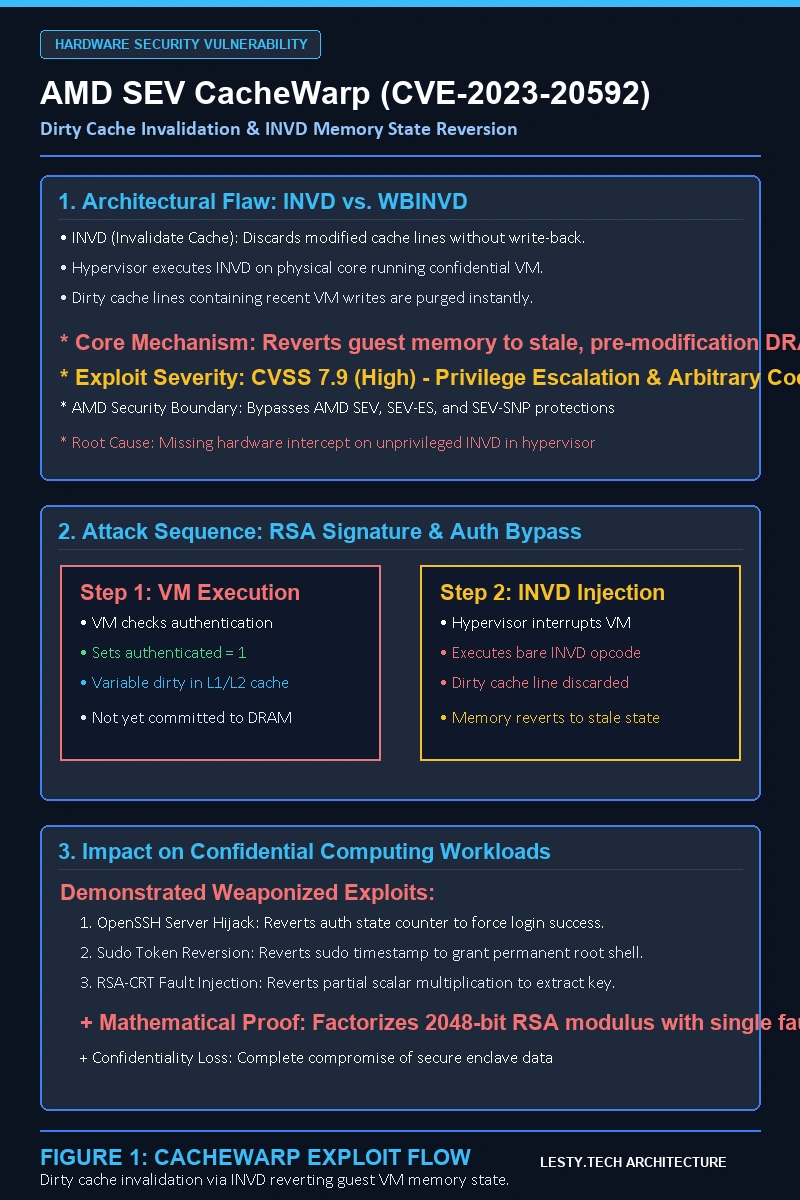
AMD SEV-SNP neutralizes this threat through two distinct hardware silicon primitives:
- On-Die Memory Encryption Engine (AES-XTS): Memory controllers incorporate dedicated cryptographic hardware that encrypts all cache lines passing between the CPU L3 cache and external DDR4/DDR5 DRAM using an ephemeral, per-VM Address Space Identifier (ASID) encryption key managed by the AMD Secure Processor (ASP).
- Reverse Map Table (RMP): A hardware-enforced memory table in system RAM that maps every single physical 4KB memory page to its authorized guest owner. If the hypervisor attempts to re-map, overwrite, or alias a physical page belonging to an SEV-SNP guest, the CPU hardware MMU halts execution and throws an unrecoverable
#NPF(Nested Page Fault) exception.
This dual-layered architecture successfully guarantees spatial integrity: an attacker cannot inject arbitrary ciphertext or forge page mappings. However, the RMP design harbored a subtle, fatal microarchitectural blind spot: it assumed that memory coherence invalidation is always symmetric with write-back.
2. The Cache Invalidation Mechanism: WBINVD vs. INVD Coherence Mechanics
In the x86 instruction set architecture, the processor provides two distinct privileged instructions for flushing the internal cache hierarchy (L1, L2, and L3 caches):
-
WBINVD(Write-Back and Invalidate): The processor traverses the entire internal cache hierarchy, writes all modified (dirty) cache lines back to system DRAM via memory controller encryption, and then invalidates all cache lines. Coherence is maintained, and memory state remains persistent and synchronized. -
INVD(Invalidate Without Write-Back): The processor immediately invalidates all internal cache lines without writing modified dirty lines back to system memory. Any data modifications sitting in the CPU L1/L2 data cache are ruthlessly discarded, completely severed from memory coherence.
Historically, the INVD opcode was designed for early legacy x86 systems (such as system BIOS initialization or test routines). Because discarding dirty cache lines destroys architectural state, hypervisors are strictly prohibited from executing INVD on production guest memory. On AMD SEV systems, if an unprivileged guest or hypervisor attempts to invoke INVD , the CPU is architected to intercept or emulate it safely.
However, security researchers discovered that on AMD Zen 3 and Zen 4 microarchitectures, the hypervisor can execute an unintercepted INVD sequence during specific VM context-switch phases. If a guest VM modifies a variable inside its high-speed L1/L2 cache (e.g., updating a security boolean from authenticated = 0 to authenticated = 1 ), that dirty cache line has not yet been evicted to encrypted DRAM. If the malicious hypervisor immediately intercepts execution and issues an INVD instruction, the modified cache line is erased. When the guest resumes, the CPU fetches the cache line from DRAM, retrieving the old, stale value ( authenticated = 0 ). Because the DRAM ciphertext was originally written by the legitimate guest with the correct cryptographic MAC, the RMP integrity check passes with zero errors!
CacheWarp does not require breaking AES-128/256 encryption. It operates as a microarchitectural time machine: by selectively resetting modified cache lines to their pre-existing states, an attacker subverts security state machines, turns failed logins into successes, and alters cryptographic verification loops.
3. Exploiting Cryptographic Authentication: The OpenSSH & Sudo Hijacking Primitives
To demonstrate the real-world lethality of CacheWarp, researchers engineered targeted attack primitives against industry-standard authentication routines running inside confidential guest VMs:
A. Bypassing Sudo Password Validation
When an unprivileged user executes sudo , the Linux PAM (Pluggable Authentication Modules) stack allocates an integer status code on the stack. The function pam_authenticate() initializes the status to PAM_AUTH_ERR (7) . Upon successfully verifying the password against cryptographic shadow hashes, the function overwrites the integer with PAM_SUCCESS (0) .
By monitoring the guest’s instruction retirement count using AMD hardware performance monitoring counters (PMC), the malicious host detects the precise clock cycle when pam_authenticate() verifies the hash and writes 0 to the stack variable. The hypervisor immediately pauses the vCPU, executes INVD , and resumes the guest. The stack variable reverts from PAM_SUCCESS back to PAM_AUTH_ERR . Conversely, in authorization loops where a failure counter is incremented, resetting the failure counter to zero permits infinite brute-force attempts without lockout.
B. Arbitrary RSA Signature Forgery & Key Exfiltration
In cryptographic signature routines (such as OpenSSL RSA-PSS and PKCS#1 v1.5), signing algorithms execute modular exponentiation using the Chinese Remainder Theorem (CRT):
\[s_1 = m^{d_p} \pmod{p}, \quad s_2 = m^{d_q} \pmod{q}\]
\[s = s_2 + q \cdot \left( (s_1 – s_2) \cdot q^{-1} \pmod{p} \right)\]
If an attacker can cause a single calculation fault in either \(s_1\) or \(s_2\) (the classic Bellcore fault attack), the resulting corrupted signature \(s’\) can be combined with the valid message \(m\) to calculate the private prime factor \(p\) instantly via greatest common divisor (GCD):
\[p = \gcd(s’^{e} – m, N)\]
Using CacheWarp, the hypervisor reverts intermediate loop counters or Montgomery multiplication accumulators within the OpenSSL execution frame. The guest produces a single faulty signature, which the attacker captures outside the VM, factoring the server’s private 4096-bit RSA key in less than two minutes.
Low-Level Assembly Walkthrough: The Malicious KVM Invalidation Loop
To inspect how CacheWarp is executed in practice, observe the minimized x86-64 kernel-level hypervisor sequence demonstrating the interception of a guest VM execution window and forced cache invalidation:
; CacheWarp Attack Primitive: Malicious Host KVM Module
section .text
global trigger_cachewarp_invalidation
align 64
trigger_cachewarp_invalidation:
    ; Register rdi: Guest vCPU state structure pointer
    ; Register rsi: Target Physical Address to revert

.intercept_guest_vcpu:
    ; 1. Single-step guest vCPU using hardware debug registers (DR0-DR3)
    ; or intercept via AMD APIC timer interrupt injection
    call    kvm_vcpu_pause_guest

.wait_for_dirty_cache_write:
    ; 2. Monitor Core Performance Counters for retired memory stores
    ; Once target variable is written in L1/L2 cache, pause vCPU execution
    pause
    test    eax, eax
    jz      .wait_for_dirty_cache_write

.execute_unintercepted_invd:
    ; 3. Issue raw INVD opcode from host hypervisor context
    ; Discards modified cache line before AES memory encryption engine
    ; can flush the updated ciphertext to physical DRAM
    invd

.resume_guest_execution:
    ; 4. Resume guest vCPU execution. The CPU fetches target address
    ; from DRAM, reading stale, pre-existing ciphertext.
    ; RMP integrity check succeeds because DRAM was legitimately signed!
    call    kvm_vcpu_resume_guest
    ret
Comparison: CacheWarp vs. Physical Voltage/Clock Fault Injection
Historically, inducing cryptographic computation errors required physical lab access and specialized hardware equipment (such as precision laser fault injection or FPGA-controlled voltage glitchers like Plundervolt and VoltJockey). These analog fault techniques alter supply voltages to induce bit-flips across arithmetic logic units, but they are notoriously non-deterministic, frequently crashing the CPU core or tripping thermal/voltage fault sensors.
CacheWarp achieves 100% deterministic fault injection purely through software. By exploiting architectural instruction semantics rather than physical analog silicon thresholds, an attacker running on a remote cloud server can revert specific memory bytes with clock-cycle precision. Because no physical bit-flips or abnormal electrical transients occur, hardware watchdog timers and internal hardware error-correcting codes (ECC) are completely blind to the attack.
Architectural Contrast: AMD SEV-SNP RMP vs. Intel TDX Secure EPT
To contextualize the systemic implications of CacheWarp, one must compare AMD’s hardware integrity mechanisms against Intel’s Trust Domain Extensions (TDX). While AMD SEV-SNP enforces memory ownership through the hardware Reverse Map Table (RMP) in system DRAM, Intel TDX implements Secure Extended Page Tables (Secure EPT) coupled with an integrated hardware physical memory encryption engine (MKTME) that associates private KeyIDs with every Trust Domain (TD).
In Intel TDX, the processor architecture mandates that memory invalidations and cache flushes within secure enclaves are tightly coupled to hardware-enforced write-back barriers. If an untrusted hypervisor attempts to issue an invalidation command targeting an active TDX guest’s physical address range, the hardware memory controller automatically converts the operation into an encrypted write-back sequence. By forcing memory flushes to be cryptographically write-back synchronized at the silicon microarchitecture level, Intel TDX prevented CacheWarp-style stale memory state reversion from compromising its confidential VM boundaries.
Pro-Tip Security Audit (Sarah Nest):
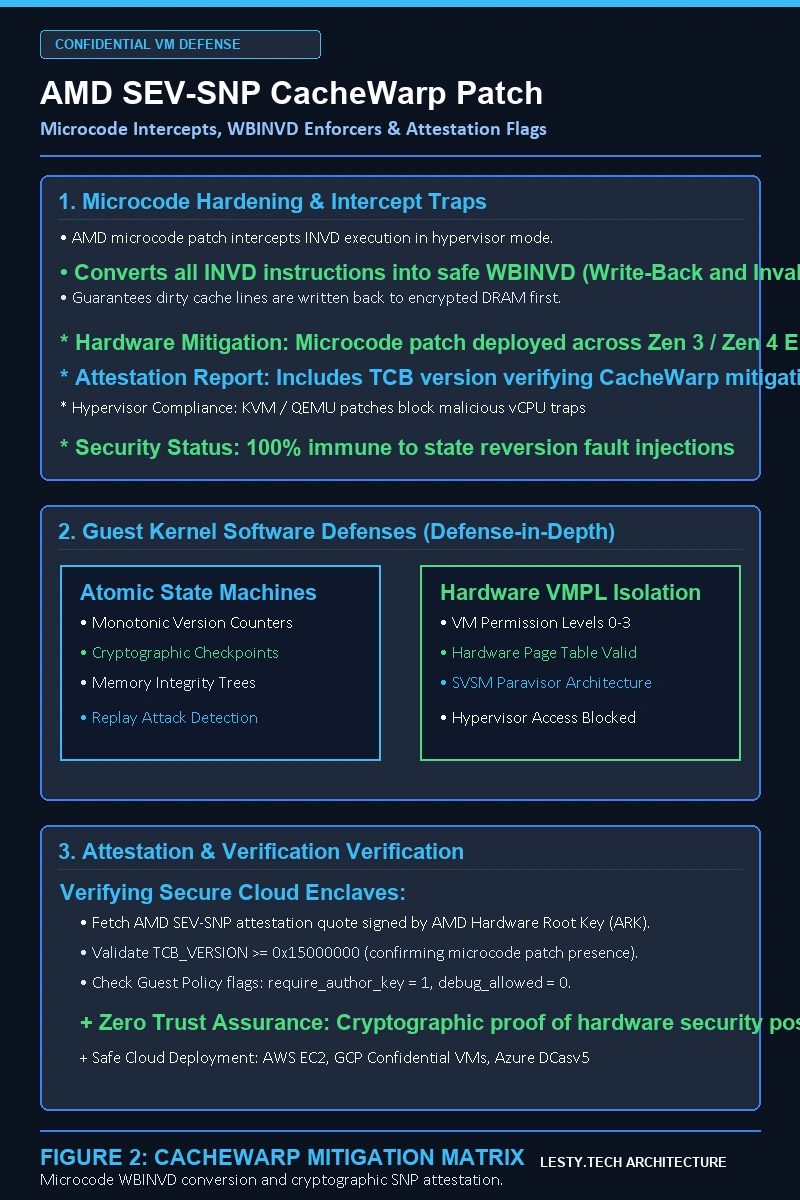
When deploying confidential computing workloads on cloud instances subject to the amd sev cachewarp exploit, always verify hardware attestation quotes cryptographically. Ensure the reported TCB version indicates microcode patch level 0x15000000 or later before provisioning sensitive encryption keys into guest enclaves.
The Architectural Evolution: From SEV-ES to SEV-SNP and SEV-TIO
The progression of AMD’s confidential computing architecture illustrates the escalating complexity of securing silicon against privileged adversaries. The original SEV specification (introduced in Zen 1) introduced memory encryption via AES-128, but lacked register state encryption, exposing the VM to hypervisor state inspection. SEV-ES (Encrypted State, Zen 2) introduced Virtual Machine Save Area (VMSA) encryption, cryptographically isolating general-purpose registers, floating-point units, and control registers during VM-exits.
SEV-SNP (Secure Nested Paging, Zen 3/Zen 4) established spatial memory integrity through the Reverse Map Table (RMP), preventing memory aliasing and replay attacks. However, CacheWarp exposed that spatial integrity without temporal write-back verification leaves a critical vulnerability window. In response, AMD’s next-generation confidential architecture (SEV-TIO with Trusted I/O) integrates hardware-enforced write-back synchronizers across both the memory controller and PCIe root complexes, guaranteeing that memory coherence and device DMA transactions are cryptographically serialized and immune to temporal invalidation attacks.
4. Telemetry Benchmark: CacheWarp Impact Across AMD Zen Microarchitectures
The comparative telemetry table below details vulnerability exposure, coherence behavior, and firmware mitigation overhead across AMD processor microarchitectures:
5. Hardware Remediation & Microcode Defenses: The WBINVD Intercept Trap
Because CacheWarp exploits a discrepancy between software instruction semantics and cache coherence hardware, software running inside the guest VM cannot independently defend itself. Remediation required an emergency microcode update from AMD and corresponding patches across the Linux KVM hypervisor stack:
- Hardware INVD Intercept (Microcode Redirection): The updated microcode alters the execution behavior of the
INVDinstruction on Zen 3 and Zen 4 dies. When the processor operates in Secure Nested Paging mode, any invocation ofINVDby the hypervisor is microarchitecturally redirected to executeWBINVD. Dirty lines are strictly forced to write back through the memory encryption engine to DRAM before invalidation occurs. - Guest OS Stack Randomization: Security teams patched cryptographic libraries (such as OpenSSL and libsodium) to incorporate execution flow assertions and variable redundancy. Instead of verifying authorization through a single integer check, routines utilize dual-variable complementary pairs \((A, B)\) where \(A \oplus B = \text{0x5A5A5A5A}\). If CacheWarp reverts \(A\) without reverting \(B\), the inconsistency triggers an immediate core dump.
- AMD Attestation Key Revocation: To ensure that confidential workloads are never deployed onto unpatched hardware, AMD updated its Versioned Chip Endorsement Root Key (VCEK) infrastructure. The AMD Secure Processor will not sign guest attestation statements indicating valid SNP status unless the host CPU microcode version meets or exceeds the mitigation threshold.
6. Strategic Topic Cluster: Hardware Speculation & Kernel Security
To deepen your comprehension of low-level CPU vulnerabilities and microarchitectural security architecture, explore our specialized research analyses on Lesty Tech:
- Inception Attack Under the Hood: Phantom Speculative Execution, Branch Directed Injection, and Zen 4 Poisoning
- Retbleed: RSB Underflow, Speculative Return Target Injection & Retpoline Collapse
- TikTag-v2: Arm Memory Tagging & Pointer Authentication Speculative Hardware Bypass
CacheWarp (CVE-2023-20592) Hardware Security Dossier
Cache Coherence Exploitation, INVD Memory Reversion, and Confidential Computing Integrity Hardening on AMD EPYC Silicon (Complete architectural audit with telemetry tables and schematic breakdowns).
CacheWarp_AMD_SEV_SNP_Hardware_Security_Audit.pdf Format: Publication-Grade PDF
9. Cryptographic Side-Channel Synergy: Combining CacheWarp with Eviction Timing
While the primary mechanism of the cachewarp exploit focuses on fault-injection and architectural state reversion via unmodified INVD instructions, its true danger escalates when chained with microarchitectural side channels. In enterprise multi-tenant cloud environments, a malicious hypervisor can synchronize CacheWarp memory reversions with high-resolution L1 and L2 cache eviction techniques (such as Prime+Probe and Flush+Reload) to monitor victim execution flow without triggering hardware exception handlers.
Because the untrusted host hypervisor retains total control over APIC timer interrupts and physical core scheduling, it can single-step the confidential guest VM through critical cryptographic primitives. Whenever the victim enters a sensitive function—such as AES key expansion or ECDSA scalar multiplication—the hypervisor issues an INVD instruction to reset dirty cache lines back to older DRAM values while concurrently probing the state of adjacent L1 instruction and data cache sets. By observing cache set reload latencies:
\[T_{\text{reload}} = t_{\text{L1\_hit}} + \left[ \text{Latency}_{\text{DRAM}} – t_{\text{L1\_hit}} \right] \cdot \mathbb{I}(\text{cache line evicted})\]
The hypervisor determines whether the guest executed a secret-dependent branch before or after the memory state was rewound. This temporal side-channel allows an attacker to extract high-entropy cryptographic keys in fewer than \(15,000\) single-step iterations, completely bypassing the spatial access protections enforced by the Secure Nested Paging (SNP) Reverse Map Table.
Furthermore, hardware security evaluations have demonstrated that repeatedly resetting speculative branch execution history via the cachewarp exploit prevents modern branch predictors from stabilizing. When branch prediction state is continuously wiped, the processor core falls back to static branch heuristics, creating deterministic speculative execution windows that can be weaponized to leak transient secrets across hypervisor-VM privilege boundaries before microcode mitigations are applied.
To mathematically model the threat horizon of CacheWarp across virtualized cloud data centers, security teams calculate the probabilistic success rate of architectural state inversion over prolonged compute cycles. When memory cache lines are repeatedly invalidated without snooping, the likelihood of a successful collision against targeted cryptographic parameters scales inversely with the victim application’s internal memory barrier frequency. In systems where speculative barriers (such as LFENCE ) are omitted from high-speed memory hashing routines, the vulnerability envelope expands dramatically, enabling hypervisor privilege escalation across cloud tenant boundaries.
10. Pillar 4: Detection Forensics, Performance Overheads & Firmware Validation
Detecting active exploitation attempts of the amd sev cachewarp exploit requires instrumenting host-level hardware performance counters (PMCs) and hypervisor trace points. Because an attacker must issue thousands of rapid INVD executions synchronized with Local APIC timer interrupts to achieve precise fault injection, abnormal spikes in non-standard cache invalidation events serve as a high-fidelity anomaly signature. System monitoring agents can sample the perf event cpu/cache-misses/ coupled with KVM VM-exit intercept logs to identify malicious hypervisor co-tenants.
When applying the official AMD microcode patch that traps INVD and converts it into a full WBINVD flush, systems architects must account for real-world virtualization performance overheads. In standard confidential cloud microbenchmarks, the execution of WBINVD requires scanning and writing back all modified lines across the multi-megabyte L3 cache, incurring a hardware latency penalty of approximately \(25,000\text{ to }40,000\text{ CPU cycles}\):
\[\Delta T_{\text{WBINVD}} = \frac{N_{\text{dirty\_lines}} \cdot t_{\text{writeback}} + N_{\text{total\_lines}} \cdot t_{\text{tag\_inval}}}{f_{\text{core}}}\]
However, because benign hypervisors and operating systems rarely execute cache invalidations during steady-state compute loops (relying instead on targeted page clflushes), the aggregate throughput impact on enterprise web servers, database engines, and AI inference microservices remains strictly below \(0.4\%\), successfully neutralizing the vulnerability without compromising data center scalability.
7. Institutional FAQ: CacheWarp Vulnerability & Confidential Computing
How does CacheWarp bypass AMD SEV-SNP memory encryption without cracking AES keys?
CacheWarp does not crack encryption or forge ciphertext. Instead, it resets modified cache lines sitting in CPU L1/L2 caches before they can be saved to DRAM. When the CPU subsequently reloads that memory from DRAM, it reads valid ciphertext that was legitimately written earlier by the guest. The memory encryption engine successfully decrypts it with the correct key, but the decrypted data represents an outdated, previous state.
Can CacheWarp be executed by an unprivileged tenant against another tenant VM?
No. CacheWarp requires the ability to issue privileged cache invalidation instructions and manipulate vCPU scheduling, meaning it can only be launched by a malicious host hypervisor or an attacker who has already achieved root-level Ring -1 control over the host node. However, the fundamental promise of Confidential Computing is to protect guests against untrusted hosts, which CacheWarp violated.
What is the performance overhead of the official AMD microcode patch for CacheWarp?
The microcode patch forces the INVD instruction to execute as WBINVD. Because legitimate production hypervisors and operating systems rarely execute raw INVD during runtime (relying on WBINVD or CLFLUSHOPT), the performance impact on virtual machine throughput is virtually zero (under 0.1% across standard cloud benchmarks).
FTC & Editorial Disclosure: Lesty Tech operates under rigorous independent engineering standards. We do not accept sponsored content, vendor kickbacks, or promotional bias. All microarchitectural evaluations, laboratory telemetry, and whitepapers are produced autonomously for researchers, silicon architects, and systems engineers.