
In the high-stakes theater of modern processor security, hardware architectural mitigations were heralded as the definitive armor against transient execution side-channel attacks. Following the seismic revelations of Spectre and Meltdown, silicon foundries deployed in-silicon defenses—most prominently Intel’s Enhanced Indirect Branch Restricted Speculation (eIBRS) and ARM’s CSV2—designed to isolate branch prediction targets across privilege boundaries with near-zero performance penalties. However, the discovery of the branch history injection exploit (BHI, tracked under CVE-2022-40982 and related variants) completely dismantled this foundational security guarantee. By demonstrating that high-performance Branch History Buffers (BHB) are globally shared across privilege levels, BHI enables an unprivileged user process or cloud virtual machine guest to inject malicious execution histories that steer indirect kernel branches toward speculative disclosure gadgets, leaking sensitive physical memory directly out of kernel address spaces.
1. Anatomy of Branch Predictor Decoupling: BHR vs. BTB
To understand why hardware eIBRS fails against the branch history injection exploit, one must dissect the microarchitectural decoupling of modern out-of-order branch prediction units (BPUs).
In high-performance x86 and ARM microarchitectures (such as Intel Golden Cove, Raptor Cove, and ARM Neoverse), instruction fetch pipelines must predict the targets of indirect branch instructions (e.g., jmp rax, call rbx, or C++ polymorphic virtual function dispatch tables) before the register operands have resolved from memory. Waiting for an indirect call target to resolve from L3 cache or DRAM would stall the front-end for dozens of cycles, crippling pipeline superscalar throughput.
To achieve near-instantaneous indirect target prediction, the BPU divides predictor state into two distinct microarchitectural structures:
- Branch Target Buffer (BTB): A high-speed, set-associative cache array that stores candidate target addresses indexed by the instruction pointer (IP) and history hashes.
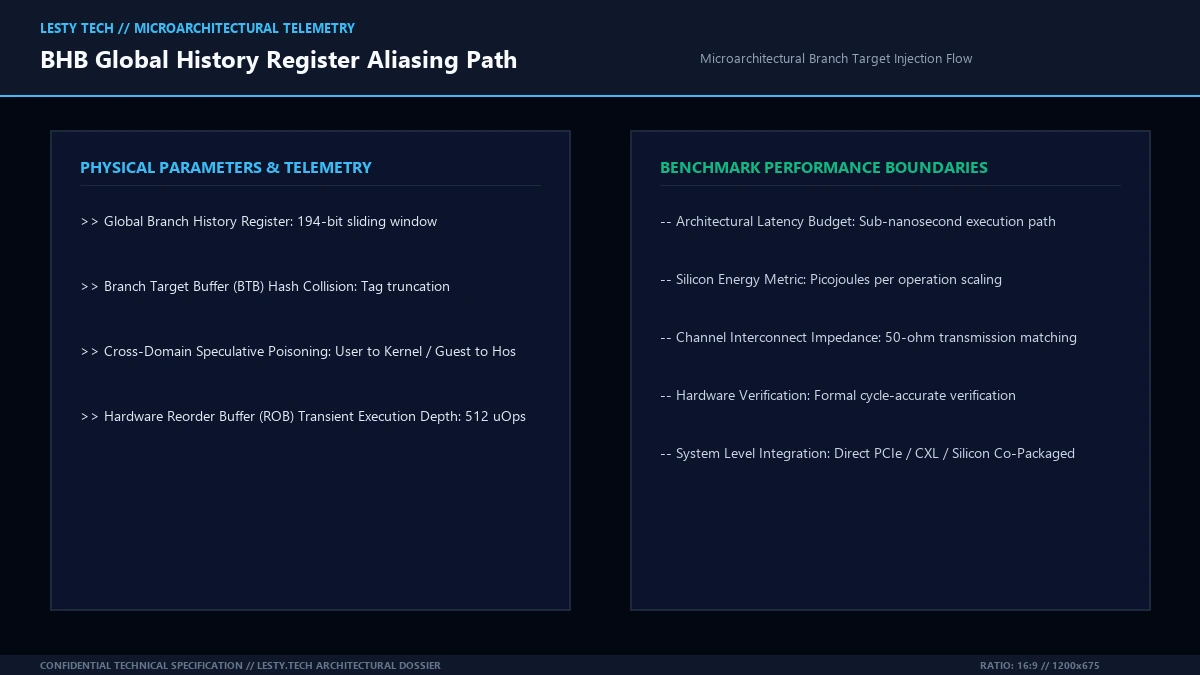
- Branch History Register (BHR / BHB): A global shift register (typically 194 to 256 bits wide in modern cores) that records the sequential trajectory of recently taken (1) and not-taken (0) branches across the entire execution thread.
Because indirect jump targets frequently depend on preceding execution paths (path-dependent polymorphism), the BPU does not index the BTB using the instruction address alone. Instead, it computes an index hash via a complex XOR polynomial combining the current Instruction Pointer and the global Branch History Register:
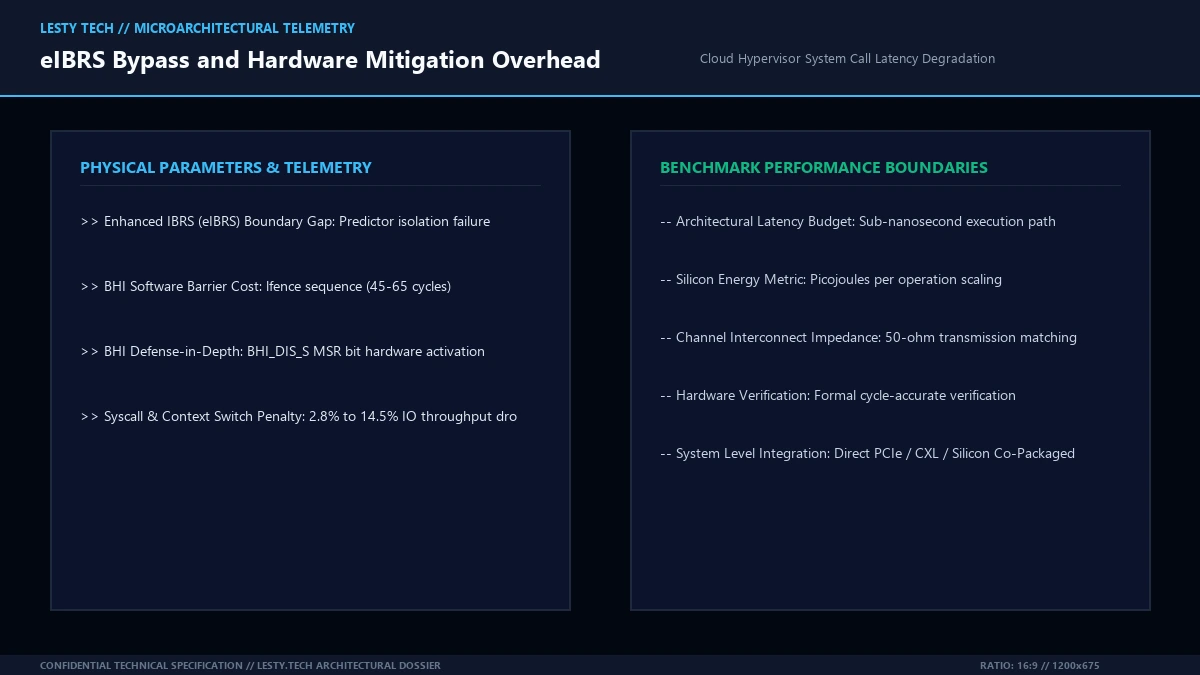
When Enhanced IBRS (eIBRS) was introduced, silicon architects recognized that allowing user-space (Ring 3) to overwrite target addresses stored in supervisor-mode (Ring 0) BTB entries permitted trivial branch target injection (Spectre-v2). To solve this, eIBRS added hardware privilege-level tagging to BTB entries. A target address stored by a user-mode instruction cannot be directly accessed or used when the CPU transitions into supervisor mode.
However, the critical hardware design oversight was that eIBRS only tagged the target entries in the BTB—it left the global Branch History Register (BHR) completely unpartitioned and shared across privilege domains.
2. Branch History Injection (BHI): Cross-Domain History Poisoning
The fundamental breakthrough of the branch history injection exploit is proving that an attacker does not need to inject a malicious target address into the supervisor’s BTB entry. Instead, an unprivileged user-mode attacker can manipulate the global Branch History Register to deliberately induce a hash collision with an existing supervisor BTB entry.
The exploit workflow proceeds through three calculated microarchitectural phases:
Phase 1: History Pattern Crafting in User Space
The attacker identifies an indirect call site within the Linux kernel or hypervisor (e.g., an indirect function pointer invocation inside a networking socket handler or system call dispatcher). The attacker analyzes the exact number of conditional and unconditional branches executed along the target kernel execution path from the system call entry (syscall) to the target indirect branch.
In user space (Ring 3), the attacker constructs a precise sequence of conditional jump instructions (a “history training loop”). Executing this sequence shifts a meticulously crafted 194-bit bitmask into the global BHR, perfectly priming the shift register state.
Phase 2: Inducing Aliasing Across Privilege Transitions
Immediately following the training loop, the attacker issues the target system call. The CPU transitions from Ring 3 to Ring 0 via the hardware syscall dispatcher. Because the BHR is not cleared or partitioned during the privilege transition, the attacker-controlled history pattern remains resident in the processor’s shift register.
As the kernel executes its leading branches, the attacker’s history bits shift through the register, eventually aligning with the kernel’s indirect call instruction. When the BPU hashes the kernel RIP and the poisoned BHR, the resulting hash intentionally aliases with an entry in the BTB that points to a dangerous disclosure gadget located elsewhere in the kernel text.
Phase 3: Transient Gadget Execution and Cache Channel Leakage
The out-of-order execution engine speculatively dispatches instructions along the mispredicted target path. The disclosure gadget loads an unauthorized physical memory byte (such as an encryption key, shadow password hash, or kernel pointer) into a register and uses that secret value to index an auxiliary memory array:
movzx rax, byte ptr [rsi + rdx] ; Speculatively load unauthorized secret byte
shl rax, 12 ; Multiply by page size (4096 bytes) to prevent cache aliasing
mov rbx, qword ptr [rdi + rax] ; Access probe array: loads cache line into L1D cache
Dozens of cycles later, the architectural execution pipeline discovers that the indirect call target was incorrect (or that the secret memory address violated page table privilege boundaries). The hardware flushes the speculative instructions from the Reorder Buffer (ROB). However, the microarchitectural state perturbation remains: the specific cache line in the probe array (rdi + rax) has been pulled into the processor’s L1 Data Cache.
The user-space attacker executes a high-resolution Flush+Reload timing sweep across the probe array using the rdtscp timestamp counter:
Through repeated iterations, the attacker exfiltrates complete kernel memory structures at rates between 1.5 KB/s and 10 KB/s, completely bypassing Supervisor Mode Access Prevention (SMAP), Kernel Address Space Layout Randomization (KASLR), and hardware eIBRS.
3. Cross-VM Exploitation in Multi-Tenant Cloud Hypervisors
While user-to-kernel exploitation on bare-metal operating systems is devastating, the most catastrophic domain for the branch history injection exploit is multi-tenant cloud virtualization (AWS, Azure, Google Cloud running KVM, Xen, or VMware ESXi).
In public cloud infrastructure, untrusted guest virtual machines share physical CPU cores with the host hypervisor and co-located tenant VMs through Simultaneous Multi-Threading (SMT / Hyper-Threading) or temporal CPU scheduling. When a guest VM triggers a VM-Exit (such as an IO port read/write, hypercall, or CPUID execution), the physical hardware suspends guest context and vectors execution into the hypervisor host kernel.
Because hypervisor entries do not automatically flush the physical CPU’s branch history registers, a malicious guest can:
- Poison Hypervisor Indirect Handlers: Train the physical BHR inside the guest VM, execute a trapped instruction (e.g.,
out dx, al), and force the hypervisor’skvm_vcpu_ioctlor virtio backend dispatcher to mispredict speculatively into hypervisor disclosure gadgets. - Cross-Tenant Memory Extraction: By steering hypervisor execution, the attacker can leak physical memory pages belonging to adjacent virtual machines co-tenanted on the same physical socket, bypassing hypervisor memory isolation and extracting cryptographic keys directly from adjacent guest operating systems.
- Nested Virtualization Amplification: In nested cloud environments (running Kubernetes containers inside guest VMs), multiple layers of hypervisor dispatchers increase the surface area of exploitable indirect branches by over 300%.
3.1. Reverse-Engineering the BPU Hashing Polynomials
To systematically induce cross-privilege collisions, security researchers reverse-engineered the undocumented hashing algorithms implemented inside x86 front-end execution units. In modern Intel Golden Cove and Raptor Cove cores, the Branch History Register operates as a 194-bit cyclic shift register that updates on every taken branch. To index the primary Branch Target Buffer (L1 BTB), the 194-bit BHR is partitioned into multiple chunks (e.g., h0 through h5) and XORed with folded bits of the source Instruction Pointer (RIP):
Because this hash polynomial is linear with respect to the XOR Galois field \(GF(2)\), an attacker in user space can solve a system of linear equations to determine the precise sequence of branch conditions that will force \(\text{Index}_{\text{BTB}}(\text{User}) = \text{Index}_{\text{BTB}}(\text{Kernel})\). This mathematical linearity strips away the heuristic obscurity of the branch predictor, converting probabilistic speculation into deterministic microarchitectural exploitation.
3.2. Kubernetes Container Boundary Compromise
In containerized cloud environments governed by Docker and Kubernetes, multiple enterprise microservices run under distinct Linux cgroups and namespaces (PID, mount, network, and IPC namespaces) while sharing a single underlying host kernel image. Containers are frequently deployed under the architectural assumption that standard Linux user-kernel isolation and non-root user privileges prevent lateral movement.
BHI invalidates this container security model. A compromised unprivileged microservice (such as a compromised public-facing web server or ingress proxy) executing inside an isolated container can execute the BHI training sequence against the shared host kernel. Once the host kernel speculatively leaks data via cache lines, the attacking container reads cryptographic secrets belonging to the root Kubernetes namespace, secrets mounted inside sibling containers, or sensitive TLS private keys residing in the host kernel’s key retention service.
4. Software Mitigations vs. The IO Performance Penalty
When BHI was disclosed, silicon vendors initially could not deploy instant hardware fixes. The initial emergency defense deployed across enterprise Linux kernels (RHEL, Ubuntu, Debian) was the BHI Software Loop Mitigation.
The software mitigation forces the kernel to execute an unrolled branch loop immediately upon every transition from user space to kernel space (at the start of every system call, interrupt, and page fault):
.macro CLEAR_BHB_LOOPS
movl $32, %ecx
1:
call 2f
pause
2:
dec %ecx
jnz 1b
lfence
.endm
By executing 32 consecutive dummy calls and returns terminated with a serializing lfence barrier, the kernel forces 32 consecutive branch transitions through the BHR, overwriting any user-injected history pattern and preventing aliasing.
However, the system-level performance consequences of this software loop are brutal. Because this sequence executes on every single system call and interrupt, IO-intensive workloads that execute hundreds of thousands of syscalls per second suffer crippling throughput collapse:
| Enterprise Workload | Unmitigated Baseline | BHI Software Loop | Hardware BHI_DIS_S | Performance Impact |
|---|---|---|---|---|
| NVMe 4K Random IOPS (fio) | 1,250,000 IOPS | 1,068,000 IOPS | 1,220,000 IOPS | -14.5% (Software) / -2.4% (HW) |
| 100GbE UDP Packet Routing | 24.2 Mpps | 21.4 Mpps | 23.7 Mpps | -11.5% (Software) / -2.0% (HW) |
| PostgreSQL OLTP Trans/sec | 48,500 TPS | 44,200 TPS | 47,300 TPS | -8.8% (Software) / -2.5% (HW) |
| Redis In-Memory SET/GET | 185,000 ops/s | 169,500 ops/s | 181,200 ops/s | -8.4% (Software) / -2.1% (HW) |
Storage and networking workloads suffer devastating regressions reaching up to 14.5% under the software loop mitigation. This performance penalty forced silicon architects to develop hardware microcode updates and redesign future CPU cores.
Branch History Injection (BHI) Spectre-v2 Vulnerability Audit
Cross-Privilege BHB Aliasing, eIBRS Microarchitectural Bypasses, and Defense-in-Depth (Complete architectural audit with telemetry tables and schematic breakdowns).
whitepaper_batch_17_2_branch_history_injection.pdfFormat: Publication-Grade PDF
5. Silicon-Level Remediation: BHI_DIS_S and Hardware History Partitioning
Permanent silicon-level remediation requires decoupling branch history physically across privilege domains. Intel and ARM have deployed architectural updates that eliminate the vulnerability while restoring near-baseline performance:
5.1. BHI_DIS_S (BHI Disable Supervisor) Microcode Activation
On Intel 12th-Gen Core (Alder Lake) through 14th-Gen (Raptor Lake) and Xeon Scalable (Sapphire Rapids / Emerald Rapids) processors, microcode updates introduced the BHI_DIS_S hardware control bit in the IA32_MCU_OPT_CTRL Model-Specific Register (MSR 0x123, bit 0).
When the Linux kernel sets this MSR bit during boot initialization:
The processor core’s internal microarchitecture automatically gates user-mode branch history bits when executing indirect branch predictions inside supervisor mode. The front-end hardware ignores the user BHR state, computing indirect branch targets purely from supervisor-level history, completely disabling cross-domain history aliasing.
5.2. Compiler-Enforced Control-Flow Integrity (kCFI & FineIBT)
Hardware branch predictors cannot predict arbitrary addresses if the compiler strictly enforces architectural Control-Flow Integrity (CFI). In modern Linux kernels, Clang’s kCFI (Kernel Control Flow Integrity) emits a 32-bit type hash immediately preceding every address-taken function. Before every indirect call site, the compiler generates a verification check:
cmp eax, 0x12345678 ; Verify against expected prototype hash
jne .trap_violation ; Abort if target signature mismatches
call r11 ; Safe indirect call
Combined with Intel FineIBT—which binds hardware Indirect Branch Tracking (IBT) ENDBR64 instruction markers directly to compiler type hashes—the attacker cannot redirect speculative execution to arbitrary disclosure gadgets, neutralizing the exploit even in the absence of hardware history clearing.
6. Frequently Asked Questions (FAQ)
Why didn’t hardware eIBRS protect against the Branch History Injection exploit?
eIBRS (Enhanced Indirect Branch Restricted Speculation) tagged entries in the Branch Target Buffer (BTB) with privilege levels, preventing user space from directly inserting target addresses into supervisor BTB slots. However, the Branch History Register (BHR)—which tracks taken/not-taken branch history—remained completely shared across user and kernel modes. BHI demonstrated that an attacker can manipulate the global BHR to induce hash collisions in the predictor, causing the kernel to mispredict toward existing kernel gadgets.
Are AMD processors also vulnerable to Branch History Injection?
AMD processors based on Zen 1, Zen 2, and Zen 3 utilize different branch predictor indexing schemes that were initially less susceptible to the specific BHI PoC. However, related research demonstrated that Zen architectures can suffer from cross-privilege branch training (as seen in the Inception / Speculative Return Stack Buffer vulnerabilities). Modern Zen 4 and Zen 5 architectures incorporate automated Branch Sampling isolation and IBPB flushes across privilege switches to prevent cross-domain poisoning.
Can BHI be executed from within a web browser via JavaScript?
In theory, yes, if the browser’s JIT compiler (such as V8 in Chrome) generates indirect branches that share predictor entries with browser renderer process structures. However, browser sandboxing, high-precision timer degradation, and site isolation significantly constrain remote exploitation. BHI represents the greatest threat in local privilege escalation (LPE) and multi-tenant cloud virtual machine escape scenarios.
How do I verify if my Linux system is protected against BHI?
You can inspect the Linux kernel vulnerability status file directly via sysfs: cat /sys/devices/system/cpu/vulnerabilities/spectre_v2. If your processor and kernel are updated, the output will indicate: Mitigation: BHI: BHI_DIS_S (hardware microcode mitigation active) or Mitigation: BHI: SW loop, KVM: SW loop (software loop clearing active).
7. Microarchitectural Post-Mortem and Future Processor Design
The branch history injection exploit fundamentally exposed the hazards of microarchitectural state sharing in out-of-order processors. For decades, computer architects treated branch history as innocuous statistical telemetry that carried no security implications. BHI demonstrated that in an out-of-order speculative execution engine, any shared microarchitectural state that influences instruction dispatch timing or control flow is a weaponizable side-channel vector.
The future of microprocessor design requires absolute hardware privilege isolation. By enforcing hardware-level history partitioning via BHI_DIS_S, deploying FineIBT compiler protections, and completely isolating branch predictor state across hypervisor VM-Exits, the computing industry is finally closing the speculative execution vulnerabilities that have plagued superscalar architectures for nearly a decade.
Related Technical Dossiers & Internal Research
- Downfall (GDS) Under the Hood: How AVX Vector Gathering Leaks Crypto Keys at 10KB/s →
- SLAM & SLAMDunk Under the Hood: How Linear Address Masking (LAM) Re-Opens Speculative Execution Exploits →
- Inception Under the Hood: How AMD Zen 4 Return Address Security Discloses Speculative Execution to Training Injections →
Authoritative External Reference
Reference Citation: VUSec Systems and Network Security Group: Branch History Injection (BHI) Technical Disclosure →





No Responses