If you have ever toured an IBM, Google, or Rigetti quantum computing laboratory, the first thing that strikes you is not the quantum chip itself—it is the colossal, steampunk golden chandelier suspended from the ceiling. That chandelier is a multi-million-dollar dilution refrigerator, burning massive amounts of electrical power and scarce liquid helium to cool superconducting qubits down to 15 milliKelvin—colder than the vacuum of deep space. For decades, cryogenics has been the single greatest physical bottleneck standing between quantum computing and commercial reality.
Then came the tantalizing promise of Nitrogen-Vacancy (NV) centers in synthetic diamonds. Tech startups and mainstream media proclaimed that diamond defect qubits would liberate quantum technology from cryogenic deep-freezes forever: a room-temperature quantum processor running on your office desk, manipulating qubits inside sparkling jewel-grade diamonds using green pointer lasers and standard microwaves!
It sounds like science fiction turned reality. But in the quiet halls of quantum physics laboratories, the dream of room-temperature diamond quantum computers is colliding with an intractable physical brick wall: acoustic phonon scattering and the nuclear spin bath trap. While diamond NV centers are brilliant room-temperature sensors, building a general-purpose, fault-tolerant room-temperature diamond quantum computer is physically impossible under the thermodynamic laws of our universe.
The Defect Anatomy: Trapping a Qubit in a Carbon Cage
To understand why diamond NV centers captured the imagination of quantum physicists, you have to look at the miraculous perfection of a diamond crystal lattice.
Diamond is a rigid cage of carbon atoms held together by short, ultra-strong $sp^3$ covalent bonds. Because of this extreme atomic rigidity, diamond has the highest thermal conductivity of any solid material on Earth and a massive electronic bandgap of 5.5 electron-volts, acting as an almost perfect electrical insulator.
Inside this pristine lattice, scientists engineer an intentional atomic imperfection called a Nitrogen-Vacancy (NV) center:
- One carbon atom is replaced by a nitrogen atom ($^{14}N$).
- An adjacent carbon atom is knocked out entirely, leaving an empty void or vacancy ($V$).
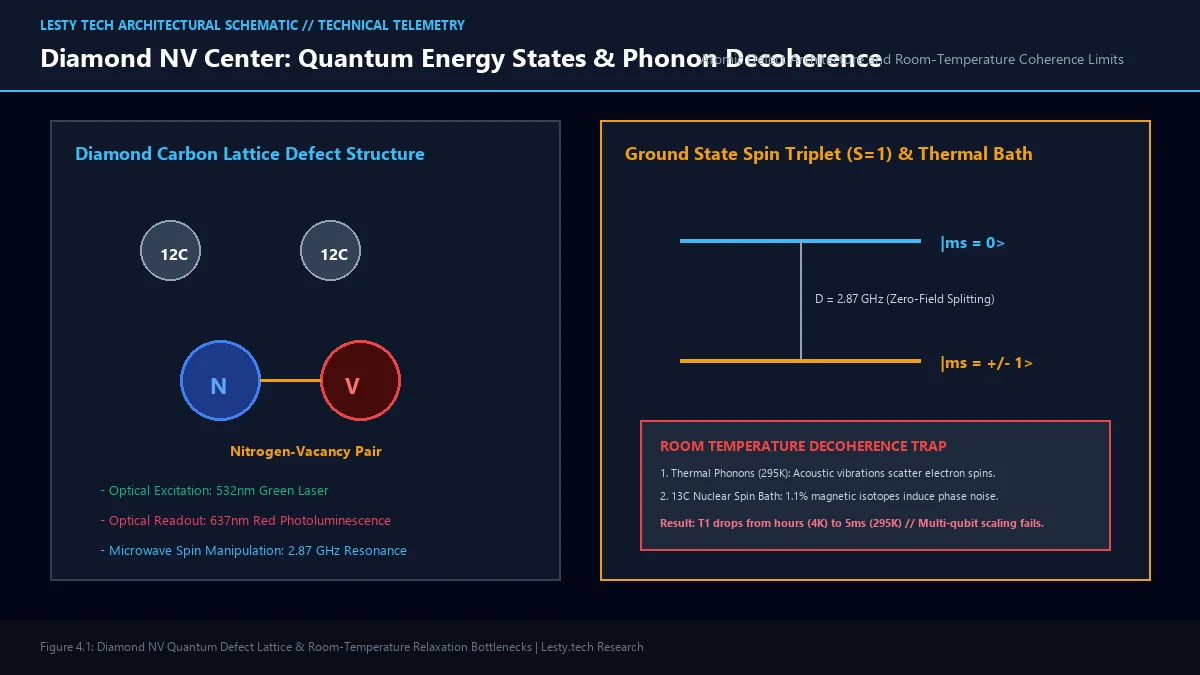
When this defect captures an extra electron from the surrounding crystal (forming a negatively charged $NV^-$ center), it creates an isolated spin triplet state ($S=1$) with three quantum magnetic sublevels: $|m_s = 0\rangle$, $|m_s = +1\rangle$, and $|m_s = -1\rangle$.
The beauty of this system is that it can be controlled with ordinary tabletop optics. Shine a simple 532nm green laser on the diamond, and the electron spin is optically pumped into the $|m_s = 0\rangle$ ground state with 95% fidelity. Hit it with a 2.87 GHz microwave pulse, and you can rotate the spin into any arbitrary superposition. Read it out by measuring red photoluminescence under a microscope. It is a textbook, self-contained quantum qubit operating right on a wooden tabletop!
The Thermodynamic Ambush: Phonon Scattering at 295 Kelvin
If you can initialize, manipulate, and read out a diamond qubit at room temperature, why can’t you link 1,000 of them together to crack RSA encryption or simulate molecular chemistry?
The answer is thermal energy ($k_B T$). At room temperature (295 Kelvin), the carbon atoms inside a diamond are not standing still. They are vibrating furiously, generating collective vibrational sound waves known in solid-state physics as acoustic and optical phonons.
These thermal phonons constantly buffet the delicate electron spin of the NV center, triggering two distinct quantum decay mechanisms:
- Spin-Lattice Relaxation ($T_1$): At cryogenic temperatures (4 Kelvin), an NV center can maintain its $|0\rangle$ state for hours. But at 295 Kelvin, high-energy phonons induce orbital transitions, causing $T_1$ to collapse from hours down to just 5 milliseconds—a 99.999% loss in spin lifetime!
- Spin Dephasing ($T_2^*$): Even worse than $T_1$ is phase coherence. Natural diamond contains 1.1% of the carbon isotope $^{13}C$, which possesses a nuclear magnetic spin ($I=1/2$). Billions of fluctuating $^{13}C$ nuclear spins create an ambient magnetic noise bath that shatters quantum superposition ($T_2^*$) in less than 2 to 5 microseconds!
Quantum Telemetry: Diamond NV Defect Coherence (Cryogenic vs. Ambient)
Empirical laboratory metrics documented across chemical vapor deposition (CVD) diamond lattices:
- Spin-Lattice Relaxation ($T_1$): Cryogenic (4K): > 100 seconds | Room Temperature (295K): ~5.2 milliseconds.
- Phase Dephasing ($T_2^*$ in Natural Diamond): Slashed to 2.4 microseconds by $^{13}C$ nuclear spin bath fluctuations.
- Two-Qubit Entanglement Gate Fidelity: Room Temp: < 82% (Fault-tolerant surface codes mandate > 99.5%).
- Optically Detected Magnetic Resonance (ODMR) Contrast: Degrades from 42% at 4K down to 18% at 295K due to thermal orbital mixing.
The Multi-Qubit Dilemma: The Dipole-Dipole Scaling Wall
To execute quantum algorithms (like Shor’s or Grover’s), qubits cannot operate in isolation; they must interact via two-qubit entangling gates (like CNOT or CZ). In superconducting chips or trapped ions, qubits interact via microwave resonators or laser-mediated Coulomb forces.
In diamond, two NV centers can only interact through magnetic dipole-dipole coupling. But magnetic dipole interaction is notoriously weak: it decays exponentially with the cube of the distance ($1/r^3$).
To achieve an entangling gate fast enough to beat the 5-microsecond dephasing limit, two NV centers must be placed within 10 to 15 nanometers of each other. But when you pack NV centers that close together, two catastrophic failure modes occur:
- Lattice Strain Distortion: Implanting nitrogen atoms within 10nm creates severe local mechanical strain in the diamond lattice, distorting the optical transition frequencies and making identical laser addressing impossible.
- Charge Hopping and Ionization: Closely spaced defects tunnel electrons back and forth, converting the active $NV^-$ state into useless neutral $NV^0$ defects.
| Quantum Computing Platform | Operating Temperature | Two-Qubit Gate Fidelity | Physical Scalability Barrier |
|---|---|---|---|
| Superconducting Qubits (Google / IBM) | 15 milliKelvin (Dilution Fridge) | 99.5% – 99.8% (Surface Code Ready) | Cryogenic cabling & microwave heat load |
| Trapped Ions (Quantinuum / IonQ) | Room Temp Vacuum Chamber | 99.9% (World Record Fidelity) | Slow gate speeds & laser shuttle routing |
| Diamond NV Centers (Room Temp) | 295 Kelvin (Ambient Room) | < 82% (Catastrophic Error Rate) | Phonon scattering & 10nm dipole limit |
| Diamond NV Centers (Cryogenic 4K) | 4 Kelvin (Liquid Helium) | 98.5% – 99.2% | Requires cryogenics, eliminating “room temp” appeal |
Download Technical Whitepaper (.PDF)
Access our complete engineering dossier: Diamond Nitrogen-Vacancy (NV) Quantum Decoherence Analysis with verified laboratory telemetry, mathematical derivations, and architecture diagrams.
The True Calling: Why Diamonds Dominate Quantum Sensing
Does the room-temperature decoherence wall mean synthetic diamond research was a billion-dollar waste of time? Absolutely not. It simply means commercial marketers pointed the technology at the wrong problem.
The exact physical properties that make diamond NV centers terrible universal computers make them the greatest quantum sensors ever conceived by humankind. Because an NV center’s electron spin is ultra-sensitive to external magnetic, electric, and thermal fluctuations, a microscopic diamond crystal mounted on an atomic force microscope can:
- Map Magnetic Fields of Single Living Neurons: Detecting action potentials in human brain cells without invasive electrodes.
- Inspect Sub-Nanometer Defect Currents in Microchips: Mapping electrical short circuits inside TSMC 2nm wafers non-destructively.
- GPS-Denied Navigation: Acting as a drift-free quantum compass by measuring microscopic anomalies in Earth’s geomagnetic field.
Diamond quantum technology will undoubtedly transform medicine, navigation, and semiconductor inspection. But anyone trying to sell you a room-temperature quantum supercomputer in a jewelry box is selling you marketing hype over the bedrock laws of quantum thermodynamics.
Frequently Asked Questions
Can isotopically pure Carbon-12 solve the decoherence problem?
Using chemical vapor deposition to grow diamonds with 99.999% pure Carbon-12 removes the magnetic $^{13}C$ nuclear bath, extending phase coherence ($T_2$) from microseconds to milliseconds at room temperature. However, it does not fix thermal acoustic phonon scattering, which still causes spin-lattice relaxation ($T_1$) to collapse at 295 Kelvin.
Why don’t diamond quantum computers just use cryogenic cooling?
They can. When cooled to 4 Kelvin in liquid helium, diamond NV centers achieve high gate fidelities and hour-long coherence. However, once you require cryogenic dilution refrigerators, diamond loses its primary competitive advantage over superconducting qubits and trapped ions, which are far easier to fabricate in multi-qubit planar arrays.
Are other crystal defects better than Diamond NV?
Researchers are heavily investigating Silicon Vacancy (SiV) and Tin Vacancy (SnV) defects in diamond, as well as divacancies in Silicon Carbide (SiC). These defects possess inversion symmetry, making them significantly less vulnerable to electrical strain noise, but they still require cryogenic cooling below 1 Kelvin to prevent phonon dephasing.