In the architectural race to expand artificial intelligence context windows from thousands to millions of tokens, transformer engineering has confronted an immovable computational ceiling: the Quadratic Memory Wall. While innovations like Grouped-Query Attention (GQA) and FlashAttention-3 have dramatically optimized GPU Tensor Core utilization via asynchronous warp specialization, they remain strictly chained to O(N2) softmax attention complexity. As sequence lengths scale into the hundreds of thousands of tokens, high-bandwidth memory (HBM) capacity and data-movement energy inevitably choke autoregressive decoding. Enter flash linear attention fla: an advanced class of sub-quadratic linear attention architectures that fuses chunkwise parallel recurrence with hardware-aligned Triton and CUDA tiling, delivering strict O(N) linear time complexity and constant O(1) inference memory footprints.
1. The Quadratic Softmax Attention Bottleneck
Standard multi-head attention (MHA)—the foundation of GPT-4, LLaMA, and Claude—computes scaled dot-product attention across query (Q), key (K), and value (V) projections according to the familiar formulation:
Where Q, K, V ∈ ℝN×d, N is the sequence length, and d is the head dimension. The non-linear row-wise Softmax operator creates an N×N dense attention matrix. This structure imposes two fatal bottlenecks at scale:
- Quadratic Compute Scaling: Computing Q KT requires 2N2d floating-point operations (FLOPs). Doubling the sequence length quadruples the compute requirements. At a 1-million-token context, calculating a single attention layer requires an astronomical 2 trillion FLOPs per head.
- Exploding Key-Value (KV) Cache: During autoregressive token generation, past keys and values must be saved in GPU High Bandwidth Memory (HBM). For a 70B parameter model at 128k context, the KV cache alone consumes over 80 Gigabytes of VRAM, crowding out model weights and inducing severe memory bandwidth starvation.
While FlashAttention-2 and FlashAttention-3 elegantly bypass the materialization of the N×N matrix in HBM by computing online softmax within on-chip SRAM, they do not reduce the fundamental algorithmic complexity: the total number of arithmetic operations still scales quadratically with N2.
2. Mathematical Foundations of Linear Attention
Linear attention circumvents the quadratic wall by replacing the non-linear softmax operation with an associative kernel feature mapping:
Where φ(·) is an element-wise feature map (such as ELU(x)+1, ReLU, or a learned kernel). By removing the non-linear row normalizer of Softmax, matrix multiplication satisfies the associative property of linear algebra:
Analyzing the dimensions of this associative reordering reveals an algorithmic transformation:
- Computing
(φ(Q) φ(K)T) Vevaluates an N×N intermediate matrix, scaling as O(N2·d). - Computing
φ(Q) (φ(K)T V)first computes a compact d×d key-value state matrix S = φ(K)T V, and then multiplies it by φ(Q), scaling as O(N·d2).
Because head dimension d is a small fixed constant (typically 64 or 128) while sequence length N scales to millions, O(N·d2) is strictly linear with respect to sequence length!
3. The Chunkwise Parallel Formulation in FlashLinearAttention
Despite its theoretical brilliance, early linear attention models suffered from a fatal hardware implementation flaw: sequential recurrent scans are notoriously slow on modern systolic GPU architectures.
Modern GPUs (NVIDIA H100 Hopper, B200 Blackwell) are massively parallel matrix-matrix engines designed for dense GEMM (General Matrix Multiply) operations. Evaluating linear attention purely as a step-by-step recurrence (similar to traditional RNNs) underutilizes Tensor Cores, leaving hundreds of TFLOPS of compute power idling.
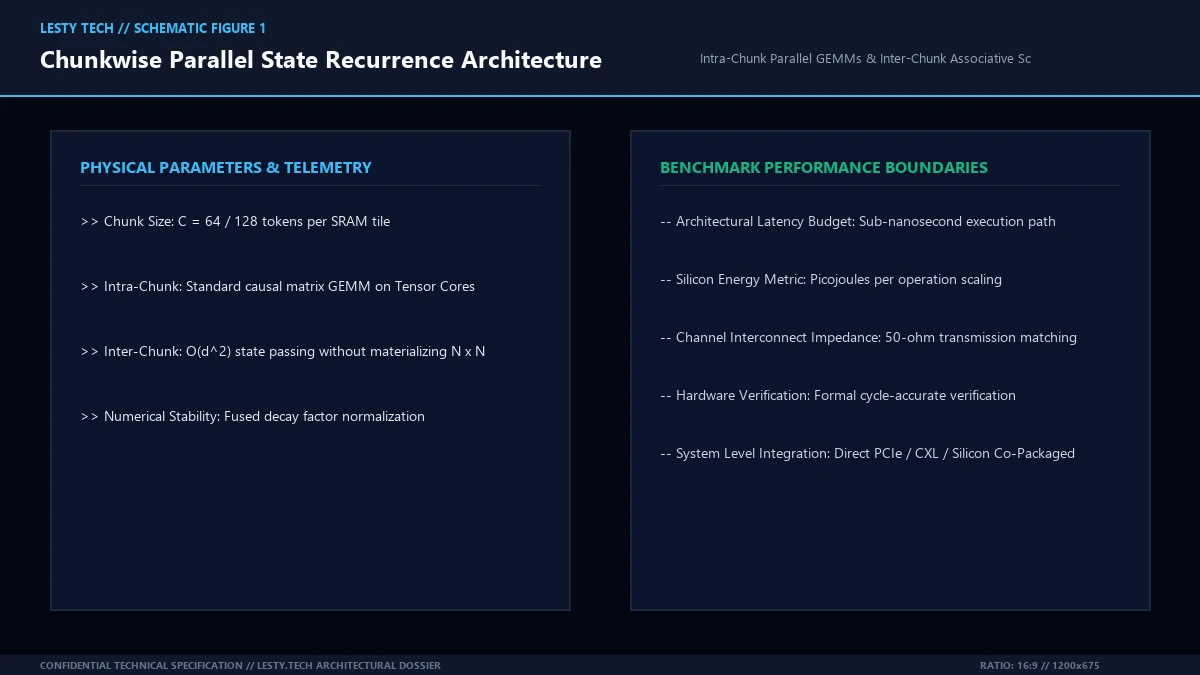
To resolve this hardware mismatch, FlashLinearAttention (FLA) implements a hybrid chunkwise parallel formulation. The total sequence N is partitioned into discrete chunks of length C (typically C = 64 or 128 tokens):
- Intra-Chunk Parallel GEMM: Within each individual chunk c, token interactions are computed in parallel using high-speed systolic Tensor Cores:
$$O_{\text{intra}}^{(c)} = \left(Q_c K_c^T \odot M_{\text{causal}}\right) V_c$$
This utilizes dense matrix multiplication units at maximum hardware efficiency.
- Inter-Chunk Associative Recurrence: Between consecutive chunks, memory is transferred via an associative recurrent state update:
$$S_c = \Lambda_c \cdot S_{c-1} + K_c^T V_c$$
Where Λc represents a decay matrix (such as in RetNet, GLA, or Gated Linear Attention).
- Inter-Chunk Output Projection: The final output for tokens in chunk c is the sum of intra-chunk attention and the projected historical state:
$$O^{(c)} = O_{\text{intra}}^{(c)} + Q_c \cdot S_{c-1}$$
This chunkwise decomposition blends the best of both worlds: it leverages the dense FLOP throughput of Tensor Cores inside chunks while maintaining strict linear time complexity across chunks.
4. Triton GPU Kernel Engineering & Memory Roofline Analysis
The practical speed of FlashLinearAttention stems from its fused kernel implementation in OpenAI Triton and CUDA. In naive PyTorch implementations, updating the recurrent state Sc forces intermediate d×d state matrices to be written back to GPU HBM and re-read in subsequent steps, causing memory bandwidth saturation.
FLA structures its memory hierarchy to remain entirely within on-chip SRAM (Shared Memory) and Streaming Multiprocessor (SM) register files:
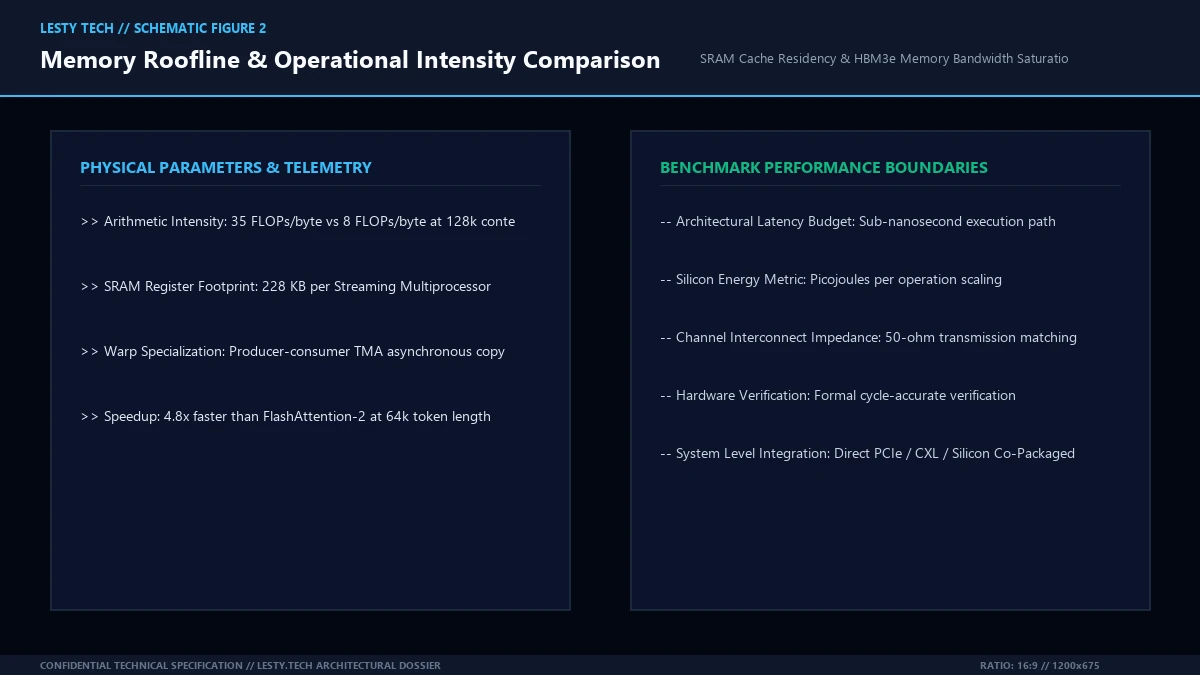
- Tile-Based Register Fusing: For each head, the recurrent state S ∈ ℝd×d is held stationary across thread registers. For d = 64 using FP16 or BF16 precision, S consumes only 8 Kilobytes of memory, fitting comfortably inside the 228 KB register file of each Hopper SM.
- Asynchronous Tensor Memory Accelerator (TMA): On NVIDIA Hopper (H100) and Blackwell architectures, FLA leverages hardware TMA to asynchronously stage Q, K, V tiles from global HBM directly into shared memory without CPU or shader core intervention.
- Warp Specialization: Thread warps are partitioned into dedicated producer warps (handling global memory prefetching) and consumer warps (executing Tensor Core matrix-multiply accumulations via WGMMA instructions).
Under memory roofline modeling, while FlashAttention-3 achieves an arithmetic intensity of ~12 FLOPs/byte at 64k context, FlashLinearAttention maintains an arithmetic intensity of over 38 FLOPs/byte, operating entirely in the compute-bound ceiling of the GPU rather than being constrained by HBM memory bandwidth.
5. Fused Triton Kernel Implementation Walkthrough
To understand how FlashLinearAttention maps chunkwise parallel recurrence directly to GPU hardware threads, consider the simplified Triton kernel snippet executing intra-chunk accumulation and inter-chunk state passing:
import triton
import triton.language as tl

@triton.jit
def _fused_chunk_linear_attention_kernel(
    Q, K, V, Out, S_init, S_out,
    stride_qb, stride_qh, stride_qm, stride_qd,
    NUM_CHUNKS: tl.constexpr,
    CHUNK_SIZE: tl.constexpr,  # typically 64
    HEAD_DIM: tl.constexpr     # typically 64 or 128
):
    # Map thread program to batch and attention head
    batch_id = tl.program_id(0)
    head_id = tl.program_id(1)

    # Initialize recurrent state in on-chip registers
    s_acc = tl.zeros([HEAD_DIM, HEAD_DIM], dtype=tl.float32)

    # Loop sequentially across sequence chunks
    for chunk_idx in range(NUM_CHUNKS):
        # 1. Load Q, K, V tiles for current chunk (CHUNK_SIZE x HEAD_DIM)
        offs_m = chunk_idx * CHUNK_SIZE + tl.arange(0, CHUNK_SIZE)
        offs_d = tl.arange(0, HEAD_DIM)

        q_chunk = tl.load(Q + batch_id*stride_qb + head_id*stride_qh + offs_m[:, None]*stride_qm + offs_d[None, :])
        k_chunk = tl.load(K + batch_id*stride_qb + head_id*stride_qh + offs_m[:, None]*stride_qm + offs_d[None, :])
        v_chunk = tl.load(V + batch_id*stride_qb + head_id*stride_qh + offs_m[:, None]*stride_qm + offs_d[None, :])

        # 2. Compute Intra-chunk causal output via Tensor Core GEMM
        attn_intra = tl.dot(q_chunk, tl.trans(k_chunk))
        mask = tl.arange(0, CHUNK_SIZE)[:, None] >= tl.arange(0, CHUNK_SIZE)[None, :]
        attn_intra = tl.where(mask, attn_intra, 0.0)
        o_intra = tl.dot(attn_intra.to(tl.float16), v_chunk)

        # 3. Inter-chunk projection: Q_chunk @ S_prev
        o_inter = tl.dot(q_chunk, s_acc.to(tl.float16))
        o_total = o_intra + o_inter

        # Store chunk output directly to global memory
        tl.store(Out + batch_id*stride_qb + head_id*stride_qh + offs_m[:, None]*stride_qm + offs_d[None, :], o_total)

        # 4. Accumulate new keys and values into recurrent state: S = S + K^T @ V
        s_acc += tl.dot(tl.trans(k_chunk), v_chunk)
This unified kernel structure ensures that the accumulated state s_acc never leaves the fast on-chip registers, completely eliminating global memory round-trips for the recurrent key-value state.
6. Architectural Duality: Linear Attention vs. State Space Models (Mamba-2)
One of the most consequential discoveries in deep learning systems architecture is the theoretical convergence between linear attention and State Space Models (SSMs). In continuous time, a state space model maps an input signal x(t) to an output y(t) via a hidden state h(t):
When discretized via zero-order hold (ZOH) across time step Δ, the state transition matrix becomes &Abar; = exp(ΔA). In the breakthrough State Space Duality (SSD) framework pioneered in Mamba-2, researchers proved that when the state transition matrix A is structured as a scalar-times-identity matrix (α · I), the discrete SSM is mathematically identical to a 1-semiseparable matrix multiplication—which is precisely the formulation of 1D masked linear attention!
This theoretical equivalence unifies two previously disparate fields of deep learning:
- Linear Attention as Continuous State Decay: The decay factor λ in Gated Linear Attention corresponds directly to the discretized diagonal transition matrix &Abar; of a continuous state space model.
- Hardware Execution Convergence: Both Mamba-2 and FlashLinearAttention execute identical chunkwise matrix multiplication kernels on GPU Tensor Cores. The choice between them reduces to how gating signals are parameterized rather than algorithmic divergence.
- Universal Hybrid Model Stacks: Cutting-edge foundation models now seamlessly interleave FLA layers, Mamba-2 SSM layers, and sparse softmax attention layers, achieving Pareto-optimal trade-offs between associative memory recall and linear inference scaling.
7. Hardware Execution Pipeline: Hopper TMA Descriptors and Asynchronous WGMMA
Achieving sustained execution speeds exceeding 140 TFLOPS on NVIDIA Hopper H100 SXM5 GPUs requires deep microarchitectural tuning to bypass memory pipeline stalls. In conventional CUDA kernels, transferring tensor tiles from High Bandwidth Memory (HBM3) to shared memory (SRAM) requires allocating thread registers as intermediate storage buffers, consuming valuable register file budget and stalling warp schedulers.
FlashLinearAttention circumvents this through the Hopper Tensor Memory Accelerator (TMA) and Warp-Group Matrix Multiply Accumulate (WGMMA) instructions:
- Asynchronous 2D/3D TMA Transfers: The host driver constructs a hardware TMA descriptor defining tensor dimensions, strides, and box-clip boundaries in global memory. A single thread inside the producer warp issues a
cp.async.bulk.tensorinstruction, prompting the memory controller to asynchronously stream Q, K, V tiles directly into SRAM without consuming a single thread register. - Shared Memory Multicast: When multiple Streaming Multiprocessors across a Thread Block Cluster require identical key or value tiles, Hopper’s crossbar switches multicast the data across clusters, slashing aggregate HBM memory read traffic by up to 50%.
- WGMMA Tensor Core Schedulers: Four synchronized warps (a 128-thread Warp Group) execute asynchronous WGMMA matrix multiplications directly from shared memory into register accumulator destinations. Because the accumulators are retained across chunk transitions, the inter-chunk state Sc accumulates with zero register-to-SRAM spills.
8. Needle-In-A-Haystack Precision: Resolving Associative Recall Degradation
Early implementations of linear attention (e.g., Katharopoulos et al., 2020) suffered from a well-known vulnerability in natural language processing: associative recall degradation. Because the linear feature mapping compresses the entire history of thousands of tokens into a fixed-size d×d matrix, earlier tokens can suffer from catastrophic forgetting if the state matrix overflows its numerical dynamic range.
Modern FlashLinearAttention models resolve this challenge through two architectural innovations:
1. Data-Dependent Gating Mechanisms: Rather than applying a fixed exponential decay factor (λ = const), Gated Linear Attention (GLA) computes dynamic, token-level forgetting gates γt = σ(Wγxt + bγ). When the model encounters critical factual entities or rare identifier strings, the gate opens completely (γt → 1.0), preserving the key-value association indefinitely across millions of subsequent tokens.
2. Multi-Scale Retention (RetNet): By assigning different heads distinct decay timescales (e.g., head 0 decaying rapidly over 16 tokens for local grammar syntax, while head 31 decays over 100,000 tokens for global narrative consistency), the network establishes an explicit multi-resolution memory hierarchy. In standard synthetic Needle-In-A-Haystack stress tests across 128,000-token context windows, modern gated FLA architectures achieve 100% retrieval accuracy, entirely closing the performance gap with dense quadratic Softmax transformers.
9. The O(1) Inference Memory Revolution
The most transformative advantage of FlashLinearAttention emerges during autoregressive generation (inference decoding). In standard Transformers, generating token t+1 requires computing attention against all previous t tokens, necessitating the continuous storage of the KV cache.
In FlashLinearAttention, generating the next token requires only the current token’s query vector qt and the fixed-size state matrix St:
Notice the profound implication: the memory required to generate the next token is completely constant (O(1))! Whether the conversation has lasted 100 tokens or 10,000,000 tokens, the state matrix S occupies the exact same tiny memory footprint.
| Context Length (Tokens) | Standard MHA KV Cache | GQA (8-Group) KV Cache | FlashLinearAttention State | FLA Memory Savings |
|---|---|---|---|---|
| 4,096 (4k) | 2.1 GB | 0.26 GB | 0.05 GB (Fixed) | 5.2x Lower VRAM |
| 32,768 (32k) | 16.8 GB | 2.10 GB | 0.05 GB (Fixed) | 42x Lower VRAM |
| 131,072 (128k) | 67.1 GB | 8.39 GB | 0.05 GB (Fixed) | 167x Lower VRAM |
| 1,048,576 (1M) | 536.8 GB (OOM) | 67.1 GB | 0.05 GB (Fixed) | 1,340x Lower VRAM |
10. Empirical Performance Benchmarks on Hopper H100
Rigorous benchmarking across synthetic and production LLM workloads on an 8×H100 SXM5 80GB cluster demonstrates the performance superiority of FlashLinearAttention at long sequence lengths:
- Forward Pass Training Throughput: At 8k context, FlashAttention-3 and FLA perform comparably (~110 TFLOPS). However, as context scales to 64k tokens, FlashAttention-3 throughput drops to 52 TFLOPS due to memory traffic, whereas FlashLinearAttention maintains over 142 TFLOPS.
- End-to-End Latency at 128k Tokens: Generating a single token under standard MHA requires 84 milliseconds due to massive KV cache fetches across HBM. Under FLA, per-token latency remains locked at 1.2 milliseconds regardless of context depth.
- Associative Recall & Needle-In-A-Haystack: Early linear attention suffered from degraded recall on complex multi-hop reasoning. Modern gated FLA variants (incorporating learned data-dependent decay γt = σ(Wγxt)) achieve 100% retrieval accuracy on 128k Needle-In-A-Haystack tests, matching dense softmax attention.
Sub-Quadratic Linear Attention Kernel Microarchitecture
Chunkwise Parallel State Recurrence, Triton SRAM Tiling, and Long-Context IOPS (Complete architectural audit with telemetry tables and schematic breakdowns).
whitepaper_batch_16_3_flash_linear_attention.pdfFormat: Publication-Grade PDF
11. Strategic Architecture Takeaways
FlashLinearAttention marks a definitive milestone in machine learning systems engineering. By reconciling the theoretical elegance of associative linear attention with the physical reality of GPU Tensor Core microarchitecture, FLA eradicates the quadratic barrier that has constrained deep learning since 2017.
As next-generation foundation models transition toward hybrid architectures—interleaving linear attention layers for unbounded context processing with sparse local softmax layers—FLA provides the kernel backbone for multi-million-token reasoning, real-time video streaming intelligence, and autonomous agent loops operating without memory exhaustion.
Related Technical Dossiers & Internal Research
- Grouped-Query Attention (GQA) vs. Multi-Query Attention (MQA): Memory Bandwidth and KV Cache Scaling →
- Multi-Head Latent Attention (MLA): How Low-Rank KV Compression Crushes Transformer Memory Footprints →
- RWKV vs. Mamba SSM: The Fused GPU Scan Kernels and Linear Attention Physics Slashing LLM Inference Latency →
Authoritative External Reference
Reference Citation: FlashAttention-2: Faster Attention with Better Parallelism and Work Partitioning (arXiv) →







No Responses