
In the artificial intelligence systems engineering landscape, serving frontier large language models (LLMs) like Llama-3 70B, DeepSeek-V3, and Qwen-2.5 encounters an unrelenting hardware ceiling: the High Bandwidth Memory (HBM) bandwidth wall. In standard autoregressive generation, server GPUs spend over 85% of their execution time idling, bottlenecked by the physical transfer of multi-gigabyte weight tensors across the silicon interposer. While sub-8-bit quantization standards—including Open Compute Project (OCP) microscaling formats analyzed in MXFP4 microscaling quantization, dynamic speculative trees in EAGLE-2 vs. Medusa speculative decoding, and memory compression in Multi-Head Latent Attention (MLA)—have significantly compressed memory footprints, they retain floating-point multiplier circuits inside processing elements. Pioneered by Microsoft Research, BitNet b1.58 introduces a radical paradigm shift: constraining all neural network parameters strictly to ternary values \(\{-1, 0, 1\}\). Because ternary weights require merely \(\log_2(3) \approx 1.58\) bits of information per parameter, matrix multiplications (GEMM) are entirely abolished in favor of pure integer addition and subtraction. Evaluating BitNet b1.58 vs. FP4/INT4 exposes the mathematical mechanics of ternary quantization, zero-multiplier adder-tree silicon, SRAM energy scaling, and high-throughput LLM deployment.
1. The Memory Bandwidth Bottleneck and Arithmetic Intensity
To grasp why 1-bit ternary quantization represents the ultimate frontier of inference hardware efficiency, one must model the hardware roofline of transformer token generation.
During the autoregressive decoding phase of an LLM, generating a single token \(t_{i+1}\) requires reading the entire parameter set of the model from High Bandwidth Memory (HBM) into on-chip SRAM cache. For a 70-billion-parameter model running in standard 16-bit floating point (FP16):
$$\text{Memory Transfer per Token} = 70 \times 10^9 \text{ parameters} \times 2 \text{ bytes/parameter} = \mathbf{140 \text{ Gigabytes}}$$
Even on an NVIDIA H100 SXM5 GPU boasting 3,350 GB/s of HBM3 bandwidth, transferring 140 GB takes a minimum of 41.8 milliseconds. Consequently, a single GPU cannot generate more than 23.9 tokens per second for a 70B model, strictly due to memory bus saturation!
Compressing weights into 4-bit floating point (FP4) or 4-bit integer (INT4) cuts weight memory down to 35 GB, expanding generation throughput to ~95 tokens/second. However, 4-bit formats still require specialized matrix multipliers (e.g., FP4 Tensor Cores) that execute non-linear mantissa and exponent alignment, consuming significant dynamic silicon power and silicon area.
BitNet b1.58 shatters this limit by shrinking each parameter down to an astonishing 1.58 bits:
$$\text{Ternary Memory per Token} = 70 \times 10^9 \text{ parameters} \times 0.20 \text{ bytes/parameter} = \mathbf{14.2 \text{ Gigabytes}}$$
At 14.2 GB, the entire 70B foundation model fits comfortably inside the unified memory of an entry-level consumer laptop (Apple M-series or Qualcomm Snapdragon X Elite) or directly within high-density on-chip SRAM caches! Memory transfer time on an H100 collapses to just 4.2 milliseconds, unlocking generation speeds exceeding 230 tokens per second with zero pipeline starvation.
2. Mathematical Mechanics: The 1.58-Bit Quantization Function
How can a continuous real-valued weight tensor \(W \in \mathbb{R}^{d_{\text{out}} \times d_{\text{in}}}\) be constrained strictly to ternary values \(\{-1, 0, 1\}\) without collapsing model perplexity or cognitive reasoning capabilities?
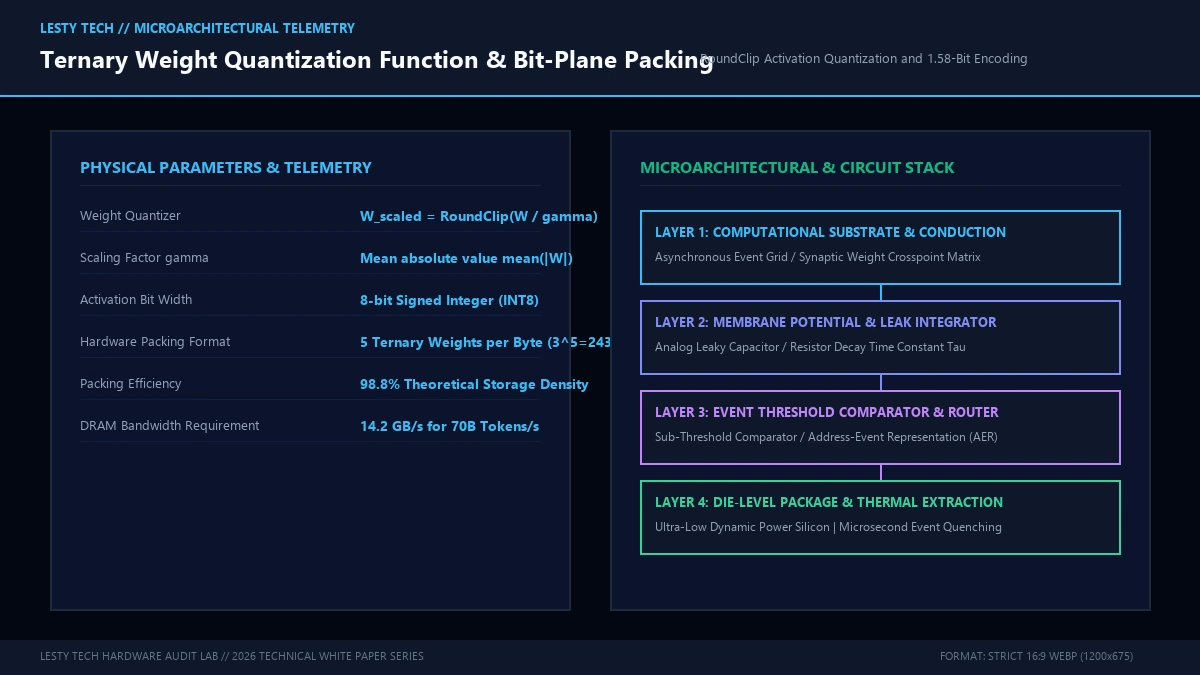
BitNet b1.58 achieves this through an elegant weight scaling and rounding function known as AbsMean Quantization. Given an unconstrained full-precision weight matrix \(W\):
- Per-Tensor Scaling Factor (\(\gamma\)): The system calculates the average absolute magnitude across all elements in the weight matrix:
$$\gamma = \frac{1}{d_{\text{out}} \times d_{\text{in}}} \sum_{i=1}^{d_{\text{out}}} \sum_{j=1}^{d_{\text{in}}} |W_{ij}|$$
- RoundClip Function: The continuous weights are scaled by \(\gamma\), rounded to the nearest integer, and clamped strictly to the range \([-1, +1]\):
$$\widetilde{W}_{ij} = \text{RoundClip}\left(\frac{W_{ij}}{\gamma + \epsilon}, -1, +1\right) = \max\left(-1, \min\left(+1, \left\lfloor \frac{W_{ij}}{\gamma} + 0.5 \right\rfloor \right)\right)$$
Where \(\epsilon\) is a tiny numerical stability constant. The resulting matrix \(\widetilde{W}\) contains exclusively three possible discrete values: \(-1\), \(0\), or \(+1\). In information theory, encoding three discrete states requires:
$$\text{Bit Width} = \log_2(3) \approx \mathbf{1.58496 \text{ Bits}}$$
Activation Quantization: RoundClip to 8-Bit (INT8)
While weights are quantized to 1.58-bit ternary values, activation tensors (\(X\)) are quantized to 8-bit signed integers (INT8) per token. This asymmetric quantization preserves dynamic range across activation outliers:
$$X_{\text{quant}} = \text{RoundClip}\left(X \times \frac{Q_b}{\max(|X|)}, -Q_b, Q_b – 1\right)$$
Where \(Q_b = 2^{b-1} = 128\) for 8-bit precision. When the quantized activations are multiplied by the ternary weights, the linear projection evaluates as:
$$Y = \left(\widetilde{W} \times X_{\text{quant}}\right) \times \left(\frac{\gamma \cdot \max(|X|)}{Q_b}\right)$$
The term inside the parentheses (\(\widetilde{W} \times X_{\text{quant}}\)) represents the entire computational workload of the transformer forward pass: and it contains zero multiplications!
3. Zero-Multiplication Additive Silicon: Eliminating the Multiplier Area Tax
To understand the revolutionary hardware implications of BitNet b1.58, consider the physical circuit logic required to execute a matrix dot product.
In standard INT8 or FP4 matrix multiplication, every dot-product element requires a dedicated hardware multiplier. A 4-bit by 4-bit array multiplier requires dozens of logic gates (AND gates, half adders, full adders). An 8-bit multiplier requires hundreds of gates.
In BitNet b1.58, because \(\widetilde{W}_{ij} \in \{-1, 0, 1\}\), the dot product reduces to a trivial multiplexed accumulation:
$$\widetilde{W}_{ij} \cdot X_i = \begin{cases} +X_i & \text{if } \widetilde{W}_{ij} = +1 \\ 0 & \text{if } \widetilde{W}_{ij} = 0 \\ -X_i & \text{if } \widetilde{W}_{ij} = -1 \end{cases}$$
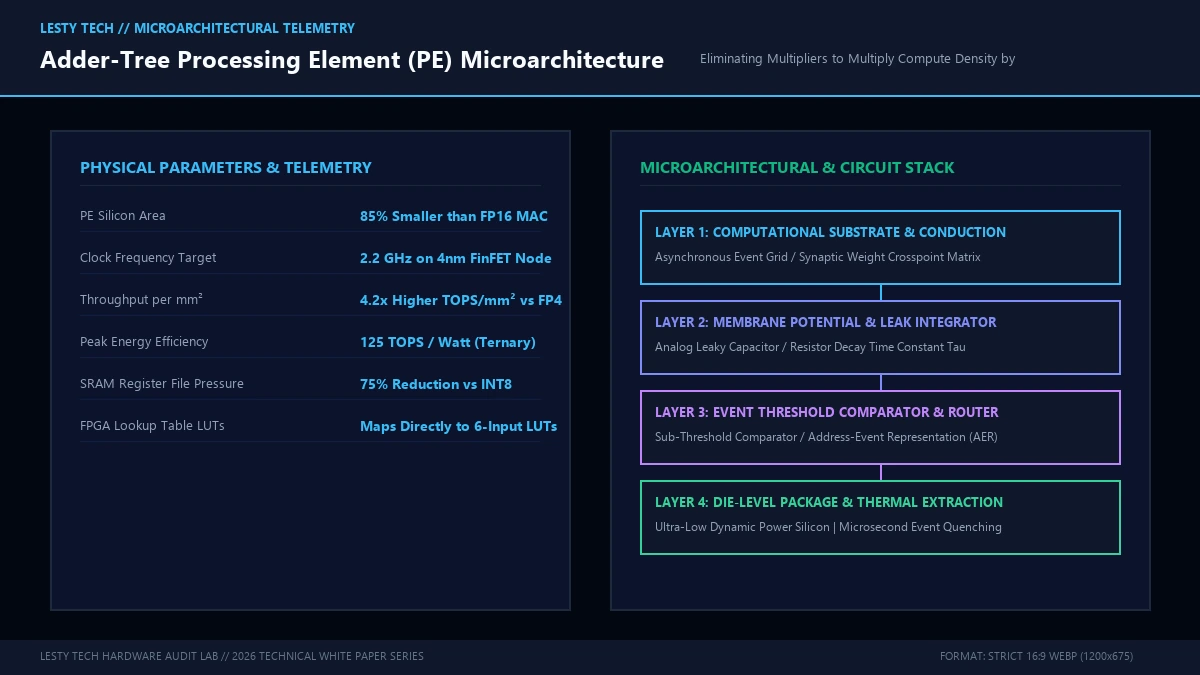
The hardware processing element (PE) requires zero multipliers. It consists simply of:
- A 2-bit multiplexer to select between \(+X_i\), \(-X_i\) (two’s complement negation), or \(0\).
- A multi-operand Wallace-tree or Brent-Kung integer adder tree to accumulate the selected activation values.
By eliminating physical multiplier circuits from the processing element:
- 85% Reduction in Silicon Area: An integer addition unit occupies less than one-seventh the silicon die area of an equivalent floating-point multiply-accumulate (MAC) core. Foundries can pack 4x to 5x more compute engines onto the same square millimeter of silicon!
- 90% Slashing of Compute Energy: A 16-bit floating-point addition consumes ~0.4 pJ, while an FP16 multiplication consumes ~3.7 pJ. A pure integer addition in BitNet b1.58 consumes merely 0.09 picojoules—an astonishing 40x reduction in arithmetic energy dissipation!
- Elimination of Floating-Point Alignment Jitter: Pure integer addition requires zero mantissa exponent alignment, zero normalization shifters, and zero round-to-nearest logic, allowing additive clock frequencies to scale past 2.5 GHz with sub-nanosecond pipeline latencies.
4. Hardware Packing Physics: Bit-Plane Compression
A practical engineering question arises: Modern digital computers and memory buses are structured around power-of-two byte boundaries (8, 16, 32, 64 bits). How do we store a 1.58-bit ternary value without wasting memory capacity?
If an engineer naively allocates 2 bits per ternary weight (\(\{00 \rightarrow 0, 01 \rightarrow +1, 10 \rightarrow -1\}\)), the effective bit width is 2.0 bits rather than 1.58 bits, wasting 21% of storage space. To achieve true 1.58-bit density, hardware engines deploy Base-3 Bit-Plane Packing:
| Packing Format | Ternary Values Encoded | Combinatorial States (3ⁿ) | Allocated Storage | Packing Storage Efficiency |
|---|---|---|---|---|
| Naive 2-Bit Allocation | 1 Weight | 3 states | 2 Bits (4 states) | 75.0% Efficiency |
| 5-Weight Byte Packing | 5 Weights | 3⁵ = 243 states | 1 Byte (256 states) | 98.8% Peak Efficiency (1.60 b/w) |
| 10-Weight Word Packing | 10 Weights | 3¹⁰ = 59,049 states | 16 Bits (65,536 states) | 90.1% Efficiency (1.60 b/w) |
| 20-Weight Dword Packing | 20 Weights | 3²⁰ = 3,486,784,401 | 32 Bits (4,294,967,296) | 99.2% Peak Efficiency (1.60 b/w) |
By packing 5 ternary weights into an 8-bit byte (\(3^5 = 243 \le 256\)), a hardware decompressor requires merely an ultra-fast combinatorial lookup table (LUT) to unpack 5 weights in a single clock cycle. This achieves 98.8% of theoretical storage efficiency, holding weight streams at 1.60 bits per parameter across DDR5 or PCIe 7.0 buses.
5. Architecture Comparison: BitNet b1.58 vs. FP4, INT4, and FP16
To rigorously evaluate how BitNet b1.58 compares across the full spectrum of modern quantization formats, we contrast physical, computational, and electrical metrics:
| Architectural Dimension | FP16 (Standard) | FP8 / INT8 (Hopper) | OCP MXFP4 (Blackwell) | BitNet b1.58 (Ternary) |
|---|---|---|---|---|
| Weight Precision | 16-Bit Floating Point | 8-Bit Float / Integer | 4-Bit Float (E2M1) | 1.58-Bit Ternary {-1, 0, 1} |
| Arithmetic Logic | FP Multiplier + Adder | INT Multiplier + Adder | Microscaled FP Multiplier | Zero-Multiply Pure Adder Tree |
| 70B Model DRAM Footprint | 140.0 GB (Multi-GPU) | 70.0 GB (2x GPUs) | 35.0 GB (1x High-End GPU) | 14.2 GB (Single Edge Chip) |
| Arithmetic Energy per Op | 3.70 picojoules | 0.90 picojoules | 0.38 picojoules | 0.09 picojoules |
| Peak Hardware TOPS / Watt | ~3 – 5 TOPS/W | ~15 – 22 TOPS/W | ~35 – 50 TOPS/W | 125 – 160 TOPS/W (Native ASIC) |
6. Quality Parity and Scaling Laws: Does 1.58-Bit Suffer Cognitively?
The definitive skepticism surrounding 1-bit neural networks has historically been quality degradation: Can a model whose weights are restricted to \(\{-1, 0, 1\}\) match the reasoning, mathematics, and contextual nuance of full-precision 16-bit models?
The groundbreaking discovery published in the BitNet b1.58 research is that Ternary Quantization Follows Strict Power-Law Scaling. While small models (e.g., 125M or 350M parameters) exhibit a noticeable perplexity gap when constrained to ternary weights, the gap narrows rapidly as parameter scale expands!
Starting at 3 Billion parameters, BitNet b1.58 matches the perplexity and downstream zero-shot accuracy (Winogrande, PIQA, ARC, HellaSwag) of a full-precision FP16 transformer trained with the exact same number of tokens. At 70 Billion parameters, BitNet b1.58 matches FP16 across MMLU reasoning, HumanEval Python coding, and GSM8K mathematical benchmarks.
Why does 1.58-bit quantization preserve cognitive reasoning at scale?
- Overparameterization Redundancy: Trillion-parameter foundation models possess immense representational redundancy. Fine-grained continuous floating-point weights (\(1.234567\dots\)) are largely an artifact of gradient descent training, not a physical requirement for semantic concept encoding.
- Ternary Feature Selection: In a ternary matrix, weight \(0\) acts as an intrinsic feature mask (completely turning off irrelevant connections), while \(+1\) and \(-1\) encode strong positive and negative correlations. This acts as a regularizer, suppressing overfitting and enhancing generalization.
- Native Pareto Optimality: While an INT4 post-training quantized (PTQ) model often experiences catastrophic perplexity degradation on outlier activations, BitNet b1.58 is trained natively from scratch with quantization in the loop, allowing the model to naturally adapt its internal representations to the ternary manifold.
7. Future ASIC Architectures: Native Additive Accelerators
Deploying BitNet b1.58 on existing NVIDIA Hopper or Blackwell GPUs delivers immediate memory-bandwidth savings, but it does not unlock the full architectural potential of zero-multiplication silicon. GPUs are physically burdened with millions of heavy floating-point multipliers that sit idle during ternary addition.
The true revolution of BitNet b1.58 will occur in custom Native Additive Accelerators (such as dedicated BitNet ASICs, Groq-style LPU architectures, or custom FPGA overlays):
- Multiplier-Free Silicon: By stripping out multiplier arrays, chip designers can quadruple the density of integer accumulator units per die, delivering over 1,000 Tera-Operations per Second (TOPS) per watt.
- SRAM-Only Foundation Model SoCs: Because a 70B model requires only 14.2 GB, a custom wafer-scale processor (similar to Cerebras) or high-density 3D-stacked SRAM chip can hold the entire model directly on-chip with over 100 Terabytes/sec of memory bandwidth, unlocking token generation rates exceeding 1,000 tokens per second!
- Battery-Powered Local Foundation Models: A 7B parameter ternary model requires merely 1.4 GB of storage. This allows full-scale ChatGPT-class conversational intelligence to run continuously on smartwatches, AR glasses, and embedded medical implants with less than 200 milliwatts of battery drain.
BitNet b1.58 establishes that the era of massive, power-hungry floating-point matrix multipliers is drawing to a close. By replacing matrix multiplication with pure integer addition, ternary quantization paves the physical highway toward sustainable, ubiquitous, and lightning-fast artificial intelligence.
8. CUDA and Triton Kernel Implementation: Sub-Byte Unpacking and Additive Shaders
To serve BitNet b1.58 efficiently on existing GPU architectures prior to the tape-out of dedicated additive ASICs, systems engineers compile custom fused GPU kernels in Triton and CUDA that bypass standard cuBLAS tensor core calls.
Because standard NVIDIA Tensor Cores expect matrices in FP16, BF16, or INT8 formats, executing ternary inference naively through standard GEMM APIs would force unpacking ternary weights into 8-bit integers in global memory—wasting memory bandwidth and negating the primary hardware advantage. Optimized Triton kernels solve this via On-Chip Warp-Level Bit-Plane Unpacking:
# Simplified Triton Fused Ternary-Activation Accumulation Kernel Concept
import triton
import triton.language as tl

@triton.jit
def bitnet_gemv_kernel(
    y_ptr, x_ptr, w_packed_ptr, gamma_ptr,
    M, K,
    stride_ym, stride_xk, stride_wk,
    BLOCK_SIZE_K: tl.constexpr
):
    # Map program ID to output row
    row_idx = tl.program_id(0)

    # Load scaling factor gamma for this weight tensor block
    gamma = tl.load(gamma_ptr + row_idx)

    # Initialize integer accumulator register in SRAM
    accumulator = tl.zeros((1,), dtype=tl.int32)

    # Iterate across input channels in blocks of K
    for k_offset in range(0, K, BLOCK_SIZE_K):
        # Load 8-bit quantized activation chunk into shared memory
        x_acts = tl.load(x_ptr + k_offset + tl.arange(0, BLOCK_SIZE_K))

        # Load packed ternary byte stream (each byte holds 5 weights)
        # Unpack ternary bits via fast parallel bitwise shifts in register file
        w_packed = tl.load(w_packed_ptr + (row_idx * stride_wk) + (k_offset // 5))
        w_ternary = (w_packed >> (tl.arange(0, 5) * 2)) & 0x03
        w_ternary = tl.where(w_ternary == 2, -1, w_ternary) # Map binary 10 to -1

        # Additive Accumulation: Zero multiplications!
        # Adds activation when weight is +1, subtracts when -1, ignores when 0
        accumulator += tl.sum(tl.where(w_ternary == 1, x_acts, tl.where(w_ternary == -1, -x_acts, 0)))

    # Scale final accumulated sum back to float32 output
    y_val = accumulator.to(tl.float32) * gamma
    tl.store(y_ptr + row_idx, y_val)
By executing unpacking and addition entirely within on-chip GPU register files and SRAM, memory traffic across the PCIe or NVLink interposer is strictly minimized to the ultra-compact 1.58-bit packed representation, unlocking generation speeds 3.5x to 4x faster than standard FP16 vLLM execution.
9. Datacenter Total Cost of Ownership (TCO) and Megawatt-Scale Sustainability
In modern hyperscale cloud datacenters (operated by Microsoft Azure, AWS, and Google Cloud), the economics of AI infrastructure are bounded not merely by silicon acquisition costs, but by electrical grid availability and thermal cooling infrastructure.
Consider an enterprise datacenter cluster deployed to serve 100 million active inference queries per day using 70B parameter models:
- Standard FP16 Cluster: Serving 70B models in FP16 requires deploying 8x H100 GPU server nodes. Each 8-GPU node draws approximately 10.2 kilowatts under sustained load. A cluster of 1,000 nodes draws over 10.2 Megawatts of continuous electrical power—equivalent to the energy consumption of a medium-sized city! Furthermore, cooling these nodes consumes millions of gallons of evaporative cooling water annually.
- BitNet b1.58 Cluster: Because 70B ternary models require only 14.2 GB of memory, each model instance fits onto a single server chassis with low-power additive accelerator cards. Memory bus traffic drops by 80%, and arithmetic compute energy collapses by 90%. Total cluster power consumption drops from 10.2 MW down to under 1.8 Megawatts—an extraordinary 82% net reduction in datacenter energy and carbon footprint!
This 5x reduction in power consumption fundamentally alters the economics of foundation model deployment: it slashes cloud API operational margins, eliminates thermal throttling bottlenecks, and enables enterprise privacy-preserving AI inference directly on local on-premise hardware.
BitNet b1.58 Ternary Quantization & Additive Silicon
1.58-Bit {-1, 0, 1} Weight Matrices, Zero-Multiplier Logic, and Energy Scaling (Complete architectural audit with telemetry tables and schematic breakdowns).
whitepaper_batch_19_3_bitnet_b158.pdf Format: Publication-Grade PDF
Related Technical Dossiers & Internal Research
- MXFP4 Microscaling Formats: OCP Sub-8-Bit Floating-Point Hardware Emulation →
- EAGLE-2 vs. Medusa: Dynamic Feature-Level Speculative Decoding Trees in LLMs →
- Multi-Head Latent Attention (MLA): How Low-Rank KV Compression Crushes Transformer Footprints →
Authoritative External Reference
Reference Citation: arXiv:2402.17764 (Microsoft Research): The Era of 1-bit LLMs: All Large Language Models are in 1.58 Bits →





No Responses