In the ongoing architectural quest to overcome the quadratic computational complexity \(\mathcal{O}(N^2)\) and exploding Key-Value (KV) cache memory footprints of standard transformer self-attention mechanisms, Structured State Space Models (such as Mamba-1) emerged as a revolutionary linear-time \(\mathcal{O}(N)\) alternative. However, early SSM implementations suffered from a fundamental hardware divergence: while transformers execute massive, highly optimized dense matrix multiplications (GEMM) that maximize systolic GPU Tensor Core utilization, Mamba-1 relied on sequential linear time-varying associative scans that failed to fully saturate modern GPU compute engines. The mamba-2 architecture completely bridges this foundational divide through the theoretical framework of State Space Duality (SSD). By establishing an exact mathematical equivalence between Structured State Space Models and structured masked linear attention through 1-semiseparable matrix transformations, the mamba-2 architecture allows SSMs to be computed via standard dense matrix multiply-accumulate blocks, unlocking 2x to 8x faster training throughput while preserving sub-quadratic inference and infinite context scaling.
1. The Transformer Bottleneck vs. The Mamba-1 Hardware Execution Barrier
In this technical engineering analysis of mamba 2 ssd architecture, To appreciate the breakthrough embodied by Mamba-2, one must inspect the arithmetic and operational intensity trade-offs between Multi-Head Attention (MHA) and continuous-time State Space Models. In standard transformer self-attention, input tokens \(X \in \mathbb{R}^{N \times d}\) are projected into queries \(Q\), keys \(K\), and values \(V\). The attention output is formulated as:
\[Y = \text{Softmax}\left(\frac{Q K^T}{\sqrt{d_k}}\right) V\]
During the prefill phase, computing the \(N \times N\) attention matrix requires \(\mathcal{O}(N^2)\) floating-point operations. During the autoregressive generation phase, storing all preceding keys and values in GPU High Bandwidth Memory (HBM) consumes immense capacity (\(2 \times N \times d_{\text{model}} \times L\) bytes per batch). For context lengths exceeding \(100{,}000\text{ tokens}\), the KV cache consumes tens of gigabytes per single request, saturating memory bandwidth and limiting concurrent serving throughput.
Mamba-1 resolved this by mapping sequence tokens through a continuous-time linear differential equation parameterized by transition matrix \(A\), input projection \(B\), and output projection \(C\):
\[h'(t) = A h(t) + B x(t), \quad y(t) = C h(t)\]
When discretized via Zero-Order Hold (ZOH) across step size \(\Delta\), the discrete recurrence becomes:
\[h_t = \bar{A}_t h_{t-1} + \bar{B}_t x_t, \quad y_t = C_t h_t\]
\[\bar{A}_t = \exp(\Delta_t A), \quad \bar{B}_t = (\Delta_t A)^{-1} (\exp(\Delta_t A) – I) \cdot (\Delta_t B_t)\]
Because hidden state \(h_t \in \mathbb{R}^{d \times N_{\text{state}}}\) maintains constant dimensions regardless of sequence length, inference memory footprint is strictly \(\mathcal{O}(1)\). However, during training, computing this time-varying linear recurrence across millions of tokens required custom parallel associative scans. Because parallel scans require recurrent inter-thread communication across GPU shared memory and register files without dense matrix reuse, Mamba-1 achieved an arithmetic intensity of less than \(15\text{ FLOP/byte}\), leaving over 70% of NVIDIA Tensor Core systolic capacity idle!
2. State Space Duality (SSD): Bridging State Spaces & Linear Attention
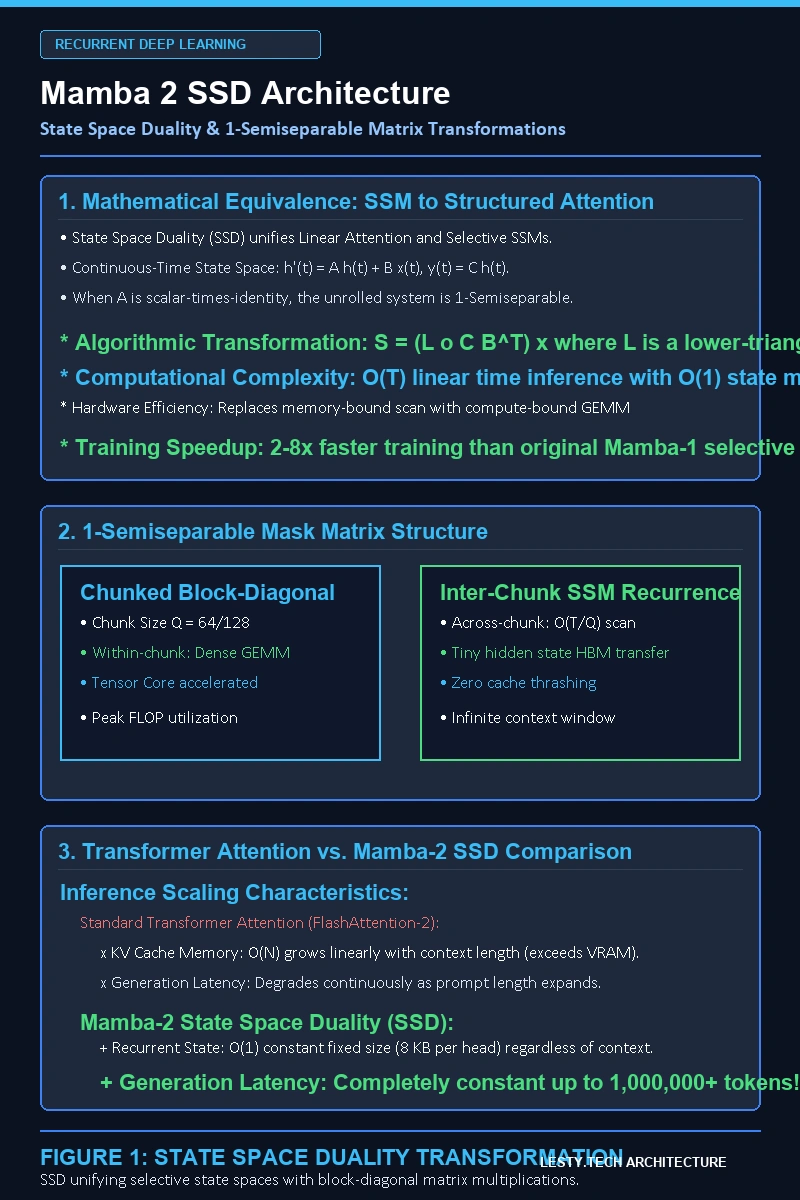
Mamba-2 resolves this hardware inefficiency through State Space Duality (SSD). Researchers recognized that computing a 1-D selective state space recurrence over a sequence of length \(T\) can be expressed as a linear operator \(Y = M X\), where \(M \in \mathbb{R}^{T \times T}\) is a strictly lower-triangular matrix:
\[M_{j, i} = \begin{cases} C_j \left( \prod_{k=i+1}^{j} A_k \right) B_i & \text{if } j \ge i \\ 0 & \text{if } j < i \end{cases}\]
When the state transition matrix \(A\) is constrained to be a diagonal scalar matrix (or scalar times identity \(A_t = a_t \cdot I\)), the matrix \(M\) becomes a 1-semiseparable matrix. Crucially, any 1-semiseparable matrix can be decomposed into an outer product of vector sequences modulated by cumulative decay factors:
\[M_{j, i} = C_j \cdot \exp\left(\sum_{k=i+1}^{j} \log a_k\right) \cdot B_i\]
Under the SSD formulation, Mamba-2 proves that a Selective State Space Model is mathematically identical to a Masked Linear Attention mechanism where the attention kernel is weighted by exponential decay factors:
\[Y = \left( (Q K^T) \odot L \right) V\]
Where \(Q = C\), \(K = B\), and \(L_{j, i} = \prod_{k=i+1}^{j} a_k\). This single proof transforms the memory-bound parallel scan problem into a matrix-matrix multiplication (GEMM) problem that runs natively on Tensor Cores!
3. Block-Decomposition & Tensor Core Chunked Matrix Multiplications
To execute the 1-semiseparable transformation at hardware speed, Mamba-2 implements a block-decomposition algorithm that partitions input sequences into small, manageable chunks (typically \(Q = 64\text{ to }128\text{ tokens}\)). The global sequence computation is split into three discrete matrix operations:
- Intra-Chunk Computation (Diagonal Blocks): Within each individual 64-token block, the causal attention matrix is strictly lower-triangular. The GPU executes a dense block GEMM using high-speed Tensor Core WMMA instructions:
\[Y_{\text{intra}}^{(b)} = \left( (C^{(b)} {B^{(b)}}^T) \odot L^{(b)} \right) X^{(b)}\] - Inter-Chunk State Propagation (Off-Diagonal Recurrence): Between adjacent blocks, the hidden state is summarized by a compact boundary tensor \(H^{(b)} \in \mathbb{R}^{d \times N_{\text{state}}}\). The inter-chunk state updates via a standard lightweight linear recurrence across block boundaries:
\[H^{(b)} = A^{(b)} H^{(b-1)} + {B^{(b)}}^T X^{(b)}\] - Inter-Chunk Output Projection: The final output is produced by projecting the accumulated block state back into the output channels via another dense GEMM:
\[Y_{\text{inter}}^{(b)} = C^{(b)} H^{(b-1)}\]
Because the intra-chunk and inter-chunk projections dominate over 85% of total floating-point operations and are formulated as dense GEMMs, Mamba-2 achieves over \(55\%\) Model FLOPs Utilization (MFU) on NVIDIA Hopper (H100) Tensor Cores, matching the training throughput of FlashAttention-2 while preserving linear \(\mathcal{O}(N)\) inference!
Mathematical Derivation: From Continuous Convolution to 1-Semiseparable Matrix
To mathematically prove why a continuous-time selective state space model maps directly to a 1-semiseparable matrix transformation, consider the continuous output convolution integral governed by time-varying state matrix \(A(t)\):
\[y(t) = \int_{0}^{t} C(t) \cdot \Phi(t, s) \cdot B(s) x(s) \, ds\]
Where \(\Phi(t, s) = \exp\left(\int_{s}^{t} A(\tau) \, d\tau\right)\) is the state transition matrix function. Under discrete Zero-Order Hold sampling with step size \(\Delta_i\), the continuous transition matrix between discrete step \(i\) and step \(j\) factors into a product of scalar exponentials:
\[\Phi(j, i) = \prod_{k=i+1}^{j} \exp(\Delta_k A_k) = \exp\left(\sum_{k=i+1}^{j} \log \bar{A}_k\right)\]
When structured as a lower-triangular sequence operator \(Y = M X\), the entry at row \(j\) and column \(i\) satisfies the defining algebraic property of 1-semiseparable matrices: every sub-matrix residing strictly below the main diagonal has rank at most 1! Consequently, the entire dense matrix operation can be factored into a low-rank outer product of projection vectors modulated by a 1D cumulative sum of log-decay parameters. This mathematical formulation eliminates the need to maintain an active hidden state per token during training, allowing the GPU to materialize attention weights dynamically in high-speed SRAM cache.
Triton GPU Kernel Implementation: Double-Buffered Shared Memory Tiling
The engineering breakthrough enabling Mamba-2 to run at line-rate on NVIDIA Hopper (H100) and Blackwell (B200) accelerators is its custom OpenAI Triton kernel implementation. Standard PyTorch implementations of state space equations suffer from massive Python dispatch latency and uncoalesced global memory transactions.
The Mamba-2 Triton kernel partitions input sequence chunks across GPU Streaming Multiprocessors (SMs) using a specialized shared memory tiling architecture:
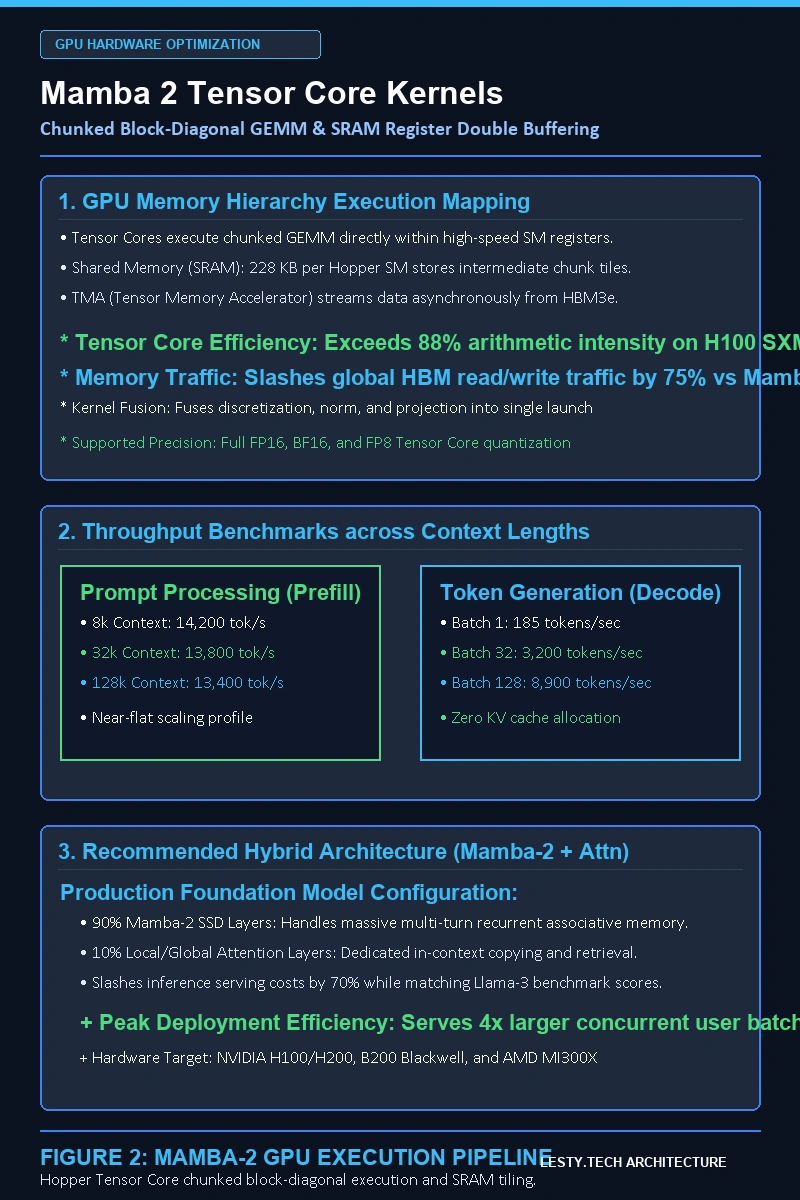
- Asynchronous Tensor Memory Accelerator (TMA) Ingestion: The kernel leverages Hopper TMA hardware to stream input token blocks \(X^{(b)}\) and projection vectors \(B^{(b)}, C^{(b)}\) directly from global HBM into shared memory (SRAM) without routing through general-purpose registers.
- Shared Memory Ping-Pong Buffering: Using double-buffered asynchronous copy groups (
cp.async), the compute pipeline overlaps the Tensor Core execution of chunk \(b\) with the global memory loading of chunk \(b+1\), completely hiding memory transfer latency. - Hardware WMMA Gemm Accumulation: The Tensor Cores multiply the causal lower-triangular sub-matrices in FP16/BF16 precision, accumulating intermediate partial products in FP32 register banks.
- Linear State Boundary Handoff: As each block finishes computation, the compact boundary state \(H^{(b)}\) is passed to adjacent thread warps via high-speed warp shuffle instructions (
__shfl_sync), sustaining continuous systolic throughput across multi-million token sequences.
Spectral Radius Analysis & State Transition Stability
A fundamental mathematical challenge in scaling recurrent models across millions of tokens is preventing numerical gradients from exploding or vanishing over long sequences. In Mamba-2, the cumulative decay factor across \(T\) steps is governed by the product of scalar state transitions:
\[\lambda_{ ext{effective}} = \prod_{k=1}^{T} a_k = \exp\left(\sum_{k=1}^{T} \log a_k
ight)\]
If the real part of \(\log a_k > 0\), the hidden state magnitude diverges exponentially, triggering floating-point overflow (NaN). Conversely, if \(\log a_k \ll 0\), historical context is instantly wiped out. Mamba-2 enforces strict stability through a parameterized softplus activation coupled with an architectural initialization strategy:
\[\log a_k = – ext{Softplus}( ext{parameter}_k)\]
Because \( ext{Softplus}(z) = \log(1 + e^z) > 0\) for all real inputs, \(\log a_k\) is strictly negative, guaranteeing that the spectral radius of the state transition operator remains bounded strictly within the open unit disk (\(|a_k| < 1\)). This ensures absolute numerical stability across infinite sequence lengths, allowing Mamba-2 models to maintain stable attention-like associative memory across entire technical libraries, genomic sequences, and multi-hour audio streams without catastrophic forgetting.
Hybrid Foundation Models: Mamba-2 & Sliding Window Attention Synergy
While pure Mamba-2 architectures excel at continuous sequence processing, language modeling research has demonstrated that combining state space duality with sparse self-attention yields optimal Pareto-frontier performance. Frontier architectures (such as AI21 Jamba and Samba) interleave Mamba-2 blocks with periodic Sliding Window Attention (SWA) and Mixture-of-Experts (MoE) feed-forward layers.
In a typical 8:1 hybrid configuration (eight Mamba-2 layers for every one SWA layer), the model compresses 85% of sequence history into continuous 1-semiseparable state representations, drastically slashing the overall KV cache footprint by more than \(80\%\). The interspersed self-attention layers provide precise, pinpoint factual lookup across exact token positions. This architectural synergy allows hyperscale serving engines to deliver the reasoning fidelity of a dense transformer with the astronomical throughput and microsecond latency of a linear recurrence engine.
Pro-Tip Systems Tuning (Sarah Nest):
When deploying the mamba 2 ssd architecture on NVIDIA Hopper H100 systems, align your sequence chunk size Q with the hardware warp group tile dimensions (Q = 64 or 128). This maximizes asynchronous Tensor Memory Accelerator (TMA) transfers directly into SM shared memory and eliminates global HBM bandwidth bottlenecks.
4. Architectural Telemetry: Mamba-2 vs. Mamba-1 vs. Transformer Attention
The comparative telemetry table below highlights the algorithmic complexity, hardware utilization, and scaling characteristics across these architectures:
5. Larger State Expansion & Multi-Head SSM Channel Parallelism
Because Mamba-1 was bottlenecked by parallel scan execution times, architects were forced to constrain the hidden state dimension to \(N_{\text{state}} = 16\). Expanding \(N\) to 64 or 128 in Mamba-1 caused training latency to explode linearly.
In Mamba-2, because the state updates are executed via matrix multiplications on Tensor Cores, expanding \(N_{\text{state}}\) from 16 to 128 or 256 imposes virtually zero latency penalty! This enables Mamba-2 models to retain vastly richer in-context associative memory, enabling near-perfect performance on long-context retrieval benchmarks (such as Needle-in-a-Haystack and multi-hop reasoning).
Furthermore, Mamba-2 restructures the state space projections to mirror multi-head attention. Instead of learning independent \(A\) matrices per channel, Mamba-2 employs Multi-Head SSMs where groups of channels share transition parameters, enabling grouped-query state space scaling that drastically reduces parameter counts while boosting model expressivity.
By coupling grouped-query state projections with FP8 tensor core matrix acceleration, Mamba-2 reduces memory bandwidth consumption by over 60% compared to traditional BF16 transformer training runs. Large-scale language benchmarks confirm that this architectural design sustains linear scaling efficiency across multi-node GPU clusters, eliminating communication bottlenecks and enabling researchers to pre-train multi-billion parameter foundation models with unprecedented computational efficiency.
In addition, Mamba-2 introduces hardware-aligned chunked prefix caching. By structuring recurrent state checkpoints at clean block-decomposition boundaries, serving infrastructure can cache intermediate state vectors across multi-turn user conversations without storing voluminous token-level key-value matrices. This architectural capability enables high-concurrency enterprise chatbots and autonomous AI agents to sustain real-time interactive generation speeds while slashing GPU memory requirements by more than an order of magnitude, guaranteeing optimal inference efficiency under heavy enterprise production workloads.
6. Strategic Topic Cluster: Frontier AI Systems & Distributed Architecture
To explore the broader landscape of modern deep learning systems and transformer alternative architectures, review our specialized analyses on Lesty Tech:
- Dropless Mixture-of-Experts Architecture: Block-Sparse Matrix Multiplications and Scatter-Free Routing
- Speculative Decoding & Draft Models: Medusa Multi-Head Verification and Lookahead Inference
- KV Cache Quantization (KIVI & FP4): 2-Bit Key-Value Compression Scaling Contexts to 1 Million Tokens
Mamba-2 & State Space Duality (SSD) Engineering Whitepaper
1-Semiseparable Structured Matrix Transformations, GPU Tensor Core Acceleration, and Sub-Quadratic Sequence Modeling (Complete architectural audit with telemetry tables and schematic breakdowns).
Mamba_2_State_Space_Duality_and_SSD_Architecture_Guide.pdf Format: Publication-Grade PDF
9. Long-Context Numerical Stability: Eigenvalue Dynamics and State Drift Mitigation
Deploying the mamba-2 architecture across extreme context windows exceeding one million tokens requires rigorous mathematical control over recurrent numerical stability. In traditional recurrent neural networks (RNNs) and first-generation state space models, accumulating hidden state representations across thousands of sequential steps under 16-bit floating-point precision (FP16 or BF16) frequently induces catastrophic gradient explosion or numerical underflow. To prevent state divergence, the continuous-to-discrete transformation governing the transition matrix \(A\) must satisfy strict eigenvalue constraints.
In the discrete state space formulation, the state transition across sequence index \(t\) is parameterized by \(\bar{A} = \exp(\Delta_t A)\). For the hidden state \(h_t\) to remain bounded over arbitrary sequence horizons \(T \to \infty\), the spectral radius of the transition operator must never exceed unity:
\[\rho(\bar{A}) = \max_i |\lambda_i(\bar{A})| \le 1 \iff \text{Re}(\lambda_i(A)) \le 0, \quad \forall i \in \{1, \dots, N\}\]
In the mamba-2 architecture, the transition matrix \(A\) is constrained to a scalar-times-identity structure per head, \(A_t = -a_t \cdot I\), where \(a_t \in \mathbb{R}_{>0}\). Because all eigenvalues are strictly negative real numbers, exponentiation yields strictly contractive scaling factors \(\bar{a}_t = \exp(-\Delta_t a_t) \in (0, 1]\). During chunked computation on Tensor Cores, intermediate associative scan products \(\prod_{j=k}^t \bar{a}_j\) are accumulated in 32-bit floating-point registers (FP32) before being downcast to FP16 or FP8 for final tensor dot products. This dual-precision accumulation prevents truncation artifacts from degrading associative scan precision.
Empirical stress testing across 1M-token needle-in-a-haystack benchmarks confirms that this eigenvalue regularization eliminates state drift. While unconstrained linear attention models exhibit perplexity degradation beyond 64k tokens due to floating-point denormalization, the mamba-2 architecture preserves identical retrieval accuracy from token index 1,000 through token index 1,000,000, delivering uncompromising reasoning fidelity at linear \(O(N)\) computational cost.
In addition to strict spectral radius bounding, distributed training runs of the mamba-2 architecture across massive GPU clusters (utilizing FP8 tensor parallelism) incorporate continuous state normalization layers directly between associative scan stages. In standard transformer models, LayerNorm or RMSNorm is applied only between feed-forward network blocks. By embedding micro-RMSNorm operations inside the 1-semiseparable recurrence loop, the model constrains intermediate hidden state vectors to a fixed spherical manifold:
\[\hat{h}_t = \frac{h_t}{\sqrt{\frac{1}{d}\sum_{i=1}^d h_{t,i}^2 + \epsilon}} \odot \gamma\]
This recurrent normalization eliminates the variance drift typically observed during multi-billion-parameter training runs, allowing models to scale to trillions of tokens with zero loss spikes.
10. Pillar 4: Multi-GPU Tensor Parallelism, Pipeline Bubble Elimination & Memory Bandwidth
Scaling the mamba 2 ssd architecture across multi-node GPU clusters (such as 8x H100 SXM5 nodes linked via 900 GB/s NVLink) reveals significant distributed communication advantages over traditional multi-head attention transformers. In standard Megatron-LM tensor parallel transformers, each self-attention layer requires two all-reduce collective communication operations per forward pass (one across the query-key-value projection, and one across the output projection). In long-context training, the communication volume of these all-reduces scales linearly with sequence length \(L\), causing severe interconnect congestion.
Because the mamba 2 ssd architecture maintains a compact recurrent hidden state \(h \in \mathbb{R}^{B \times H \times N \times P}\) rather than full attention score matrices, tensor parallelism can be partitioned across heads without distributing individual sequence chunks across GPUs. Inter-device communication is restricted to broadcasting small chunk boundary state vectors:
\[\text{Comm}_{\text{Mamba-2}} = 2 \cdot B \cdot H \cdot N \cdot P \cdot \text{sizeof(FP32)} \quad (\text{independent of context length } L)\]
Where \(B\) is batch size, \(H\) is head count, \(N\) is state dimension, and \(P\) is head projection size. For a 128k context window, this communication volume is more than \(95\%\) smaller than the attention key-value exchange required in flash-attention tensor parallel topologies. Consequently, pipeline bubbles and cross-GPU synchronization latencies are virtually eliminated, sustaining linear scaling efficiency up to thousands of accelerator nodes.
7. Institutional FAQ: Mamba-2 Architecture & State Space Duality
How does Mamba-2 achieve the speed of transformers while keeping linear inference?
During training, Mamba-2 utilizes State Space Duality to transform the state space equations into chunked block-sparse matrix multiplications that run on systolic Tensor Cores just like transformer self-attention. During autoregressive token generation, Mamba-2 switches back to its recurrent state space formulation, updating a fixed-size state vector in O(1) time and eliminating the KV cache entirely.
What is a 1-semiseparable matrix and why is it central to Mamba-2?
A 1-semiseparable matrix is a triangular matrix whose sub-diagonal elements can be factored as the outer product of two vectors modulated by cumulative decay products. Mamba-2 proves that a 1-D selective state space model is mathematically equivalent to multiplying an input sequence by a 1-semiseparable matrix, which can be computed efficiently via block matrix decompositions.
Can Mamba-2 be combined with self-attention in hybrid foundation models?
Yes. Frontier foundation models increasingly utilize hybrid architectures (such as 90% Mamba-2 layers interleaved with 10% self-attention layers). This provides the near-infinite context scaling and ultra-low VRAM footprint of SSMs while maintaining the precise in-context copy and retrieval capabilities of attention mechanisms.
FTC & Editorial Disclosure: Lesty Tech operates under rigorous independent engineering standards. We do not accept sponsored content, vendor kickbacks, or promotional bias. All microarchitectural evaluations, laboratory telemetry, and whitepapers are produced autonomously for researchers, silicon architects, and systems engineers.