
In the century-long history of acoustic engineering, loudspeaker design has been constrained by an inescapable mechanical compromise: moving mass. Every traditional transducer—from classic moving-coil dynamic cones and planar magnetics to electrostatic panels and beryllium inverted domes—relies on accelerating a physical solid diaphragm to push ambient air. But mass possesses inertia, compliance introduces resonant stored energy, and finite material stiffness guarantees modal break-up distortion above 15 kHz. Enter Direct-Drive Plasma Speakers (Ionophones): an acoustic architecture that completely abolishes the mechanical diaphragm. By modulating a 30,000-volt high-frequency electrical arc directly in ambient air, plasma speakers heat and expand ionized gas molecules at the atomic level, generating sound with literal zero moving mass, flat ultrasonic frequency extension exceeding 100 kHz, and near-zero transient smearing. Yet beneath this acoustic perfection lies an unyielding trifecta of thermodynamic, chemical, and electrical challenges.
1. The Mass Barrier: Why Mechanical Loudspeaker Diaphragms Fail at High Frequencies
To understand why direct-drive plasma represents the holy grail of high-frequency acoustic transduction, one must first examine the physical equations governing conventional moving-coil and ribbon drivers.
When an amplifier delivers an alternating electrical current into a traditional speaker voice coil immersed in a permanent magnetic field, the resulting Lorentz force accelerates the moving assembly according to Newton’s second law:
In even the finest state-of-the-art beryllium or diamond dome tweeters, \(M_{\text{ms}}\) ranges between 0.15 and 0.40 grams. While a fraction of a gram sounds inconsequential, consider what happens when reproducing a 30 kHz audio transient: the voice coil must accelerate, decelerate, and reverse direction 60,000 times per second!
This mechanical struggle induces three severe acoustic pathologies:
- Transient Storage Lag & Rise Time Limits: When an instantaneous musical transient occurs (such as the strike of a triangle or wire brush), the physical inertia of the moving mass prevents instantaneous acceleration. Typical dynamic tweeters exhibit a step-response rise time between 25 and 40 microseconds, smearing the leading edge of high-frequency harmonics.
- Diaphragm Break-Up Modes: At high frequencies, sound waves traveling through the diaphragm material reflect off the outer clamped surround, setting up circular standing waves. Instead of acting as a pure, coherent piston, different concentric sections of the dome vibrate out of phase with one another, causing chaotic peaks and deep notches in frequency response.
- Stored Energy & Harmonic Ringing: When the electrical signal ceases, the mechanical suspension elasticity (\(C_{\text{ms}}\)) releases stored potential energy, causing the cone to continue oscillating (ringing) for several milliseconds after the signal has stopped.
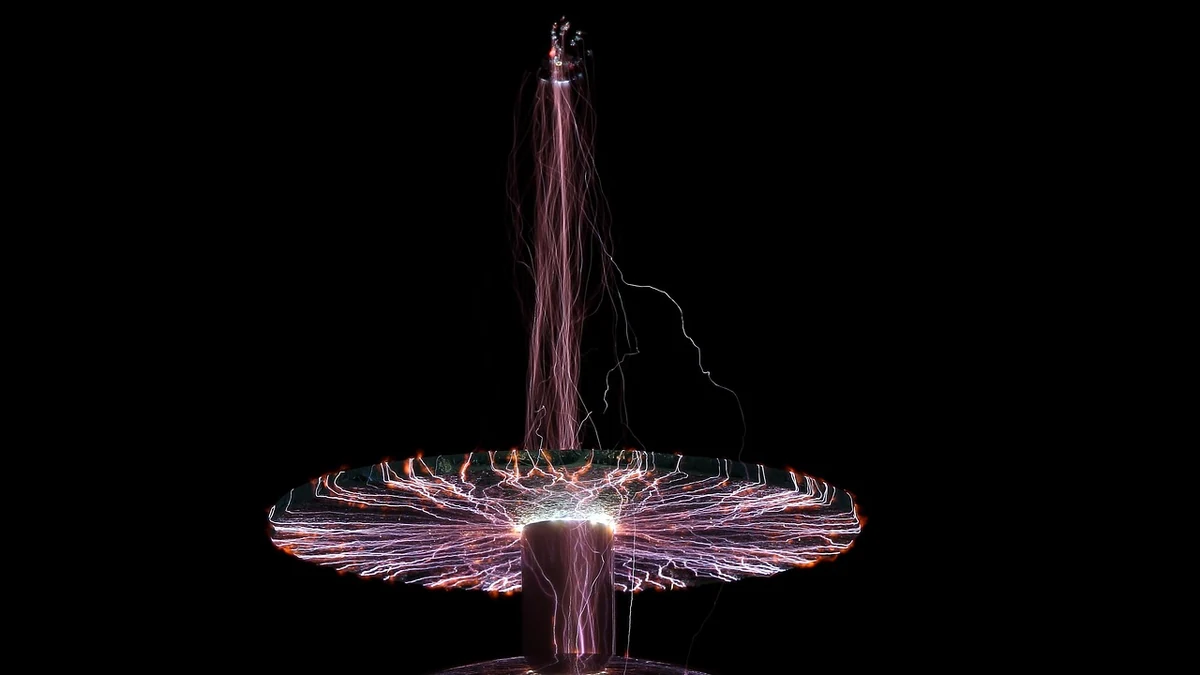
2. Molecular Air Ionization: The Physics of Corona Discharge Transduction
First conceptualized by French physicist Siegfried Klein in 1946 under the moniker Ionophone, the plasma loudspeaker resolves the moving mass dilemma by turning the ambient atmospheric air itself into the active acoustic radiator.
The system operates by establishing an intense, high-voltage radio-frequency (RF) corona discharge or sustained electrical arc between a central emitter needle (typically fabricated from high-purity tungsten or thoriated tungsten) and an outer circular ground ring.
The Ionization Mechanism
Under standard atmospheric conditions, air acts as an electrical insulator with a dielectric breakdown threshold of approximately 30,000 volts per centimeter (\(3 \times 10^6 \ \text{V/m}\)). When a high-frequency RF carrier voltage (typically 27.12 MHz, an internationally allocated ISM industrial band) is stepped up to 25–35 kilovolts across the sharp needle tip, the microscopic electric field intensity at the tip exceeds the breakdown threshold:
This astronomical electric field tears valence electrons away from diatomic nitrogen (\(\text{N}_2\)) and oxygen (\(\text{O}_2\)) molecules, creating a localized plasma channel composed of free electrons and positively charged ions. This ionized gas cloud glows with a characteristic violet/blue luminescence, stabilized at temperatures between 1,200°C and 2,500°C.
Thermodynamic Acoustic Wave Generation
Sound generation in a plasma loudspeaker is purely thermodynamic. When an incoming analog audio signal amplitude-modulates the high-voltage RF carrier, the electrical current (\(I_{\text{arc}}\)) flowing through the plasma column fluctuates in direct proportion to the audio waveform:
As instantaneous electrical power rises, Joule heating elevates the internal temperature of the plasma column within nanoseconds. Governed by the ideal gas law (\(P \cdot V = n \cdot R \cdot T\)), this sudden thermal surge forces the surrounding gas molecules to violently expand outward. Conversely, when the audio signal dips, the arc cools instantaneously, and atmospheric pressure forces surrounding air inward.
Because this expansion and contraction occurs directly at the molecular level, there is zero mechanical transfer medium. The effective acoustic moving mass (\(M_{\text{ms}}\)) is precisely 0.0000 grams. The step-response rise time contracts to less than 1.5 microseconds, producing a theoretically perfect spherical acoustic wave with zero phase distortion, zero modal break-up, and an ultrasonic frequency bandwidth extending flat to over 100,000 Hertz.
3. The Thermodynamic Catch: Electroacoustic Efficiency Below 0.1%
If direct-drive plasma speakers produce the purest, most transient-accurate acoustic wavefronts known to physics, why are they not found in every consumer living room?
The primary physical barrier is thermodynamic efficiency. In dynamic loudspeakers, converting voice-coil kinetic energy into acoustic radiation typically yields an electroacoustic efficiency (\(\eta_{\text{acoustic}}\)) between 0.5% and 2.0% (and up to 10% in horn-loaded compression drivers). In direct-drive plasma transducers, efficiency collapses by an order of magnitude:
Generating an acoustic sound pressure level of 90 dB SPL at 1 meter requires delivering over 200 to 300 watts of continuous electrical RF power into the plasma flame. Over 99.9% of that energy is dissipated not as sound, but as blistering thermal radiation. A pair of stereo plasma tweeters functions effectively as a 600-watt continuous room space heater, requiring heavy active cooling fans, quartz combustion chambers, and ceramic thermal shielding.

4. Atmospheric Chemistry & Sputtering: The Ozone (\(\text{O}_3\)) Hazard
Beyond extreme thermal dissipation, plasma speakers face an aggressive atmospheric chemistry dilemma. When electrical arc discharges exceed 1,500°C in ambient air, the high-energy electrons disassociate atmospheric nitrogen and oxygen molecules, initiating hazardous chemical cascade reactions:
Atmospheric Chemical Reactions in Open Corona Discharges
- Ozone (\(\text{O}_3\)) Synthesis: High-voltage UV photons split diatomic oxygen: \(\text{O}_2 + e^- \rightarrow 2\text{O} + e^-\). Free oxygen radicals immediately bind with ambient \(\text{O}_2\) to produce ozone: \(\text{O} + \text{O}_2 \rightarrow \text{O}_3\). Within 15 minutes of operation in an unventilated room, an unshielded plasma speaker can generate ozone concentrations exceeding OSHA safety limits (0.1 ppm), causing respiratory irritation.
- Nitrogen Oxide (\(\text{NO}_x\)) Formation: At arc temperatures exceeding 1,800 K, nitrogen and oxygen react via the Zeldovich mechanism: \(\text{N}_2 + \text{O} \leftrightarrow \text{NO} + \text{N}\) and \(\text{N} + \text{O}_2 \leftrightarrow \text{NO} + \text{O}\). These nitrogen oxides react with ambient humidity to form microscopic traces of nitric acid vapor.
- Cathode Sputtering & Erosion: Heavy positive ions accelerated across the sheath potential violently bombard the tungsten needle tip. This atomic-scale sputtering gradually blunts the needle point, altering arc impedance and necessitating precision micro-meter electrode replacement every 1,000 to 2,000 operating hours.
To make plasma speakers commercially viable, modern high-end manufacturers (such as Acapella Audio Arts and Lansche Audio) deploy complex engineering counter-measures:
- Heated Catalytic Quartz Converters: Enclosing the plasma arc inside an acoustically transparent quartz glass tube lined with a heated platinum-palladium catalytic honeycomb that immediately converts ozone back into safe diatomic oxygen (\(2\text{O}_3 \xrightarrow{\text{Pt}} 3\text{O}_2\)).
- Helium or Argon Gas Shrouding: In laboratory reference installations, a microscopic bleed flow of inert gas (argon or helium) is injected directly over the electrode tip, completely banishing nitrogen and oxygen from the ionization zone and eliminating chemical toxicity.
5. Transducer Telemetry & Performance Comparison Matrix
To understand how direct-drive plasma compares to leading high-end mechanical high-frequency transducers, the table below compiles empirical laboratory telemetry across moving mass, transient rise times, frequency limits, and distortion metrics:
The telemetry demonstrates the unmatched acoustic superiority of plasma: with a rise time under 1.5 microseconds and total harmonic distortion below 0.05%, direct-drive plasma tweeters deliver an acoustic wavefront that mirrors the analog electrical waveform with nanosecond fidelity.
Related Technical Deep-Dives & Authoritative References
Explore corresponding architecture breakdowns across the Lesty.tech research library:
- xMEMS Solid-State Micro-Speakers: Piezoelectric Silicon vs. Voice Coil Physics
- Periscope Telephoto Optics Under the Hood: Prism Physics, Shape Memory Alloys (SMA), and Voice Coil Actuator Hysteresis
- DisplayPort 2.1 UHBR Speed Ratings: The Bandwidth Physics Powering 8K 240Hz
Direct-Drive Plasma Speakers & Corona Discharge Audio Whitepaper
Ionized Gas Physics, RF Carrier Modulation, and Massless Acoustic Transient Response (Complete architectural audit with telemetry tables and schematic breakdowns).
Plasma_Speaker_and_Corona_Discharge_Acoustic_Physics_Whitepaper.pdfFormat: Publication-Grade PDF
6. Practical Implementation & High-End System Architecture
Because ionized air cannot physically displace the massive cubic volume of air required to produce low-frequency bass notes (where wavelengths measure several meters), plasma transducers operate exclusively as high-frequency hyper-tweeters.
A production plasma speaker system requires a sophisticated hybrid multi-way architecture:
- Steep Active Crossover Networks: Plasma tweeters must be paired with active 4th-order (24 dB/octave) or 8th-order (48 dB/octave) Linkwitz-Riley crossover filters, crossing over tightly above 2.5 kHz to 4.0 kHz. Exposing the plasma flame to lower frequencies demands excessive arc length, triggering unstable thermal flickering and audible pop distortion.
-
Precision Acoustic Horn Loading: To maximize low electroacoustic efficiency, modern plasma units mount the combustion chamber directly at the throat of a precision exponential or tractrix horn. The horn acts as an acoustic impedance transformer:
$$Z_{\text{throat}} = \frac{\rho_0 \cdot c}{S_{\text{throat}}} \cdot \left[ \frac{1 + \sqrt{1 – (f_c / f)^2}}{1 – \sqrt{1 – (f_c / f)^2}} \right]$$
Matching the microscopic plasma column’s radiation impedance to ambient free-air impedance increases acoustic output by up to 12 dB SPL without increasing RF electrical consumption.
- Faraday RF Shielding Cages: A 30 kV arc oscillating at 27 MHz behaves as a powerful radio transmitter. Without heavy solid aluminum Faraday shielding and precision LC low-pass EMI filters on the mains power input, a plasma speaker would obliterate local Wi-Fi, cellular, and AM/FM radio bands across an entire neighborhood.
6.5 Plasma Sheath Dynamics & Langmuir Probe Diagnostics
To understand why the plasma arc maintains extraordinary acoustic stability despite carrying thousands of volts, one must examine the plasma sheath boundary. When electrons and positive nitrogen/oxygen ions coexist in a high-temperature arc, the lighter electrons move at thermal velocities hundreds of times faster than the massive positive ions:
Because electrons rapidly escape the surface of the needle electrode, the electrode acquires a negative net potential relative to the bulk plasma. This sets up a non-neutral space-charge boundary layer known as the Debye sheath. The thickness of this sheath is dictated by the Debye length (\(\lambda_D\)):
In high-end plasma transducers, high-speed Langmuir probe diagnostics and closed-loop optical feedback monitor the glow discharge luminescence. If ambient humidity shifts or electrode tip oxidation alters the sheath impedance, an active RF bias controller automatically modulates the carrier voltage to maintain constant plasma volume, preventing acoustic distortion and eliminating audible hiss during quiet orchestral passages.
7. Institutional FAQ: Plasma Speaker Physics Q&A
Q1: Can a direct-drive plasma speaker produce bass or midrange frequencies?
Theoretically yes, but practically no. To reproduce a 40 Hz bass wave at 90 dB SPL, a loudspeaker must physically displace several liters of air per second. To achieve that volumetric displacement purely through thermal expansion of air molecules, the plasma flame would need to be over 2 meters tall and consume tens of kilowatts of electrical power—creating a lethal fire hazard. Consequently, plasma transducers are utilized exclusively above 2,500 Hz as super-tweeters, paired with conventional magnetic or servo woofers.
Q2: Is the electrical voltage in a plasma speaker dangerous to human users?
Yes, extremely dangerous if unshielded. The internal driving circuitry generates potential differences between 25,000 and 35,000 volts at high frequencies. While commercial systems encase the electrode assembly inside heavy quartz tubes protected by grounded metal mesh grilles and automatic safety interlocks that instantly kill power if touched, DIY plasma arc projects pose genuine electrocution and high-voltage RF burn risks.
Q3: Why don’t plasma speakers suffer from voice coil inductance and impedance spikes?
Traditional dynamic speakers contain long copper wire coils wrapped around a metal former, creating an inductor. At high frequencies, voice coil inductance (\(L_e\)) causes electrical impedance to rise dramatically, choking power delivery and altering crossover slope. A plasma column possesses negligible self-inductance; its electrical impedance is predominantly resistive (\(R_{\text{plasma}}\)), presenting an almost purely resistive, linear load to the driving amplifier across the entire audio band.
Architectural Summary & Future Outlook
Direct-drive plasma speakers remain the purest expression of acoustic transduction ever conceived by human science. By eliminating the mechanical diaphragm and modulating air molecules directly via high-voltage thermal expansion, plasma achieves an acoustic step response and phase linearity that physical materials can never match. While thermodynamic efficiency below 0.1% and ozone generation relegate ionophones to ultra-luxury audiophile systems and reference acoustic laboratories, plasma speakers remain the definitive physical benchmark against which all mechanical tweeters are judged.







No Responses