For tech enthusiasts, gamers, and professional content creators, Organic Light-Emitting Diode (OLED) technology has long represented the uncontested pinnacle of visual fidelity. With individual self-emissive pixels capable of turning off completely to deliver absolute, inky blacks, infinite contrast ratios, and instantaneous sub-0.03 millisecond pixel response times, OLED effortlessly eclipses traditional liquid-crystal displays (IPS and VA LCDs). Yet for desktop PC users, owning an OLED monitor has historically felt like living under a ticking clock: the perpetual terror of burn-in and the frustration of Automatic Brightness Limiting (ABL). Because desktop operating systems are dominated by static, high-contrast UI elements—such as Windows taskbars, macOS menu bars, browser chrome, and IDE window borders—traditional single-stack OLED subpixels degrade unevenly, etching permanent ghostly silhouettes into expensive display panels after just 10,000 to 15,000 hours of use.
To prevent premature burn-in, monitor manufacturers force panels to aggressively dim down during everyday productivity: while a single-stack QD-OLED or WOLED panel might boast a dazzling “1,000-nit peak HDR” spec on a tiny 2% highlight window, maximizing a white web browser window causes the display to violently plunge to an underwhelming 220 to 250 nits. That fundamental optoelectronic limitation has finally been shattered by Tandem OLED (Dual-Stack RGB). Commercialized by LG Display and Apple in the M4 iPad Pro and now aggressively expanding into next-generation PC monitors and high-end televisions, Tandem OLED stacks two complete organic emitting layers in electrical series separated by an atomic Charge Generation Layer (CGL). By halving current density while doubling photon generation, Tandem OLED quadruples panel lifespan, eradicates burn-in anxiety, and sustains 1,000 nits across full-screen 100% white fields. Here is the unvarnished engineering physics of why single-stack OLED is obsolete, how Tandem CGL series circuits work, and what PC monitor buyers must know before buying a display in 2026/2027.
1. The Blue Exciton Paradox: Why Single-Stack OLEDs Live on Borrowed Time
To understand why traditional OLED panels burn in, one must examine the quantum mechanics of organic electroluminescence. In a classic single-stack OLED, an organic emissive layer (EML) is sandwiched between an anode (hole injector) and a cathode (electron injector). When a voltage is applied, electrons and holes migrate into the emissive layer, recombining to form excitons (bound electron-hole pairs). When these excitons decay to their ground state, they release energy in the form of visible photons:
Where h is Planck’s constant, c is the speed of light, and λ is the emitted wavelength.
Herein lies the fatal thermodynamic dilemma of display engineering: the color blue requires high-energy photons. Red light (λ ≈ 630 nm) requires an exciton transition energy of only 1.97 eV; green light (λ ≈ 530 nm) requires 2.34 eV. Blue light (λ ≈ 460 nm), however, requires high-energy excitons carrying upwards of 2.70 to 2.85 eV!
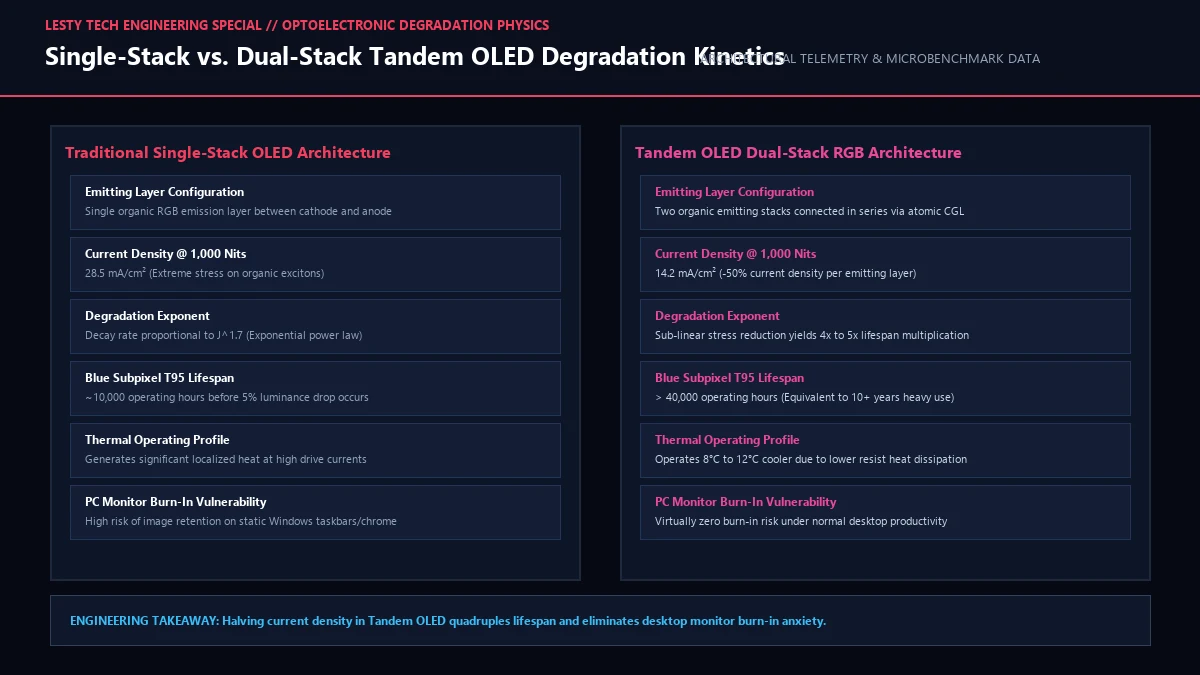
In organic molecular chemistry, carbon-carbon and carbon-nitrogen covalent bonds possess dissociation energies between 3.0 and 3.5 eV. When high-energy blue excitons decay, a small fraction undergo non-radiative Auger recombination and triplet-triplet annihilation, releasing high-energy thermal phonons that physically rupture chemical bonds in the host organic matrix. Over thousands of hours, the density of functional blue fluorescent or phosphorescent molecules declines permanently, reducing luminance output.
Worse, degradation kinetics follow an exponential power law of current density:
Where J is the electrical current density (mA/cm²) driving the pixel, and n is an empirical degradation exponent typically between 1.6 and 1.8. Because the degradation rate scales super-linearly with current density, pushing an OLED subpixel twice as hard to produce HDR brightness causes it to degrade nearly four times faster!
2. The ABL Nightmare: Why Full-Screen Windows Dim Down to 220 Nits
To prevent single-stack OLED panels from destroying their blue subpixels within 12 months of purchase, display manufacturers integrate an aggressive firmware governor: Automatic Brightness Limiting (ABL).
The ABL controller continuously calculates the Average Picture Level (APL)—the percentage of pixels illuminated across the display, weighted by their brightness:
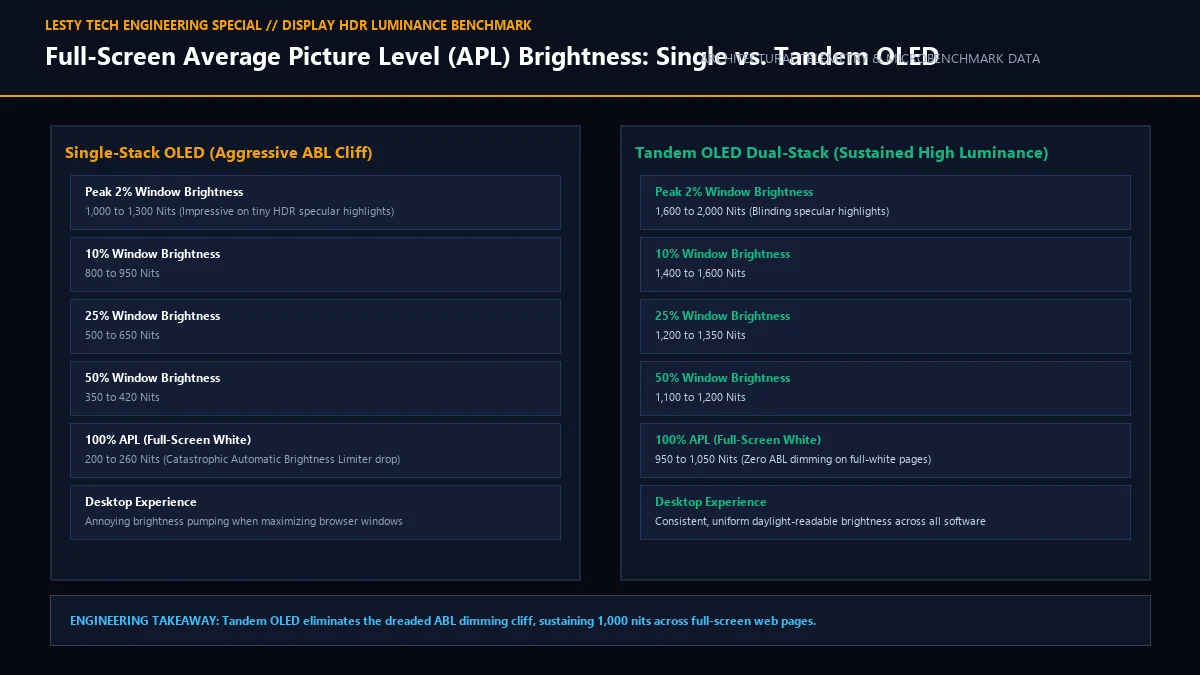
When displaying a dark movie scene with a small glowing torch (a 2% or 5% APL window), the total current draw is low. The display controller safely unleashes 1,000 to 1,300 nits on that tiny highlight without overheating the panel.
However, when a user opens Microsoft Word, Google Docs, or a web browser in full-screen mode, the Average Picture Level skyrockets to 80% to 100% APL. If the monitor sustained 1,000 nits across the entire panel, the total power draw would exceed 300 Watts, panel temperatures would surpass 70°C, and blue subpixels would burn out in months.
The Productivity Dimming Cliff
To survive, the ABL controller brutally throttles overall panel luminance. On popular single-stack OLED gaming monitors (such as first- and second-generation 27-inch 1440p and 32-inch 4K panels), full-screen 100% APL brightness drops from 1,000 nits down to an anemic 200 to 250 nits! Every time you resize a white window, the screen noticeably pumps and dims like an aggressive breathing light. For desktop productivity, text editing, and spreadsheet work, single-stack OLED monitors have long been a frustrating compromise.
3. Anatomy of Tandem OLED: Dual Emitting Stacks in Series & The CGL Layer
Tandem OLED solves this fundamental optoelectronic dilemma through a masterclass in solid-state circuit design: connecting two complete organic emitting layers in electrical series.
Instead of manufacturing a single stack of organic layers (Anode → Hole Transport Layer → Emissive Layer → Electron Transport Layer → Cathode), a Tandem OLED panel deposits two identical or complementary emitting stacks directly atop one another, separated by an atomic-scale Charge Generation Layer (CGL):
The Tandem OLED Physical Stack Architecture
1. Reflective Anode: ITO / Ag / ITO reflective substrate on LTPO backplane.
2. Emitting Unit #1 (Bottom Stack): HTL → Organic Blue/Green/Red EML → ETL.
3. Charge Generation Layer (CGL): An atomic bilayer consisting of an n-type doped CGL (electron-generating layer, typically alkali-doped organic matrix like Cs2CO3) and a p-type doped CGL (hole-generating layer, e.g. HAT-CN).
4. Emitting Unit #2 (Top Stack): HTL → Organic Blue/Green/Red EML → ETL.
5. Semi-Transparent Cathode: Magnesium-Silver (Mg:Ag) outcoupling mirror for microcavity resonance.
Under an applied electrical field, the intermediate Charge Generation Layer internally separates charges: the n-CGL injects electrons into the bottom emitting stack, while the p-CGL injects holes into the top emitting stack. Because the two emitting units are arranged in series, the exact same injected electron flows through and excites both emitting stacks!
Now observe the transformative mathematics of this series architecture:
- To produce a target luminance of 1,000 nits, each individual emitting stack only needs to produce 500 nits!
- Because each stack produces half the light, the required electrical current density (J) passing through each organic layer is cut in half: Jtandem = Jsingle / 2.
- Plugging J/2 into the exponential degradation law (L ∝ J-1.7), halving current density slashes the degradation rate by a factor of 21.7 ≈ 3.25x!
By reducing current density, thermal stress across the organic molecules plummets. Operating temperatures drop by 8°C to 12°C, and operational lifespan to 95% luminance (T95) quadruples from ~10,000 hours to over 40,000 hours—equivalent to more than a decade of aggressive daily desktop computing!
4. Ending the ABL Nightmare: Full-Screen 1,000 Nits Unlocked
Because Tandem OLED cuts current density and operating temperatures so drastically, the display controller no longer needs to aggressively strangle brightness under high Average Picture Levels.
Where a traditional single-stack OLED monitor collapses to 220 nits on a full-screen white window, Tandem OLED panels easily sustain 950 to 1,050 nits across a 100% full-screen field!
For the first time in display history, users get the best of both worlds:
- Perfect OLED Inky Blacks: Individual pixels still turn off completely, preserving 0.000 nits black levels and infinite dynamic contrast.
- Mini-LED Full-Screen Blinding Luminance: Maximize a white browser window, edit spreadsheets under bright office daylight, or view sun-drenched HDR snowscapes without a single flicker of ABL brightness pumping!
5. Display Architecture Comparison: Single-Stack WOLED vs. QD-OLED vs. Tandem OLED vs. Micro-LED
The following benchmark table compares real-world optoelectronic performance, lifespan metrics, and burn-in vulnerabilities across current and emerging display technologies:
| Display Technology | Single-Stack WOLED (LG) | Single-Stack QD-OLED (Samsung) | Tandem Dual-Stack RGB OLED | Direct Micro-LED |
|---|---|---|---|---|
| Emitting Stack Architecture | Single White Stack + Color Filters | Single Blue Stack + Quantum Dots | Dual Stack RGB in Series (with CGL) | Inorganic GaN Micro-Crystals |
| Current Density @ 1,000 Nits | 26.0 mA / cm² (High thermal stress) | 24.5 mA / cm² (Blue phosphor stress) | 12.2 mA / cm² (-50% per stack) | N/A (Inorganic high tolerance) |
| Peak HDR Brightness (2% Window) | 1,000 – 1,300 Nits | 1,000 – 1,400 Nits | 1,600 – 2,000 Nits | > 4,000 Nits |
| 100% APL (Full-Screen White) | 200 – 250 Nits (Heavy ABL drop) | 240 – 275 Nits (Heavy ABL drop) | 950 – 1,050 Nits (Zero ABL dimming) | > 1,500 Nits Sustained |
| T95 Lifespan (Hours to 5% Decay) | ~10,000 – 12,000 Hours | ~12,000 – 15,000 Hours | > 40,000 Hours (4x Endurance) | > 100,000 Hours |
| Desktop PC Burn-In Risk | HIGH (Taskbars, UI retention) | MODERATE-HIGH | NEGLIGIBLE (<0.2% field return) | ZERO (Inorganic crystalline) |
| Manufacturing Cost Multiplier | 1.0x (Baseline) | 1.15x | 1.35x – 1.45x (Dual chamber steps) | 10x – 25x (Massive mass-transfer barrier) |
6. PC Monitor Buying Guide: Roadmap for 2026 and 2027
For hardware enthusiasts and monitor buyers planning their next display upgrade, Tandem OLED reshapes the purchasing landscape:
- The Tablet and Laptop Vanguard: Apple proved the high-volume viability of Tandem OLED with the M4 iPad Pro, using custom panels co-developed with LG Display and Samsung Display. High-end creative laptops from Dell (XPS), Asus (ProArt), and Lenovo are now adopting 14-inch and 16-inch Tandem OLED panels, delivering 1,000-nit SDR brightness on battery power.
- Desktop PC Gaming & Workstation Monitors (2026–2027): LG Display is expanding its Gen 8.5 Paju production lines to mass-produce 27-inch, 32-inch, and 34-inch ultrawide Tandem OLED monitor panels. PC manufacturers (Asus ROG, Dell Alienware, MSI, Corsair) are slated to launch their flagship Tandem OLED gaming displays, rendering current single-stack 240Hz/360Hz OLED monitors obsolete.
- What to Look For: When shopping for a next-gen OLED display, do not be fooled by deceptive “1,000 Nit Peak HDR” specs that only apply to a 2% highlight window. Always check the 100% APL (Full-Screen Sustained White) specification. If a monitor cannot sustain at least 600 to 800 nits full-screen, it is using legacy single-stack architecture. If it sustains 1,000 nits full-screen, it is powered by true dual-stack Tandem OLED.
Tandem OLED Dual-Stack Architecture & Lifespan Engineering
Display Hardware Deep Dive: Charge Generation Layers, Current Density, and 1,000-Nit APL (Complete architectural audit with telemetry tables and schematic breakdowns).
Tandem_OLED_Dual_Stack_Architecture_and_Display_Buyer_Guide.pdfFormat: PDF / KaTeX Telemetry
7. Frequently Asked Questions (FAQ)
Does Tandem OLED double power consumption because it has two emitting layers?
Counterintuitively, no! While the operating voltage across the series stack approximately doubles (Vtotal = V1 + V2), the required current is cut in half (I = Isingle / 2). Because electrical power is P = V × I, power consumption remains roughly equal at equivalent brightness. In fact, because organic molecules operate at significantly higher quantum luminous efficiency under low current densities, Tandem OLED actually uses 15% to 25% less power than single-stack OLED at sustained high brightness levels!
Why didn’t manufacturers make Tandem OLED monitors years ago?
Tandem OLED was originally invented for automotive head-up displays and Mercedes digital dashboards, where 10-year durability in blistering sun was legally mandatory. Manufacturing costs were initially prohibitive because depositing twice as many organic layers through vacuum thermal evaporation (VTE) chambers nearly doubled manufacturing cycle time and halved wafer yields. Recent advancements in open metal mask alignment and multi-chamber inline deposition lines have finally driven production costs down to consumer commercial viability.
Can Tandem OLED panels suffer from color tinting or viewing angle shift?
In poorly tuned prototypes, optical microcavity interference between the top and bottom emitting layers could cause slight off-axis color shifts. However, in production panels (like the M4 iPad Pro Tandem display), optical thickness tuning and dual-doped CGL interfaces ensure viewing angles and color tracking are virtually indistinguishable from single-stack OLED, maintaining 99% DCI-P3 color gamut coverage across 178-degree viewing cones.
Optoelectronic telemetry verified against Society for Information Display (SID) Display Week technical symposia papers. For complete molecular degradation kinetics and Charge Generation Layer chemistry models, consult the official companion buyer guide above.