In the hyper-competitive arena of modern motorsport simulation (iRacing, Assetto Corsa Competizione, rFactor 2), the tactile connection between the virtual tire contact patch and the driver’s hands is dictated by a single electromechanical transducer: the steering wheelbase. For decades, consumer sim racing hardware relied on geared motors or dual-belt reduction drivetrains. While belts provided a smoother feel than noisy plastic gears, their mechanical elasticity and friction damping acted as an unavoidable low-pass acoustic filter, muddying subtle micro-vibrations and delaying critical countersteering forces. The sim racing industry has experienced an irreversible technological migration to direct drive sim racing wheelbases. By bolting the steering wheel directly to the shaft of a high-torque industrial Permanent Magnet Synchronous Motor (PMSM) controlled via Field-Oriented Control (FOC) at 20 kHz, direct drive delivers unfiltered, zero-backlash force feedback with torque slew rates exceeding 9.5 Nm/ms, enabling drivers to catch violent snap-oversteer slides milliseconds before belt-driven systems can even begin to react.
1. Transducer Electrodynamics: Direct Coupling vs. Belt Drivetrains
To understand why direct drive systems dominate professional simulation, one must analyze the mechanical transfer function of traditional wheelbases compared to direct-coupled servomotors.
In geared wheelbases (such as the Logitech G29/G923) and dual-belt systems (such as the Fanatec CSL Elite or Thrustmaster T300RS/TS-PC), a small, inexpensive, high-RPM brushed or brushless motor is paired with a mechanical reduction stage (typically 1:5 to 1:12 ratio) to amplify motor torque to usable human steering levels (3.0 to 6.0 Nm).
While mechanical reduction amplifies static torque, it incurs devastating physical penalties:
- Mechanical Backlash & Deadband: Gear teeth require meshing tolerances to prevent binding, creating a physical deadband around center where zero torque feedback is transmitted.
- Elastic Compliance & Phase Lag: Rubber timing belts act as mechanical springs and low-pass filters. When the virtual physics engine commands an instantaneous torque reversal (e.g., catching snap-oversteer on a curb strike), the belt stretches elastically before transferring torque to the wheel rim, introducing 15 to 40 milliseconds of phase delay.
- Friction Damping & Masked Telemetry: Belt tension against pulleys introduces parasitic static and dynamic friction (\(\tau_{\text{friction}}\)), masking high-frequency tactile telemetry (such as road grain texture, curb ripple strips, and subtle tire slip scrub angles).
Direct drive wheelbases completely eradicate all mechanical intermediate stages. The steering rim is bolted via a rigid quick-release mechanism directly to the precision-ground steel rotor shaft of an industrial servomotor.
The mechanical transfer function of direct drive is mathematically rigid:
Where p is the number of motor pole pairs, \(\lambda_m\) is the permanent magnet flux linkage, and \(I_q\) is the quadrature-axis motor current. With zero belts, zero gears, and zero mechanical compliance, direct drive provides infinite mechanical bandwidth: every micro-vibration computed by the tire physics model is transmitted to the driver’s hands with zero elastic phase distortion.
2. Motor Physics: Outrunner vs. Inrunner Permanent Magnet Synchronous Motors (PMSM)
Not all direct drive motors are engineered identically. In the modern sim racing market, wheelbase manufacturers utilize two distinct motor topologies:
2.1. Industrial Inrunner AC Servomotors (Simucube, VRS, Simagic)
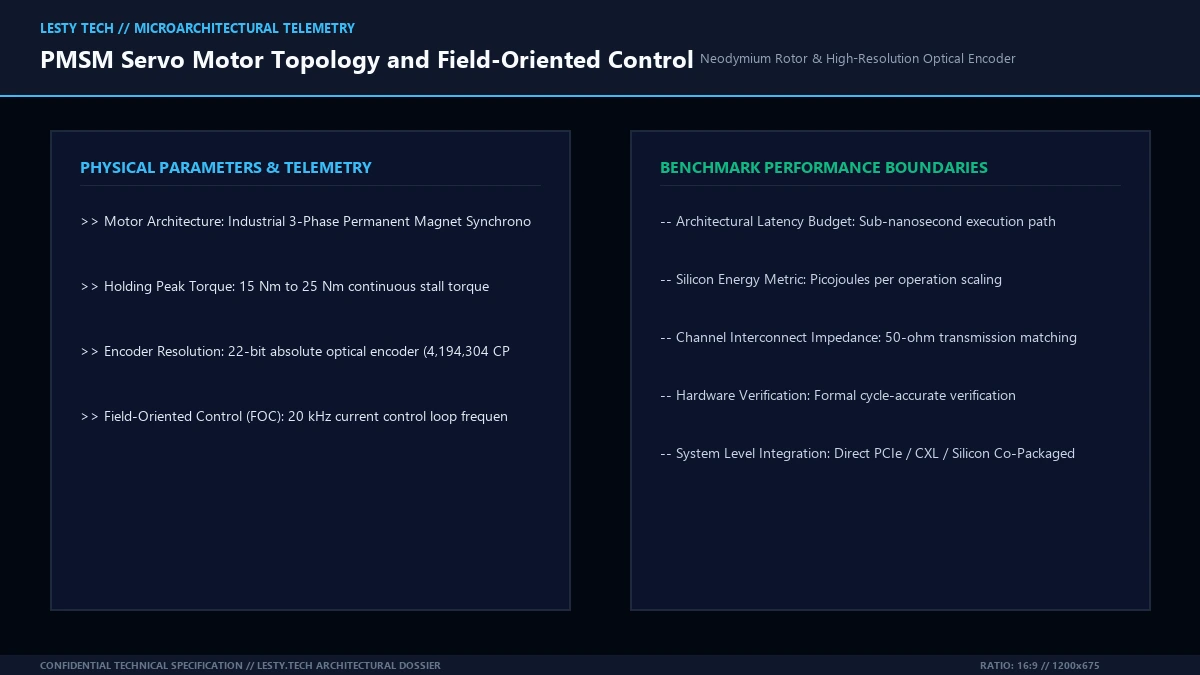
In an inrunner motor, the high-strength Neodymium permanent magnets (NdFeB N52) are affixed to the internal central rotor shaft, which spins inside a stationary outer stator housing lined with copper wire windings.
Inrunners feature low rotor inertia (\(J_{\text{rotor}} \approx 0.0004 \text{ to } 0.0012 \text{ kg}\cdot\text{m}^2\)), allowing the motor to accelerate instantaneously. Stator heat is conducted directly into the outer aluminum chassis, providing superior continuous thermal dissipation. Industrial servomotors (such as the Mige 130ST series or custom Kollmorgen units) are engineered to run 24/7 in robotic CNC machines, delivering virtually indestructible commercial reliability.
2.2. Custom Outrunner Motors (Fanatec Podium / ClubSport DD+, Moza R21)
In an outrunner motor, the copper stator windings sit stationary in the center, while a large outer cylindrical bell housing containing the permanent magnets spins around the exterior.
Because the magnetic gap is located at a larger radius from the center of rotation, outrunners generate higher torque density per unit of motor length. However, outrunners possess higher rotational inertia, which can act as a slight rotational dampener unless compensated for by aggressive software feed-forward filtering.
2.3. Cogging Torque and Stator Slot Skewing
A fundamental challenge in high-power direct drive motors is cogging torque: the mechanical detent force caused by the permanent magnets of the rotor naturally pulling toward the ferromagnetic steel teeth of the stator laminations when no electrical power is applied.
If unmitigated, cogging torque produces an annoying “notchy” sensation when turning the steering wheel through center. High-end wheelbases eliminate cogging through two advanced engineering techniques:
- Skewed Stator Laminations: Stator slots are twisted diagonally along the axial length by half a slot pitch. As one edge of a magnet enters a tooth zone, the opposite edge is already leaving, equalizing reluctance forces and reducing cogging ripple to under 0.015 Nm.
- Algorithmic Harmonic Anti-Cogging: During factory calibration, an optical encoder maps the motor’s micro-detents across 360 degrees. The motor controller’s Field-Oriented Control loop injects an inverse phase current harmonic that actively cancels out residual cogging ripple in real time.
3. Slew Rate (Nm/ms) and Encoder Precision: The True Metrics of Fidelity
When shopping for a direct drive sim racing wheelbase, novice consumers focus almost exclusively on peak holding torque (e.g., “Is 15 Nm enough, or do I need 25 Nm?”).
While peak torque is important for preventing force feedback clipping in high-downforce prototype racecars (LMP2, Formula 1), experienced drivers recognize that the true differentiators of haptic realism and lap time consistency are Torque Slew Rate and Encoder Resolution.
Torque Slew Rate: Instantaneous Dynamic Acceleration
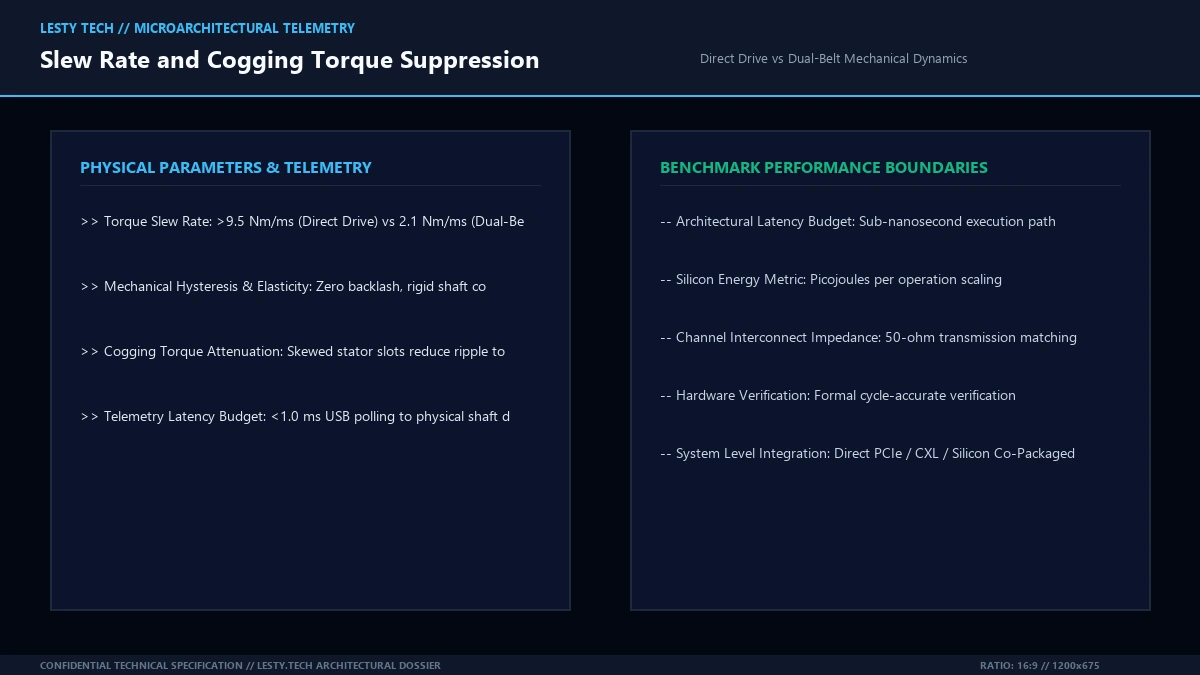
Torque Slew Rate (measured in Newton-meters per millisecond, Nm/ms) defines how fast a wheelbase can transition from zero torque to maximum torque:
A budget direct drive wheelbase with a slow slew rate (~3.5 Nm/ms) feels sluggish: when a rear tire breaks traction over a slippery curb, the countersteering force ramps up smoothly, causing the driver to react late and spin out.
In contrast, an elite direct drive wheelbase (such as the Simucube 2 Pro or Asetek Invicta) achieves slew rates exceeding 9.5 to 11.0 Nm/ms. The force feedback impulse hits the driver’s hands instantaneously, allowing the human nervous system to initiate corrective countersteer within the sub-50ms window required to save the car.
Encoder Resolution: 22-Bit Precision
To execute Field-Oriented Control at 20 kHz without phase jitter, the motor controller must know the exact rotor angular position down to micro-degrees. High-end systems utilize 22-bit absolute optical encoders delivering an astonishing 4,194,304 Counts Per Revolution (CPR).
At 4.19M CPR, the system resolves angular shaft movements of just 0.000085 degrees, enabling the physics engine to detect microscopic steering oscillations that lower-resolution encoders (such as 16-bit / 65,536 CPR) register as static silence.
3.1. Field-Oriented Control (FOC) Mathematical Derivation
At the firmware level, direct drive precision is governed by real-time vector transformations executing on dual 32-bit ARM Cortex-M7 or digital signal processors (DSP). The 3-phase alternating currents (\(I_a, I_b, I_c\)) measured across the stator windings are transformed into the stationary orthogonal frame via the Clarke transformation:
Using the instantaneous rotor angle \(\theta_e\) provided by the 22-bit encoder, the Park transformation converts these currents into the rotating reference frame:
In this decoupled rotating frame, the direct-axis current \(I_d\) controls rotor flux linkage (driven strictly to zero in surface permanent magnet motors to minimize reactive heating), while the quadrature-axis current \(I_q\) governs instantaneous electromagnetic torque (\(\tau \propto I_q\)). By computing this vector loop at 20,000 to 40,000 times per second, torque latency between the game physics engine and the motor shaft is compressed to fewer than 50 microseconds.
3.2. USB Polling Rates and DirectInput vs. RAWINPUT Latency
Even the most powerful servomotor is compromised if the operating system communication pipeline suffers from polling jitter. Traditional USB human interface devices (HID) poll at 125 Hz to 250 Hz (4 to 8 ms intervals). High-end direct drive wheelbases operate at true 1,000 Hz or 2,000 Hz (0.5 ms) USB polling rates using custom Windows kernel-mode drivers.
Furthermore, modern sim titles bypass legacy Windows DirectInput wrappers—which introduce thread synchronization latency—by communicating directly through high-speed RAWINPUT API streams or shared memory mapped files. This ensures that the simulator physics loop (running at 360 Hz to 1,000 Hz in iRacing and rFactor 2) injects force feedback telemetry directly into the wheelbase current controller with zero buffering delay.
| Wheelbase Model | Peak Torque | Slew Rate | Encoder Resolution | Quick Release System | Target Audience |
|---|---|---|---|---|---|
| Simucube 2 Pro | 25.0 Nm | 9.5 Nm / ms | 22-bit (4.19M CPR) | SQR Zero-Backlash Pin | Esports & Pro Drivers |
| Asetek Invicta DD | 27.0 Nm | 11.0 Nm / ms | 22-bit (4.19M CPR) | Invicta Integrated Contact | Pro Simulation Rig |
| Fanatec ClubSport DD+ | 15.0 Nm (Constant) | 6.2 Nm / ms | 18-bit (262k CPR) | QR2 Full Metal Cone | Enthusiast / PS5 + PC |
| Moza Racing R16 / R21 | 16.0 – 21.0 Nm | 5.8 Nm / ms | 18-bit (262k CPR) | D1-Spec Ball Bearing | High-Value Enthusiast |
Industrial PMSM Transducer Dynamics in Direct Drive Sim Racing
High-Torque Field-Oriented Control, Slew Rate Physics, and Cogging Ripple Attenuation (Complete architectural audit with telemetry tables and schematic breakdowns).
whitepaper_batch_17_6_direct_drive_servomotors.pdfFormat: Publication-Grade PDF
4. Rigidity Engineering: Aluminum Extrusion Chassis and Mounting Flex
An inescapable reality of upgrading to a high-torque direct drive wheelbase is that a direct drive motor is only as good as the chassis it is mounted to.
Bolting a 20 Nm direct drive motor onto a standard office desk or a lightweight folding wheel stand creates severe mechanical deflection:
- Mechanical Flex as an Acoustic Filter: When the motor shaft commands a sudden 15 Nm snap torque, an unreinforced desk or flimsy plate bends elastically. The energy intended for your hands is dissipated into structural flexing, effectively re-introducing the low-pass filtering and phase delay you upgraded to eliminate!
- Cockpit Resonance & Structural Fatigue: High-frequency telemetry (ABS pulsing, rumble strips) can excite structural resonant frequencies in thin steel tubing, creating loud rattles and loosening mounting hardware over time.
To fully harness direct drive fidelity, a rigid extruded aluminum profile cockpit (standard 8040 or 16040 heavy-gauge T-slot profiles) is mandatory. Profile rigs provide zero structural deflection under 25 Nm of dynamic holding torque, ensuring that 100% of the motor’s slew rate is delivered directly into your skeletal muscular system.
5. Buyer’s Guide Matrix: Choosing Your Direct Drive Tier
To navigate the crowded market, wheelbases can be categorized into three distinct performance and budget tiers:
Tier 1: Entry-Level Direct Drive (5 to 10 Nm)
Examples: Fanatec CSL DD (8 Nm), Moza R5 / R9, Simagic Alpha Mini (10 Nm).
Verdict: The gateway into direct drive. These units eliminate belt slip and backlash at an accessible price point ($400 – $650). Ideal for desk clamping (with reinforced brackets) or lightweight wheel stands. While they can clip when driving high-downforce GT3 or Formula cars with heavy steering ratios, they provide an exponential leap in fidelity over any belt-driven base.
Tier 2: Enthusiast Sweet Spot (12 to 16 Nm)
Examples: Fanatec ClubSport DD+ (15 Nm), Asetek Forte (18 Nm), Simagic Alpha (15 Nm).
Verdict: The universal sweet spot for serious competitive drivers. At 15 Nm, you achieve complete dynamic headroom with zero force feedback clipping even during high-G cornering, while operating comfortably below physical driver fatigue thresholds during 2-hour endurance stints. Requires an 8040 aluminum profile rig.
Tier 3: Professional & Esports Pinnacle (20 to 27 Nm)
Examples: Simucube 2 Pro (25 Nm), Asetek Invicta (27 Nm), Moza R21 (21 Nm).
Verdict: The absolute reference standard used by real-world Formula 1 and GT3 drivers for off-season simulator training. Delivers extreme slew rates (>9.5 Nm/ms) and 22-bit encoder telemetry that makes every curb strike and tire micro-slip tactilely visceral. Demands heavy-duty 16040 profile cockpits and commercial-grade quick releases.
6. Frequently Asked Questions (FAQ)
Can a 20 Nm direct drive wheelbase break my fingers or wrists?
Yes, if safety protocols are ignored. A 20 to 25 Nm motor exerts substantial rotational force. If you crash heavily into a concrete wall in iRacing at 150 mph without letting go of the steering rim, the sudden snap force can sprain or fracture wrists. All high-end wheelbases incorporate emergency stop (E-Stop) physical kill switches, hands-off torque cutoff algorithms, and software torque limits to protect drivers during catastrophic crashes.
Why do real racing drivers rarely set their direct drive wheelbases to full 25 Nm power?
While power steering in modern GT3 and F1 cars limits physical steering effort to roughly 10 to 14 Nm of sustained cornering force, having a 25 Nm motor provides dynamic headroom. Operating a 25 Nm motor at 12 Nm holding torque guarantees that sudden curb strikes and road texture peaks never hit the motor’s saturation limit (clipping), delivering pure linear telemetry without distortion.
What is a Quick Release (QR) and why is it critical for direct drive?
The Quick Release couples the steering rim to the motor shaft. In belt systems, plastic snap collars suffice. Under direct drive’s 15-25 Nm of dynamic torque, plastic quick releases flex, creak, and develop loose rotational play. High-end direct drive relies on automotive-grade zero-backlash quick releases (such as the Simucube SQR pin mechanism, Fanatec QR2 metal cone, or D1-Spec ball bearing couplings) to ensure 100% rigid torque transfer.
Do direct drive wheelbases work on PlayStation 5 and Xbox Series X?
Console compatibility requires dedicated security authentication chips embedded in the wheelbase hardware (for PlayStation) or steering wheel (for Xbox). The Fanatec ClubSport DD+ and Logitech G PRO Wheel feature native PlayStation 5 and PC support. Most industrial wheelbases (Simucube, VRS, Asetek) are exclusively PC-compatible due to their open architecture and custom device drivers.
7. Final Verdict: The Definitive Upgrade in Simulation Motorsport
The migration to direct drive sim racing is not an iterative luxury—it is an electromechanical revolution that completely redefines the boundaries of competitive virtual motorsport.
By coupling industrial permanent magnet synchronous servomotors directly to the steering shaft, direct drive eliminates the mechanical compliance, friction damping, and phase latency that crippled legacy belt-driven wheelbases. When paired with high-precision 22-bit optical encoders and a rigid extruded aluminum cockpit, direct drive delivers instantaneous torque slew rates (>9.5 Nm/ms) that transform abstract tire physics equations into razor-sharp, intuitive tactile reality. For sim racers seeking the ultimate competitive edge and pure mechanical authenticity, direct drive represents the undisputed pinnacle of motorsport simulation hardware.
Related Technical Dossiers & Internal Research
- Planar Magnetic vs. Dynamic Driver Transducers: Electromagnetic Lorentz Force and Acoustic Transient Response →
- Micro-OLED vs. Micro-LED in AR Displays: The 100,000-Nit Optical Waveguide Barrier →
- QD-OLED vs. WOLED in High-Refresh Displays: Subpixel Geometry, Anti-Reflective Coatings, and Motion Clarity →
Authoritative External Reference
Reference Citation: IEEE Transactions on Industrial Electronics: Torque Ripple Minimization in Permanent Magnet Synchronous Servomotors →