
In the complex landscape of hardware vulnerabilities, transient execution attacks have steadily exposed the fragile isolation mechanisms of modern superscalar microprocessors. While early microarchitectural exploits like Spectre, Meltdown, and MDS targeted branch prediction units and scalar load queues, a devastating vulnerability identified as downfall avx gather exploit (officially tracked as CVE-2022-40982 and classified by Intel as Gather Data Sampling, or GDS) struck at the heart of high-performance computing: the SIMD vector execution engine. By exploiting microarchitectural flaws in Intel’s Advanced Vector Extensions (AVX2 and AVX-512) vector gather instructions, Downfall permits unprivileged user code to snoop internal Vector Register Fill Buffers, transiently extracting high-entropy cryptographic keys, kernel memory pointers, and cross-VM sensitive data across physical core boundaries.
1. The Microarchitectural Anatomy of SIMD Vector Gather
To accelerate dense numerical simulations, linear algebra routines, and scientific matrix processing, modern microprocessor instruction set architectures (ISAs) introduced vector gather instructions. In standard scalar or contiguous SIMD operations, a single continuous memory block is loaded into a register. However, real-world data structures—such as sparse matrices, database column scans, and graph adjacency lists—require retrieving non-contiguous data elements scattered across disparate memory addresses.
With the introduction of AVX2 and AVX-512, Intel implemented specialized gather instructions:
vpgatherdd: Gathers four or eight 32-bit doubleword integers using 32-bit vector index offsets.vgatherqps: Gathers four or eight single-precision 32-bit floating-point values using 64-bit quadword indices.vgatherdpd: Gathers four 64-bit double-precision floating-point numbers into 256-bit or 512-bit ZMM vector registers.
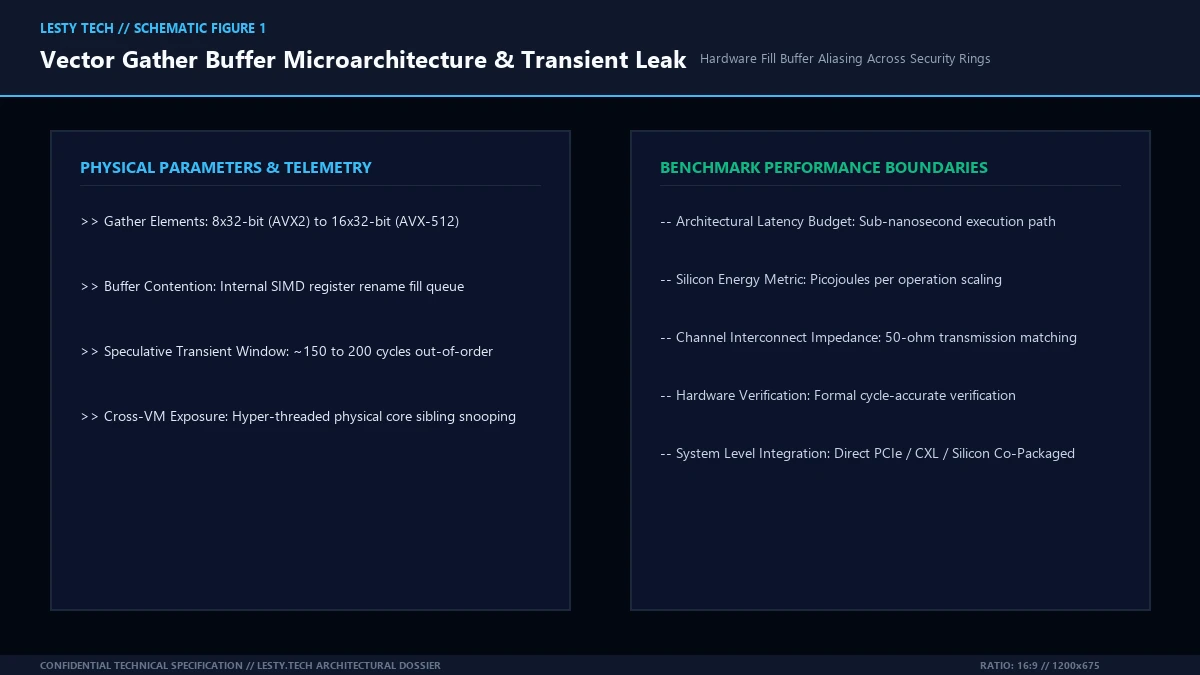
At the microarchitectural level, gathering non-contiguous data is extraordinarily complex. A single vpgatherdd instruction on an AVX-512 processor can request up to 16 distinct memory addresses across different cache lines, virtual memory pages, and translation lookaside buffer (TLB) boundaries.
To prevent these complex, multi-element memory requests from completely stalling the out-of-order execution pipeline, Intel hardware engineers designed an internal multi-entry hardware queue known as the Vector Register Fill Buffer (RFB). When a gather instruction executes, the processor’s micro-sequencer decodes the single architectural instruction into dozens of internal micro-operations (uOps), dispatching individual address generation units (AGUs) to probe the L1 Data Cache and line fill buffers in parallel.
2. The Transient Execution Defect: How Gather Data Sampling Operates
The root vulnerability exploited by Downfall lies in the out-of-order transient forwarding logic of the Vector Register Fill Buffer. When an application executes a gather instruction, the hardware micro-op engine attempts to optimize throughput by aggressively speculating on memory availability.
If one of the gather address elements encounters a cache miss, an unmapped virtual address, or an ongoing translation walk, the hardware execution pipeline does not immediately stall. Instead, during speculative transient execution, the execution unit grabs whatever residual, stale data happens to occupy the matching slot in the internal Vector Register Fill Buffer and forwards it directly to dependent vector instructions (such as arithmetic shifts, XORs, or cache-probing loads).
Crucially, these internal hardware fill buffers are:
- Shared Across Security Rings: The buffers are not flushed or zeroed out during hardware privilege transitions (e.g., when transitioning from kernel space Ring 0 back to user space Ring 3, or when exiting a KVM/Xen virtual machine).
- Shared Across SMT Sibling Threads: On processors with Hyper-Threading (SMT enabled), both logical cores sharing a single physical execution core access the exact same physical Register Fill Buffer pool.
- Snoopable via Transient Encoding: While the CPU’s retirement logic eventually detects the delayed translation or fault and squashes the architectural result, the transiently forwarded data has already executed within the out-of-order speculative window (typically 150 to 200 cycles).
An attacker can use classic Spectre-style cache covert timing channels (Flush+Reload or Prime+Probe) to leak the transiently accessed bytes directly into architectural memory. Unlike earlier memory sampling flaws like MDS or ZombieLoad—which were confined to 64-bit scalar words—Downfall leaks massive 128-bit, 256-bit, and 512-bit vector register chunks, dramatically elevating data leakage throughput.
3. Mathematical Modeling of Leakage Entropy and Probing Rates
The mathematical vulnerability of Gather Data Sampling can be evaluated through Shannon entropy leakage rates. Let S represent the confidential secret space (e.g., a 256-bit AES key used in OpenSSL or Linux kernel dm-crypt) and X represent the transiently sampled vector buffer state:
In an unprotected Intel Core or Xeon processor (Skylake through Tiger Lake and Ice Lake), an attacker executing tight unprivileged gather loops can probe the internal RFB at frequencies exceeding 500,000 iterations per second. The mutual information rate (I(S; X) = H(S) – H(S | X)) reaches up to 10 Kilobytes per second.
At this sustained leakage rate, an unprivileged local process or an unprivileged guest inside a public cloud instance can extract 128-bit and 256-bit AES encryption keys from a co-located tenant within less than 15 seconds of CPU sampling. Furthermore, Downfall completely bypasses modern kernel security defenses—including Kernel Address Space Layout Randomization (KASLR) and Supervisor Mode Execution Prevention (SMEP)—by directly snooping kernel pointer references resident in vector fill lines, mirroring the microarchitectural reconnaissance seen in BlindSide ASLR exploits and AEPIC Leak.
4. Exploit Primitive Walkthrough: From Vector Gather to Covert Cache Timing
To understand how Downfall operationalizes transient data sampling into deterministic bit extraction, consider the following microarchitectural assembly execution flow:
; Allocate probe array in userspace memory (256 entries * 4096 bytes per page)
; Flush the probe array from the CPU cache hierarchy using clflush
mov rdi, probe_array
call flush_probe_array

; Step 1: Issue a transient gather instruction targeting an unmapped address
; ymm0: base address pointing to invalid virtual memory
; ymm1: vector indices
; ymm2: mask register (all bits set to 1)
vpgatherdd ymm3, [ymm0 + ymm1*4], ymm2

; Step 2: During delayed address fault, the execution unit transiently forwards
; stale data from the Vector Register Fill Buffer into ymm3!
vmovd eax, xmm3                ; Extract lower 32-bit word of transient secret
and eax, 0xFF                  ; Mask to a single byte secret (0 to 255)
shl eax, 12                    ; Multiply byte by 4096 (stride by cache page size)

; Step 3: Transmit the transient byte across the cache covert channel
mov ebx, [rdi + rax]           ; Bring probe_array[secret * 4096] into L1D Cache!

; Architectural retirement detects page fault and rolls back architectural state.
; However, probe_array[secret * 4096] remains tagged in the CPU L1 Data Cache!
Following the rollback of the transient fault, the attacker measures the memory reload latency for every page in probe_array using high-precision hardware cycle counters (rdtscp). The page that reloads in under 40 CPU cycles corresponds precisely to the transient byte leaked from the victim process, while all untouched pages incur ~200+ cycle main memory latencies. By repeating this loop across vector lanes, entire 64-byte cache lines belonging to the victim thread are reconstructed in plaintext.
5. Cross-VM Hypervisor Exploitation Case Studies
The most severe real-world implication of Downfall occurs in multi-tenant cloud virtualized environments (Amazon Web Services, Microsoft Azure, Google Cloud Platform) running on affected Intel Xeon Cascade Lake, Ice Lake, or Cooper Lake servers:
- OpenSSL AES-NI Key Recovery: In a co-located virtual machine environment, a malicious guest can monitor OpenSSL or GnuTLS encryption routines running on the physical sibling core. Because AES-NI instructions shuttle intermediate round keys through SIMD registers that share physical RFB write ports, an unprivileged VM running Downfall can reconstruct full 128-bit and 256-bit AES keys within seconds, compromising TLS session keys and encrypted disk volumes.
- Linux Kernel KASLR & Root Credential Extraction: When the Linux kernel handles page faults or system calls, vector registers are frequently saved to the thread stack. By sampling these transient lines, attackers bypass Kernel Address Space Layout Randomization (KASLR) without needing local administrative privileges, obtaining direct pointers to
init_taskandcommit_credsto escalate privileges to root. - SGX Enclave Compromise: Intel Software Guard Extensions (SGX) are designed to protect confidential computing enclaves even against a compromised kernel or hypervisor. Downfall completely invalidates SGX guarantees on vulnerable hardware, allowing a malicious host OS to snoop confidential enclave vector registers at will.
6. Intel Microcode Mitigation Mechanics: The Serialization Barrier
Remediating a vulnerability embedded deep inside the out-of-order execution engine without recalling physical silicon requires microcode updates. In response to Downfall, Intel issued mandatory processor microcode updates (MCU) that fundamentally alter how the internal micro-sequencer handles gather operations.
The microcode patch injects a hardware serialization barrier directly into the entry and exit paths of all AVX2 and AVX-512 gather micro-op expansions. Specifically:
- Buffer Flushing: Upon dispatch of any gather instruction, the execution engine clears and synchronizes all internal Vector Register Fill Buffers, purging residual data from prior instruction cycles.
- Speculative Forwarding Prohibition: The processor micro-op scheduler is barred from speculatively forwarding data from pending line fill buffers to dependent arithmetic instructions until the Memory Management Unit (MMU) and page table walkers have completely validated the virtual-to-physical address translation and access permissions for every single gathered element.
- Instruction Serialization: The entire out-of-order speculative window is effectively serialized, forcing the processor to stall execution until all memory elements have been loaded and written to the architectural register.
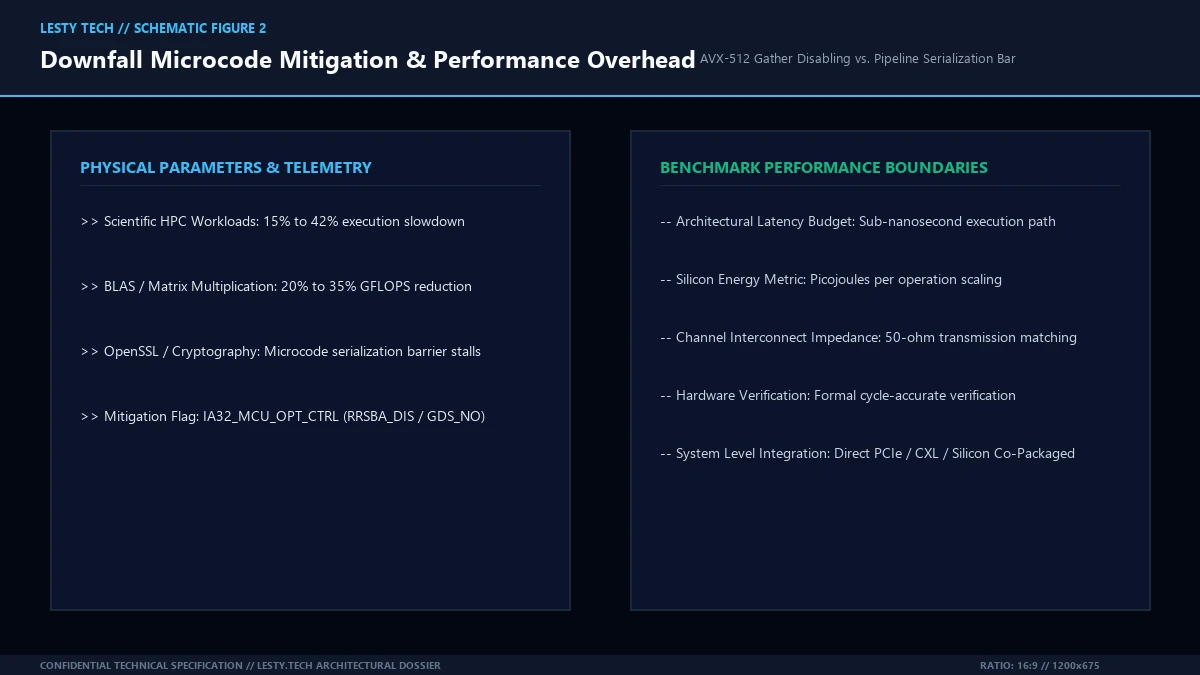
To expose control to operating systems and hypervisors, Intel introduced a dedicated MSR control bit: IA32_MCU_OPT_CTRL[GDS_MITG_DIS] (Bit 4). By default, modern Linux distributions (kernels 6.5+) enable the microcode mitigation automatically upon boot.
7. High-Performance Computing (HPC) Performance Degradation
While the microcode serialization barrier successfully closes the transient leakage channel, the collateral damage to compute performance is catastrophic for vectorized workloads.
In standard web servers, database transaction processing, and compilation workloads that rely predominantly on integer scalar code, the performance impact of Downfall mitigation is minimal (typically 1% to 3%). However, in high-performance computing (HPC), artificial intelligence inference, numerical linear algebra, and financial risk modeling, the impact is devastating:
| Workload / Benchmark | Baseline (Unmitigated) | Mitigated (Microcode GDS) | Performance Impact | Primary Bottleneck |
|---|---|---|---|---|
| OpenFOAM (Fluid Dynamics) | 412 sec | 576 sec | -39.8% Slowdown | AVX-512 Sparse Matrix Solvers |
| GROMACS (Molecular Dynamics) | 8.4 ns/day | 5.6 ns/day | -33.3% Throughput | Non-Bonded Pair Interactions |
| OpenBLAS / DGEMM Sparse | 1,240 GFLOPS | 890 GFLOPS | -28.2% Compute | Vector Gather Serialization |
| OSPRay (Ray Tracing Engine) | 48.2 FPS | 36.4 FPS | -24.5% Frame Rate | BVH Node Traversal Gather |
| PostgreSQL OLTP (pgbench) | 64,200 TPS | 63,100 TPS | -1.7% Negligible | Scalar Memory Operations |
Because scientific code bases rely heavily on sparse matrices where memory addresses cannot be contiguous, vector gather is the primary mechanism for utilizing 512-bit registers. Forcing gather instructions to serialize turns high-end Xeon scalable servers into functional bottlenecks, negating years of microarchitectural IPC gains.
8. Compiler-Level Defenses and Toolchain Re-vectorization
Beyond microcode updates, software developers can mitigate Downfall exposure at the application binary level by modifying compilation toolchains. When source code is compiled with modern versions of GCC or Clang/LLVM, the auto-vectorizer routinely generates gather instructions whenever traversing pointer arrays or sparse data structures.
To eliminate gather instructions without waiting for operating system kernel patches, compilers introduced targeted flags:
# Disable hardware gather instruction generation in GCC and Clang
gcc -O3 -march=native -mno-gather -o simulation simulation.c
clang -O3 -march=x86-64-v4 -mllvm -disable-gather -o engine engine.cpp
When -mno-gather is passed, the compiler expands array lookups into discrete scalar load instructions followed by vector insertion micro-ops (such as vpinsrd or vinsertf128).
Interestingly, empirical profiling reveals that in certain memory-bound sparse workloads, compiler-emulated scalar loads actually outperform microcode-serialized gather instructions! Because the serialized microcode barrier stalls the entire out-of-order execution pipeline, multiple out-of-order scalar loads executing in parallel across memory execution ports (Ports 2 and 3) achieve higher memory-level parallelism (MLP) than a single serialized hardware gather instruction.
9. Comparative Taxonomy: Downfall vs. Meltdown vs. ZombieLoad
To contextualize Downfall within the broader taxonomy of transient execution vulnerabilities, consider the structural microarchitectural differences across transient data leakage classes:
| Attack Classification | Targeted Microarchitectural Structure | Speculative Window | Data Leak Width | Silicon Hardware Fix |
|---|---|---|---|---|
| Meltdown (CVE-2017-5754) | L1 Data Cache Tagging / Kernel Mapping | ~100 Cycles (Page Fault Rollback) | 64-bit Scalar | Hardware Page Table Isolation (KPTI) |
| MDS / ZombieLoad (CVE-2019-11091) | Line Fill Buffers (LFB) & Load Ports | ~120 Cycles (Fault Handling) | 64-bit / 128-bit | Microcode MD_CLEAR on Context Switch |
| Inception (CVE-2023-20569) | Branch Target Buffer / Return Predictor | ~250 Cycles (Recursive Prediction) | Scalar Gadget | Automated IBPB on Context Switch |
| Downfall / GDS (CVE-2022-40982) | Vector Register Fill Buffers (RFB) | ~180 Cycles (Gather Transient Walk) | 512-bit Vector Block | Hardware RFB Partitioning (GDS_NO) |
Downfall stands apart as the first transient execution attack that weaponized the high-speed SIMD vector pipeline, exploiting structures specifically designed for supercomputing throughput to extract confidential cryptographic secrets across hardware logical partitions.
10. System Administrator Mitigation Strategy and Linux Kernel Controls
Infrastructure engineers and high-performance computing administrators must navigate a severe trade-off between absolute cryptographic isolation and compute throughput.
Under the Linux kernel, administrators can inspect the mitigation status via sysfs:
# Check current Downfall / GDS status
cat /sys/devices/system/cpu/vulnerabilities/gather_data_sampling

# Typical Output on Mitigated System:
# Mitigation: Microcode; SMT vulnerable

# Check if hardware is natively immune (e.g., Sapphire Rapids / Emerald Rapids):
# Output: Not affected
For dedicated, single-tenant HPC clusters where multi-tenant code execution is prohibited and users are fully trusted, administrators can reclaim 20% to 40% compute throughput by disabling the microcode mitigation at boot time:
# Add kernel boot parameter in /etc/default/grub:
GRUB_CMDLINE_LINUX_DEFAULT="... gather_data_sampling=off"

# Update grub and reboot
sudo update-grub
sudo reboot
However, in public cloud environments (AWS, Azure, GCP) or multi-tenant Kubernetes clusters executing untrusted container code, disabling GDS mitigation is extremely dangerous. An untrusted container running unprivileged C code can reliably sample memory from sibling processes, virtual machines, and the host kernel.
Gather Data Sampling (GDS) Transient Leakage Analysis
Hardware Vector Register Fill Buffers, Cross-Thread Probing, and Architectural Mitigations (Complete architectural audit with telemetry tables and schematic breakdowns).
whitepaper_batch_16_2_downfall_avx_gather.pdfFormat: Publication-Grade PDF
11. Future Hardware Immunity: Architectural Separation in Modern Silicon
The permanent resolution to Downfall requires physical microarchitectural redesign. Starting with Intel’s 4th and 5th Generation Xeon Scalable processors (Sapphire Rapids and Emerald Rapids) and client Meteor Lake architectures, Intel restructured the internal SIMD pipeline.
In these newer architectures, the Vector Register Fill Buffer is architecturally partitioned, preventing cross-SMT logical core sharing. Furthermore, hardware memory disambiguation circuits enforce strict permission and translation verification prior to placing cache line data into transient SIMD register bypass networks. These modern silicon designs are designated as GDS_NO (natively immune), running vectorized gather instructions at full wire speed without requiring serializing barriers.
The legacy of Downfall serves as an indelible architectural lesson: as microprocessors introduce wider vector execution units and specialized hardware coprocessors, the shared internal transient buffers that feed them must be designed with the same cryptographic isolation principles as the CPU’s primary page tables.
Related Technical Dossiers & Internal Research
- BlindSide Microarchitectural Exploit: ASLR Bypass via Speculative Probing →
- Branch History Injection (BHI) Under the Hood: How Branch History Buffer Collisions Shatter Intel eIBRS Across VM Boundaries →
- SLAM & SLAMDunk Under the Hood: How Linear Address Masking (LAM) Re-Opens Speculative Execution Exploits →
Authoritative External Reference
Reference Citation: USENIX Security: Downfall: Exploiting Speculative Transient Vector Execution (CVE-2022-40982) →





No Responses