On May 18th, a space rock roughly the size of a famous Chicago landmark will zip past our planet at a distance that feels surprisingly close. The object, designated 2026 JH2, measures about 20 meters across, which is similar to the dimensions of the Cloud Gate sculpture, better known as The Bean. For anyone who has ever glanced up at the night sky and wondered what is out there, this event offers a concrete example of how active our solar system really is. The asteroid jh2 flyby will bring it within 57,000 miles of Earth, a path that places it much nearer than the Moon, which orbits at roughly 239,000 miles away. Among all the tracked near-Earth objects scheduled to pass us in the coming months, this one will come the closest.
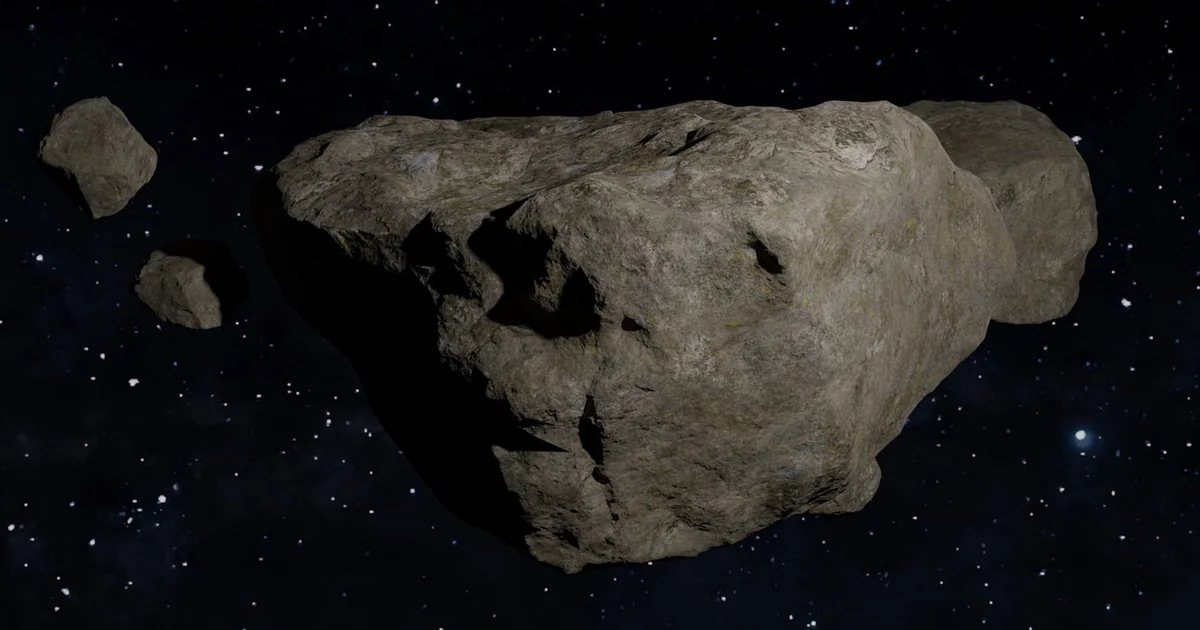
The Asteroid Is About the Size of a City Landmark
Visualizing the scale of an asteroid can be tricky. Numbers like 20 meters do not always spark an immediate mental image. To put it in perspective, imagine the polished, reflective surface of Cloud Gate in Chicago’s Millennium Park. That sculpture stands 33 feet tall and 66 feet long. The asteroid 2026 JH2 shares that length. If you stood it on end next to a six-story building, it would reach about halfway up.
An object of this size is not tiny by any means. It is large enough to create a dramatic fireball if it entered our atmosphere. However, it is also small enough that astronomers might not spot it until it gets relatively close. This particular rock was detected well in advance, which gave scientists time to calculate its trajectory and confirm it poses no threat.
For comparison, the Chelyabinsk event in 2013 involved an asteroid roughly 17 to 20 meters in diameter. That object exploded over Russia with the force of about 30 times the Hiroshima atomic bomb, shattering windows and injuring over 1,400 people. The difference is that Chelyabinsk was not detected beforehand. 2026 JH2 was tracked, its path was modeled, and we know exactly where it will be.
It Will Pass Closer Than the Moon
The Moon is our nearest celestial neighbor, but it is still a long way off. The average distance from Earth to the Moon is about 239,000 miles. The asteroid jh2 flyby will bring the rock to a minimum distance of roughly 57,000 miles from our planet. That is less than one-quarter of the lunar distance.
To understand that gap, think about the circumference of Earth. Our planet’s equator measures about 24,901 miles around. The asteroid will pass at a distance that is a little more than twice that circumference. It is close enough to be considered a near miss in astronomical terms, yet far enough to be completely safe.
Objects that pass within one lunar distance are tracked carefully. The term “lunar distance” is a standard unit used by astronomers to categorize close approaches. An event like this happens more often than many people realize. In fact, several asteroids pass within that zone every year. What makes this particular flyby stand out is that among the monitored NEOs passing over the next few months, 2026 JH2 will come the closest.
What Does “Close” Really Mean for an Asteroid?
When news reports say an asteroid will pass “close” to Earth, it is easy to picture a near-collision. In reality, the distances involved are vast. Even 57,000 miles is a significant gap. For context, the International Space Station orbits at an altitude of about 250 miles. Geostationary satellites sit at roughly 22,000 miles. The asteroid will pass more than twice as far out as those satellites.
The term “grazing” is sometimes used in media coverage, but it can be misleading. A grazing pass suggests the object skims the upper atmosphere. That is not the case here. The rock will stay well outside the range of human-made satellites. The word “close” is relative, and astronomers use it to describe objects that pass within the Moon’s orbit.
You Can Watch the Flyby Live
You do not need to own a telescope to see this event. The Virtual Telescope Project, an online service that provides real-time views of the night sky, will host a live broadcast of the asteroid jh2 flyby. The stream will show the rock moving against a backdrop of stars, allowing viewers to witness its motion in real time.
For amateur astronomers with a small telescope, spotting the asteroid directly is also possible. However, it will not be visible to the naked eye. The object’s brightness is expected to peak at around magnitude 14 or 15. That is far dimmer than what a person can see without optical aid. A telescope with an aperture of at least 6 inches (150 mm) should be sufficient, provided the observer has a clear, dark sky and knows exactly where to look.
How to Tune Into the Virtual Telescope Broadcast
The Virtual Telescope Project typically announces live streams a few days before the event. You can visit their website or follow their social media channels for the exact time and link. The broadcast usually starts a few hours before the closest approach. The feed is free and does not require registration.
If you plan to watch from home, check the weather forecast for your area. Cloud cover can block the view even through a telescope. The live stream bypasses that problem entirely by using a robotic telescope located at a site with optimal conditions.
There Is Zero Risk of Impact
Whenever news of a close asteroid appears, some readers feel a flutter of anxiety. The good news is that 2026 JH2 has been thoroughly analyzed. According to data cited by New Scientist, this object is not listed among the asteroids that carry any risk of impacting Earth. Its orbit has been calculated, and it will not hit us on this pass or any foreseeable future pass.
Scientists monitor thousands of NEOs. A small fraction of them have orbits that bring them close enough to warrant additional observation. Those objects are placed on risk lists, and their paths are refined over time. 2026 JH2 is not on any such list. Its trajectory is well understood, and it poses no danger.
Why Some Asteroids Are Monitored More Closely
Not all NEOs receive the same level of scrutiny. The ones that are larger than 140 meters (about 460 feet) and have orbits that bring them within 4.6 million miles of Earth are classified as Potentially Hazardous Asteroids (PHAs). 2026 JH2 is far smaller than that threshold, and its orbit, while intersecting Earth’s neighborhood, does not put it on a collision course.
The monitoring systems operated by NASA’s Center for Near-Earth Object Studies (CNEOS) and similar agencies around the world track these objects using radar and optical telescopes. They refine orbital models with each observation. For an object like 2026 JH2, the data is clear: it will pass safely.
It Is an Apollo-Type Asteroid
Asteroids are grouped into classes based on their orbital characteristics. 2026 JH2 belongs to the Apollo group. Understanding what that means helps clarify why it passes near Earth in the first place.
Apollo-type asteroids have a semi-major axis larger than Earth’s. In plain terms, their average distance from the Sun is greater than one astronomical unit (AU), which is roughly 93 million miles. However, their orbit brings them closer to the Sun at their perihelion, the point in their orbit nearest to the Sun, at a distance of less than 1.017 AU. This means their path crosses Earth’s orbit.
You may also enjoy reading: Bike Tech Guide: Choose Your Bike and Schedule a Pro Fitting.
Think of it like a highway intersection. Earth travels along a nearly circular lane around the Sun. Apollo asteroids travel on a more elongated, oval-shaped lane that cuts across Earth’s lane at specific points. When both objects arrive at the intersection at the same time, we get a close approach. Most of the time, they pass through without incident.
How Common Are Apollo-Type Flybys?
Apollo asteroids are the most common type of NEO that crosses Earth’s orbit. According to data from the Minor Planet Center, more than 10,000 Apollo asteroids have been cataloged as of 2024. They account for a significant portion of all known NEOs. The fact that 2026 JH2 is an Apollo-type object means its behavior is well understood. Scientists have plenty of examples to compare it against.
This particular flyby is not a rare event. In the past year alone, several asteroids have come as close or closer. For instance, the small asteroid 2025 TF passed within about 260 miles of Earth’s surface. That is dramatically closer than 57,000 miles. Events like those remind us that near passes happen frequently, and our detection capabilities continue to improve.
How Astronomers Detect Objects as Small as 20 Meters
Spotting a rock the size of a city sculpture from millions of miles away is no small feat. Astronomers rely on a combination of ground-based telescopes and space-based observatories. Survey telescopes like Pan-STARRS in Hawaii and the Catalina Sky Survey in Arizona scan the sky systematically, looking for points of light that move relative to the background stars.
When a moving object is detected, its position is recorded over several nights. Those data points are fed into orbital calculation software. The software determines whether the object is a new discovery or a known asteroid. If it is new, it receives a provisional designation like 2026 JH2.
The Naming Convention for Asteroids
The name 2026 JH2 follows a standard format. The first four digits indicate the year of discovery. The first letter represents the half-month of discovery. The second letter and number indicate the order of discovery within that half-month. So 2026 JH2 was discovered in 2026, during the first half of May (J is the tenth letter, corresponding to the first half of May), and it was the 47th object discovered in that period (H is the eighth letter, and the number 2 indicates it is the second cycle through the alphabet).
This system allows astronomers to assign unique identifiers quickly. It also gives researchers a way to track when and where an object was first spotted.
What This Flyby Means for the Future
Every close approach provides valuable data. When an asteroid like 2026 JH2 passes by, radar observatories can bounce signals off its surface. Those reflections reveal details about its shape, rotation, and composition. That information helps scientists build better models of asteroid populations and their behavior.
For the general public, events like this serve as gentle reminders that we live in a dynamic solar system. Rocks are constantly moving around us. Most are harmless. A few require attention. The systems in place to detect and track them are robust and improving every year.
If you are a parent explaining this to a curious child, you can compare the asteroid to a car passing by your house on a street. It comes close, but it stays on its own road. The asteroid jh2 flyby is just one of many such passes that happen every year. The difference is that this time, we knew it was coming, we measured its size, and we watched it go by safely.
For students working on school projects about NEOs, 2026 JH2 makes an excellent case study. It demonstrates how classification works, how distances are measured, and how risk assessments are made. It also shows that not every close approach is cause for alarm.
Mark your calendar for May 18th. Whether you tune into the live stream or step outside with a telescope, take a moment to appreciate the precision of modern astronomy. A 20-meter rock is racing through space at thousands of miles per hour, and we know exactly where it will be.